Paris Saint Germain vs Arsenal: UEFA Champions League Final Preview
On 30 May 2026, under the steep stands of the Puskas Arena in Budapest, Paris Saint Germain and Arsenal walk out knowing that ninety minutes will define their year in the UEFA Champions League. Paris Saint Germain arrive as dangerous outsiders, a side that has already punched its ticket into the knockout picture but now chases immortality on neutral ground. Arsenal come in as the competition’s standard-bearers, top of the charts and unbeaten, seeking to turn statistical superiority into the ultimate European crown on this grand stage.
Season Context
For Paris Saint Germain, this Champions League campaign has been powerful but imperfect. They have taken 14 points from 8 matches, scoring 21 goals and conceding 11, numbers that underline a potent attack (21 goals in 8 games) but a defence that can be asked questions (11 conceded). Ranked 11th in the overall table yet already in the “Promotion - Champions League (Play Offs: 1/16-finals)” bracket, they know they have the firepower to trouble anyone; the challenge in Budapest is to marry that threat with control when it matters most.
Arsenal’s path has been close to flawless. They sit 1st with 24 points from 8 matches, boasting 23 goals scored and only 4 conceded, a blend of cutting edge and defensive discipline (23 goals for, 4 against) that few can match. Their perfect record from those 8 games and a goal difference of 19 reflect why they are already in the “Promotion - Champions League (Play Offs: 1/8-finals)” zone and why they step into the Puskas Arena as the statistical benchmark in this Champions League year.
Form & Momentum
Paris Saint Germain’s recent run, captured in the form line “DLDWL”, speaks of volatility but also of resilience. They remain a side that can explode in attack, averaging more than two and a half goals per game across the campaign (21 goals in 8 matches), yet that same stretch shows they can be exposed at times (11 goals conceded in 8). The mix of draws and defeats in “DLDWL” underlines that their ceiling is high but their margin for error in Budapest is thin.
Arsenal arrive with the ruthless rhythm of “WWWWW”. That sequence, combined with their season numbers of 23 goals scored and 4 conceded in 8 games, paints a picture of a team both clinical in front of goal and extremely secure at the back (goal difference +19). This unbroken winning run gives them a psychological edge, reinforcing the sense of a side that knows how to manage big occasions and close out tight contests.
Head-to-Head Patterns
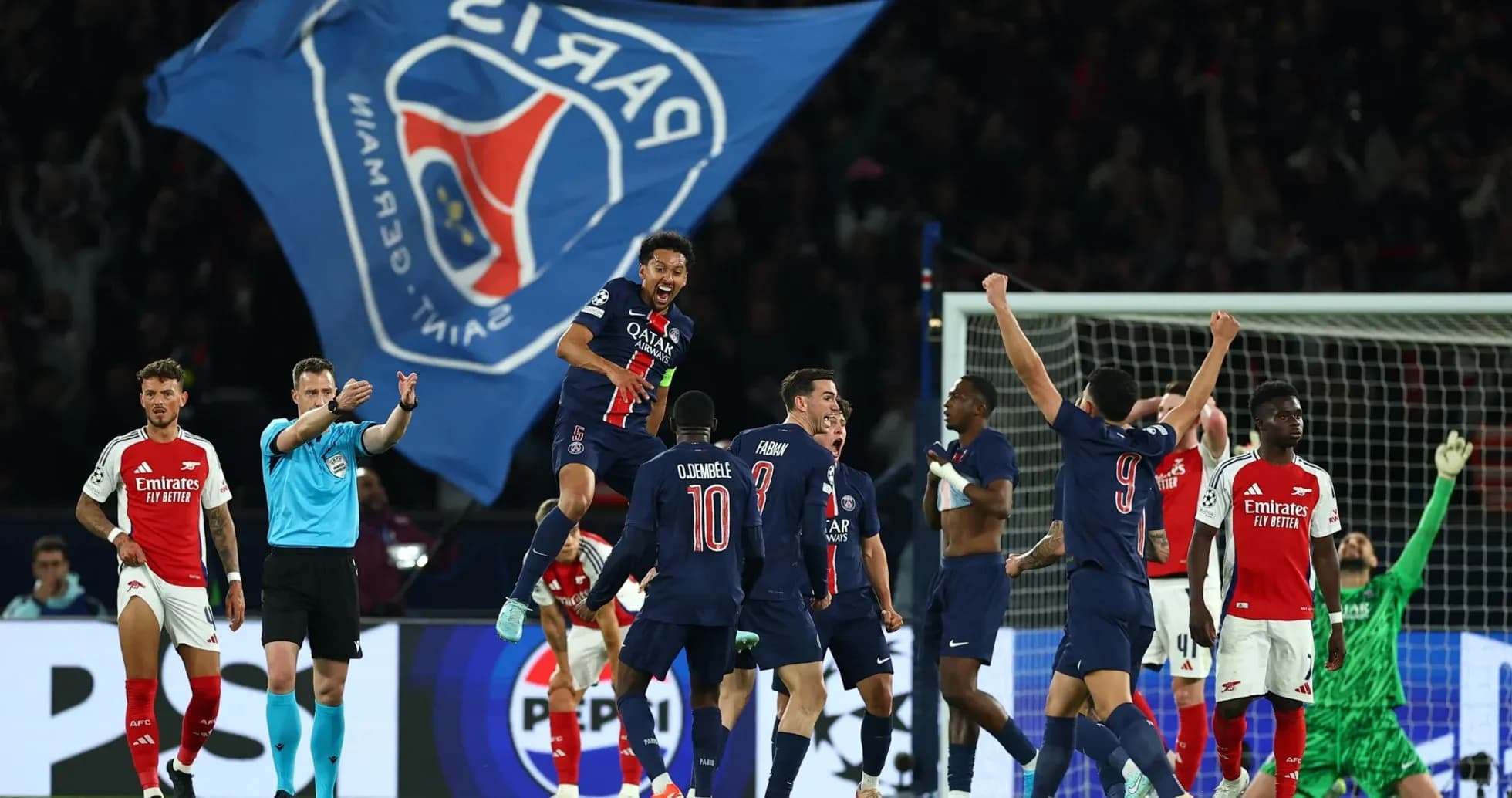
Recent history between these clubs in the UEFA Champions League has been finely poised and fiercely contested. On 7 May 2025, Paris Saint Germain edged Arsenal 2-1 at Parc des Princes (UEFA Champions League, season 2024, May 2025), a night that showcased the French side’s ability to strike in Paris and then suffer late under pressure. Just days earlier, on 29 April 2025, Paris Saint Germain had already claimed a 1-0 away victory at Emirates Stadium (UEFA Champions League, season 2024, April 2025), a cagey contest where their defensive organisation and efficiency in transition proved decisive. Go back to 1 October 2024 and the pattern flips: Arsenal controlled proceedings in a 2-0 home win at Emirates Stadium (UEFA Champions League, season 2024, October 2024), demonstrating that when they dictate tempo, Paris Saint Germain can be kept at arm’s length. Those three ties underline a rivalry where momentum swings quickly and where both sides have already proven they can win on the other’s terms.
Tactical Preview
Paris Saint Germain are expected to lean again on their familiar 4-3-3, a shape they have used 16 times in this Champions League campaign. That structure gives them width for “O. Dembélé” and “D. Doué” to attack full-backs, while “K. Kvaratskhelia” provides a devastating cutting edge from the front line (10 goals and 6 assists in 15 appearances). “Vitinha”, operating as a midfielder, is central to their rhythm and balance, with 6 goals, 1 assist and an outstanding passing accuracy of 93% across 16 appearances, suggesting Paris Saint Germain will try to construct attacks through controlled possession and late runs from midfield. At the back, “A. Hakimi” offers thrust from defence with 6 assists and 23 key passes, though the presence of players like “I. Zabarnyi” and “L. Hernández”, each having received one red card, hints at a back line that can be aggressive and must keep its discipline under the spotlight.
Arsenal’s tactical identity is more flexible but equally clear. They have alternated between a 4-3-3 (9 times) and a 4-2-3-1 (5 times), systems that allow them to blend control in midfield with sharp movement across the front line. Their season figures of 23 goals scored and only 4 conceded in 8 matches show a side that marries offensive variety with defensive solidity (average of nearly three goals scored for every one conceded). “Gabriel Martinelli”, listed as a midfielder, is a key attacking outlet with 6 goals and 2 assists in 13 appearances, while “Martín Zubimendi” provides the steel and structure in the middle, combining 14 tackles and 10 interceptions with 4 yellow cards that underline his combative edge. Arsenal’s defensive record in the wider data set is backed by 9 clean sheets, and their last-five defensive index of 95% underlines a unit that rarely gives up clear chances.
The central battle in Budapest will revolve around whether Paris Saint Germain’s attacking volume (21 goals in 8 Champions League matches) can disrupt Arsenal’s defensive organisation (4 goals conceded in 8). If “K. Kvaratskhelia” and “O. Dembélé” can isolate Arsenal’s full-backs and force transitions, Paris Saint Germain have the weapons to tilt the game. Conversely, Arsenal’s structure in either 4-3-3 or 4-2-3-1, combined with their ability to manage tight scorelines as shown in their recent head-to-heads, positions them to absorb pressure and strike in controlled waves, particularly through the wide channels and late midfield arrivals.
Statistical Snapshot
- Competition: UEFA Champions League, season 2025 — 30 May 2026.
- Venue: Puskas Arena, Budapest.
- Prediction: Win or draw — Double chance : draw or Arsenal.
- Win Probabilities: Home 10% / Draw 45% / Away 45%.
- Model: Paris Saint Germain 42.0% — Arsenal 58.2%.
Betting Verdict
The models tilt towards Arsenal’s resilience and balance, with the prediction favouring a “Win or draw” outcome for the English side and a double-chance angle of “draw or Arsenal”. Given Arsenal’s immaculate form line “WWWWW” and defensive record (4 goals conceded in 8 Champions League matches), backing them not to lose aligns with both data and recent performances. Paris Saint Germain’s attacking threat and their wins in the 2-1 and 1-0 semi-final ties in 2025 suggest this final could be tight, which makes the draw-or-Arsenal route more attractive than committing to an outright away win. With home odds for Paris Saint Germain hovering around 2.30–2.40, and Arsenal generally priced a little above 3.00, the value lies in the safety of the double chance on Arsenal in a game that may be decided by fine margins rather than a clear gulf in quality.