Arsenal vs Atletico Madrid: UEFA Champions League Semi-Final Analysis
Under the lights at Emirates Stadium, a semi‑final of the UEFA Champions League settled into something far more attritional than the narrative around Arsenal’s flawless campaign had promised. Following this result, a 1–0 home win sealed in regulation time, the contrast between the sides’ seasonal identities was stark: Arsenal, ranked 1st in the competition standings with 24 points and a perfect eight‑win run, against an Atletico Madrid ranked 14th, hardened by turbulence rather than perfection.
I. The Big Picture – Control vs Chaos
Arsenal arrived with the statistical profile of a machine. Heading into this game they had played 14 Champions League matches this season, winning 11 and drawing 3, with no defeats. Overall they averaged 2.1 goals for and only 0.4 against per match, with a goal difference of 23 in the group‑stage standings (23 goals for, 4 against). At home in this Champions League run they had scored 12 and conceded 3, winning all 4.
Atletico Madrid, by contrast, were a study in volatility. Overall they had played 16 matches, winning 7, drawing 3, and losing 6. They scored 2.2 goals per match and conceded 1.8, with a group‑phase goal difference of 2 (17 for, 15 against). On their travels they had managed 6 goals and shipped 10 across 4 away games, an away defensive average of 2.1 goals conceded per match that would loom large in London.
The formations told the story of intent. Mikel Arteta set Arsenal in a 4‑2‑3‑1, with D. Raya behind a back four of B. White, W. Saliba, Gabriel and R. Calafiori, shielded by a double pivot of D. Rice and M. Lewis‑Skelly. Ahead, B. Saka, E. Eze and L. Trossard supported the lone striker V. Gyökeres. Diego Simeone answered with a classic 4‑4‑2: J. Oblak in goal, a defensive line of M. Pubill, R. Le Normand, D. Hancko and M. Ruggeri, a midfield band of G. Simeone, M. Llorente, Koke and A. Lookman, and a front pair of A. Griezmann and J. Álvarez.
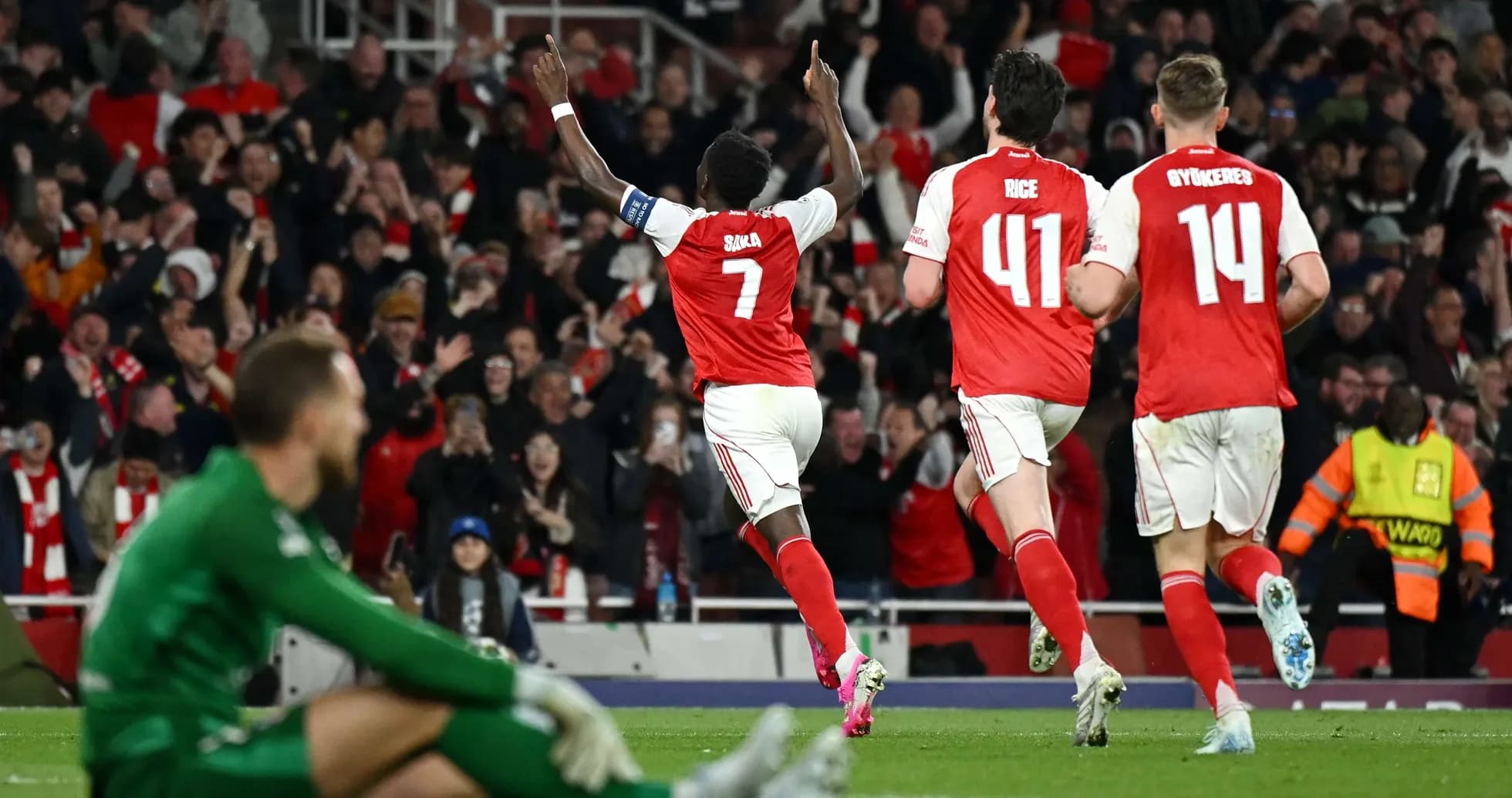
The scoreboard – 1–0 at half‑time and full‑time – reflected Arsenal’s season‑long defensive parsimony more than any attacking explosion. But beneath that minimalism sat clear structural choices from both coaches.
II. Tactical Voids – What Was Missing
Both sides entered the semi‑final with notable absentees that subtly reshaped their options.
For Arsenal, M. Merino (foot injury) and J. Timber (ankle injury) were ruled out. Merino’s absence removed a high‑volume passer and late‑runner option in midfield; Timber’s injury denied Arteta a flexible defender capable of tucking inside or overlapping from full‑back. The response was pragmatic: Saliba and Gabriel were kept as the fixed central pairing, with White and Calafiori providing width but rarely vacating their defensive responsibilities simultaneously. In a tie where Arsenal already defended superbly – only 6 goals conceded overall this Champions League campaign, 3 at home and 3 away – the priority was clearly to preserve that structure.
Atletico Madrid’s voids were higher up the pitch. P. Barrios and N. Gonzalez, both out with muscle injuries, stripped Simeone of rotation options and ball‑winning energy in midfield. With Koke orchestrating and M. Llorente tasked with box‑to‑box coverage, the bench lacked a like‑for‑like disruptor who could change the rhythm if Arsenal’s control grew suffocating.
Disciplinary trends also framed the risk profiles. Arsenal’s yellow‑card distribution this season showed a pronounced late‑game spike: 31.82% of their bookings arriving between 61–75 minutes and another 18.18% from 76–90. Atletico Madrid’s yellows peaked just after half‑time, with 25.93% between 46–60 minutes and a further 18.52% from 61–75. It created a predictable tension line: the hour mark as the point where both sides tend to tilt into aggression. That pattern helped explain why both coaches kept their benches heavy with midfielders – M. Zubimendi and C. Norgaard for Arsenal; O. Vargas, A. Baena, J. Cardoso and T. Almada for Atletico – ready to either cool or escalate the central battle.
III. Key Matchups – Hunter vs Shield, Engine Room vs Enforcer
The headline duel was “Hunter vs Shield”: J. Álvarez, one of the competition’s most potent forwards, against the most miserly defensive unit left standing.
Álvarez came into the semi‑final with 10 goals and 4 assists in 15 Champions League appearances, supported by 37 total shots (22 on target) and 34 key passes. He had scored all 3 of his penalties, underscoring a ruthless streak in decisive moments. Yet he ran into an Arsenal defence that, overall, conceded just 0.4 goals per match and had kept 9 clean sheets across 14 fixtures. With White and Calafiori narrowing the channels and Saliba and Gabriel patrolling Álvarez’s preferred central zones, Atletico’s main scorer was forced into deeper and wider positions, blunting his penalty‑box threat.
Behind him, the “Engine Room” clash was just as decisive. For Arsenal, Rice and Lewis‑Skelly formed the structural core; on the bench, Zubimendi – one of the Champions League’s most combative midfielders – loomed as a potential enforcer. Zubimendi’s season numbers spoke of controlled aggression: 14 tackles, 5 successful blocks and 10 interceptions, but also 20 fouls committed and 4 yellow cards. When introduced in previous rounds, he had been the player to step into the storm just as Arsenal’s yellow‑card curve rose between 61–75 minutes.
Atletico’s counterweight was Koke’s distribution and Llorente’s vertical surges, flanked by G. Simeone’s work rate and Lookman’s dribbling threat. Yet with Arsenal’s line sitting on a foundation that had allowed only 3 goals at home in this Champions League run, Atletico’s midfield was repeatedly forced sideways rather than through the lines, leaving Griezmann and Álvarez chasing half‑chances rather than clear xG opportunities.
On the flanks, M. Pubill’s duel with Trossard and later the fresh legs of Gabriel Martinelli was another key theatre. Pubill’s season showed defensive reliability – 18 tackles, 6 successful blocks and 6 interceptions – but also 4 yellow cards, underlining how often he operates on the edge. Against an Arsenal side whose wide players constantly invert and overload the half‑spaces, that edge was always likely to be tested.
IV. Statistical Prognosis – Where the Tie Tilts
Strip away the single‑goal margin and the numbers still point the same way. Arsenal’s overall attacking average of 2.1 goals per game, paired with just 0.4 conceded, sits in direct opposition to Atletico’s away profile: 1.6 goals scored and 2.1 conceded on their travels. The defensive goal difference in European play tells its own story: Arsenal’s group‑phase GD of 19 (23 scored, 4 conceded) against Atletico’s 2 (17 scored, 15 conceded).
Following this result, the tactical picture for any second leg or future meeting is clear. Arsenal’s blueprint – a controlled 4‑2‑3‑1, disciplined back four, and a midfield capable of toggling between Rice’s authority and Zubimendi’s bite – is built to suppress xG against and grind out low‑scoring wins like this one. Atletico’s route back into any tie rests heavily on Álvarez maintaining his elite shot volume and penalty reliability, and on Simeone finding a way to protect a back line that, away from home, has been far too generous.
In narrative terms, this semi‑final first leg felt tight. In statistical terms, it followed the arc Arsenal have traced all season: not just winning, but bending the game towards their defensive certainty and trusting that one goal, at Emirates Stadium, would be enough.