England vs Argentina: Tactical Analysis of World Cup Semi-final
England’s 2-1 defeat to Argentina at Mercedes-Benz Stadium was a tactical arm-wrestle that turned decisively in the final minutes. Thomas Tuchel’s 4-2-3-1 was designed to compress space centrally and attack in quick bursts, while Lionel Scaloni’s 4-4-2 gave Argentina territorial control and, eventually, the cutting edge to overturn a deficit and reach the World Cup Semi-finals.
England’s structure without the ball was clear from the outset. Declan Rice and Elliot Anderson formed a narrow double pivot in front of a back four of Reece James, John Stones, Marc Guéhi and Djed Spence. The wingers, Anthony Gordon and Morgan Rogers, tucked in alongside Jude Bellingham to create a compact second line of three behind Harry Kane. This 4-4-1-1/4-2-3-1 hybrid block aimed to deny Lionel Messi and Julián Álvarez central pockets, forcing Argentina wide.
The trade-off was possession. Argentina completed 590 passes to England’s 324, with a striking accuracy gap (Argentina 537 accurate at 91%, England 272 at 84%). That translated into a 64%–36% possession split. Scaloni’s side built patiently through Leandro Paredes and Enzo Fernández, using Alexis Mac Allister between the lines and full-backs Nahuel Molina and Nicolás Tagliafico to stretch England horizontally. The 4-4-2 often resembled a 2-4-4 in sustained pressure, with both full-backs high and Messi drifting into the right half-space.
Despite the territorial dominance, England’s defensive scheme initially held. Argentina generated 15 total shots to England’s 5, but England kept the Albiceleste largely to lower-quality efforts for long stretches. Argentina’s 7 shots inside the box and 8 from outside reflected their persistence, yet the expected goals split – 1.84 for Argentina versus 0.53 for England – shows that while Argentina were the more dangerous side, this was not a procession of clear one-on-ones until late on.
Jordan Pickford (England) was central to that resistance. He made 3 saves and, crucially, his goals prevented figure of 0.02 suggests Argentina’s goals aligned closely with the chances they created; he neither stole the game nor underperformed. At the other end, Emiliano Martínez (Argentina) faced only 2 shots on target, making 1 save, with an identical 0.02 goals prevented. England’s lone goal came from one of their few clean transitions, rather than sustained pressure.
Tuchel’s offensive plan leaned heavily on directness and vertical running. With only 1 corner and 5 total shots, England were selective rather than expansive. The front four were tasked with exploiting the spaces left by Argentina’s aggressive full-backs. Gordon’s opener at 55’ – assisted by Rogers – encapsulated this: England broke Argentina’s first line, attacked quickly into the channels, and finished clinically despite a low overall xG. It was a textbook execution of a low-possession, high-punishment game model.
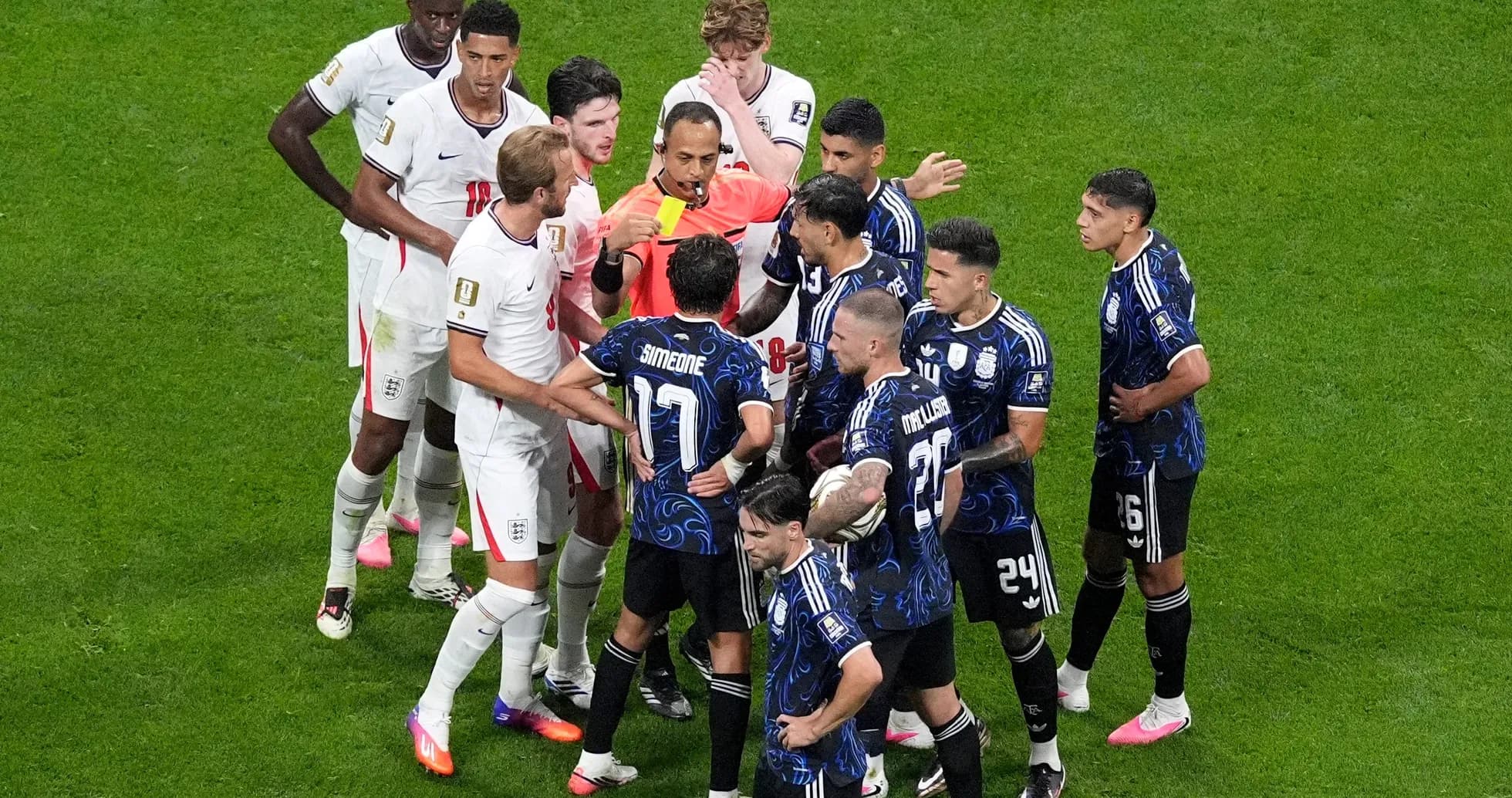
Discipline and duels were another key battleground. England committed 11 fouls to Argentina’s 15, but the card count skewed towards Scaloni’s side: 3 yellows for Argentina, 1 for England. Anderson’s 37’ booking for “Foul” underlined his combative role screening the back four. For Argentina, Lisandro Martínez (42’) and Cristian Romero (51’) were both cautioned for “Foul”, a direct consequence of England’s attempts to spin in behind and break pressure. Rodrigo De Paul’s late yellow at 90+4’ for “Argument” reflected the emotional intensity as Argentina protected their lead.
The substitutions shifted the tactical landscape decisively. At 64’, Nicolás González (IN) came on for Leandro Paredes (OUT), effectively adding another forward runner and pushing Argentina towards a more attacking 4-2-4/4-2-3-1 shape. The triple change at 72’ was even more telling: Gonzalo Montiel (IN) for Nahuel Molina (OUT), Nicolás Otamendi (IN) for Lisandro Martínez (OUT), and Rodrigo De Paul (IN) for Giuliano Simeone (OUT). In one sweep, Scaloni refreshed both full-back and centre-back positions and injected De Paul’s energy and vertical passing into midfield, while keeping Messi central as the creative hub.
Tuchel’s changes were more reactive and structurally conservative. Ezri Konsa (IN) for Anthony Gordon (OUT) at 72’ signalled a shift towards protecting the 1-0 lead, with England effectively adding an extra defender and reducing their counter-attacking threat. At 82’, Dan Burn (IN) for Reece James (OUT) and Nico O’Reilly (IN) for Declan Rice (OUT) altered the defensive profile and removed England’s primary midfield anchor. The late double switch at 90’, Ivan Toney (IN) for John Stones (OUT) and Marcus Rashford (IN) for Djed Spence (OUT), came only after Argentina had already turned the match around; it was a desperate tilt towards a back-three/back-two hybrid to chase an equaliser, but too late to reshape the flow.
Argentina’s late surge reflected both their structural gamble and England’s retreat. With England sinking deeper and losing Rice’s control in front of the defence, the central lanes opened. Enzo Fernández’s 86’ equaliser, assisted by Messi, came from precisely that dynamic: Argentina circulating around the block, Messi finding a seam, and Fernández arriving from midfield to finish. Lautaro Martínez’s winner at 90+2’, again set up by Messi, was the culmination of sustained pressure and superior occupation of the box, with Argentina’s 7 shots inside the area finally telling.
Statistically, the match validated Argentina’s approach. Their 5 shots on goal to England’s 2, 6 corners to England’s 1, and the 1.84–0.53 xG gap all point to a side that created more and better chances over 90 minutes. England’s passing volume and accuracy deficit mirrored their strategic choice to concede territory and trust in compactness and transitions. For 80 minutes, that plan was close to working; once Argentina’s bench tilted the game and England’s substitutions eroded their midfield control, the underlying numbers asserted themselves.
In tactical terms, this Semi-finals tie became a case study in risk management. Tuchel’s England nearly executed a low-possession upset through structure and efficiency, but Scaloni’s Argentina, with superior control, deeper attacking resources, and Messi’s late-game influence, ultimately bent the match to the logic of the statistics.