Argentina vs England Semi-Final: Tactical Analysis and Key Matchups
Under the closed roof of Mercedes-Benz Stadium, this semi-final was always going to be about identity as much as execution: England’s evolving, possession-heavy 4-2-3-1 under Thomas Tuchel against Argentina’s ruthless, late-surging World Cup machine guided by Lionel Scaloni.
Heading into this game, both sides arrived as group winners. England had topped Group L with 7 points and a goal difference of 4, built on 6 goals scored and 2 conceded over 3 matches. Across the tournament they had played 7 fixtures in total, winning 5, drawing 1 and losing 1. Their attacking profile was balanced: overall they averaged 2.0 goals per game, split between 1.8 at home and 2.3 on their travels, with a pronounced surge between 31-45 minutes, when 26.67% of their goals had arrived, and a steady threat either side of the hour (20.00% between 46-60 and 20.00% between 61-75).
Argentina, though, came in with a perfect record. They had taken 9 points from Group J with a goal difference of 7, scoring 8 and conceding just 1. Over the full campaign they had won all 7 matches, scoring 19 in total and conceding 7, for an overall average of 2.7 goals for and 1.0 against. Their attacking DNA was unmistakable: a devastating late-game punch, with 44.44% of their goals arriving between 76-90 minutes and another 11.11% from 106-120, making them the tournament’s most dangerous side when legs and minds tired.
Starting XI
Tuchel’s starting XI reflected a desire to control the centre and protect transitions. J. Pickford anchored a back four of R. James, J. Stones, M. Guehi and D. Spence. In front, D. Rice and E. Anderson formed the double pivot, with an aggressive, mobile line of three – M. Rogers, J. Bellingham and A. Gordon – supporting H. Kane as the lone forward.
The absence of J. Quansah, suspended through a sports court decision, subtly shaped England’s defensive options. Without his aerial presence and aggression, Tuchel had to lean fully on Stones and Guehi, with no like-for-like enforcer to rotate in. It made D. Burn and E. Konsa more important as contingency plans, but also increased the on-ball responsibility of the starting pair to progress play cleanly under pressure.
Argentina’s 4-1-4-1 was a study in controlled aggression. E. Martinez started in goal behind a back line of N. Molina, C. Romero, L. Martinez and N. Tagliafico. L. Paredes sat as the single pivot, with G. Simeone, E. Fernandez, A. Mac Allister and J. Alvarez forming a fluid band behind L. Messi, who operated nominally as a forward but, in reality, as the system’s orbit.
Midfield Dynamics
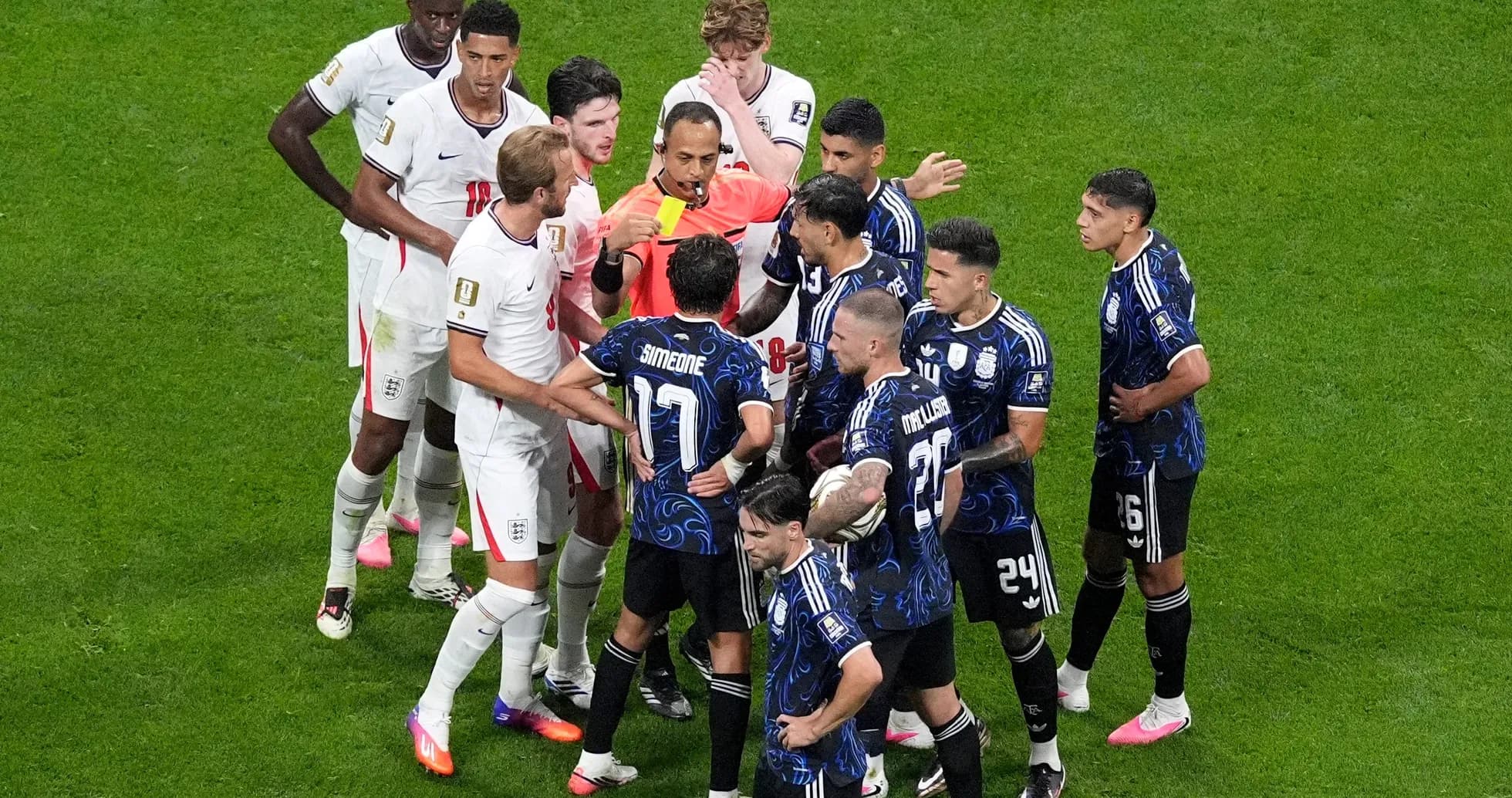
Structurally, this was a clash between England’s double pivot and Argentina’s lone holder plus advanced four. Rice, one of the tournament’s standout enforcers with 2 yellow cards in 6 appearances and 240 completed passes at 91% accuracy, was tasked with both shielding the back four and igniting counters. His disciplinary edge – two yellows but no reds in this competition – meant he walked a tightrope: England needed his aggression to disrupt Messi’s lanes, but could not afford another high-profile dismissal after Quansah’s earlier red in the tournament.
On the other side, Argentina’s disciplinary profile was calmer in terms of expulsions but spiky in timing. A cluster of yellow cards had tended to arrive late, with 44.44% of their bookings between 91-105 minutes and 22.22% from 106-120. That pattern suggested a side willing to foul to break rhythm in extra time – a tactical lever Scaloni could pull if England’s rotations with B. Saka and N. Madueke began to stretch them.
Messi vs England’s Defense
The “Hunter vs Shield” battle was defined by L. Messi against England’s defensive block. Messi entered this semi-final as the competition’s top scorer with 8 goals and 4 assists, averaging a 9.07 rating across 7 appearances. He had taken 28 shots, 18 on target, and completed 24 dribbles from 35 attempts. Even his flaws carried tactical weight: from the spot, he had missed 2 penalties and scored none, despite Argentina’s overall penalty record being 3 taken with only 1 converted and 2 missed. That vulnerability from 12 yards meant England could, in theory, be more aggressive in the box, trusting that even if they conceded a penalty, Argentina were not automatic from the spot.
For England, the response came through their own dual spearheads. J. Bellingham and H. Kane had each scored 6 goals in total this campaign, both adding 1 assist. Bellingham, with 223 completed passes at 82% accuracy and 8 key passes, functioned as the “engine and blade” between the lines, while also contributing 14 tackles and 3 interceptions. Kane, meanwhile, blended penalty-box instincts with link play: 18 shots (12 on target), 5 key passes and 3 successful blocks underline his dual role as finisher and first defender. Crucially, from the spot he had been flawless in this tournament, scoring both of England’s penalties, which gave Tuchel’s side a psychological edge in any high-pressure dead-ball moment.
Engine Room Duel
The “Engine Room” duel sat between Rice and Paredes, but also extended to E. Fernandez and A. Mac Allister against England’s interior trio. Argentina’s goals against profile revealed a vulnerability between 46-60 minutes, when 37.50% of the goals they conceded had arrived, and another 25.00% between 61-75. That window overlapped almost perfectly with England’s offensive rhythm: 20.00% of England’s goals had come between 46-60 and another 20.00% between 61-75. Tuchel’s substitutions – particularly the introduction of Saka or O. Watkins to attack tired full-backs – were always likely to target that hour mark, turning controlled possession into vertical surges.
Conversely, England’s defensive soft spot was clear: 50.00% of their goals conceded had come between 31-45 minutes and 25.00% between 76-90. Those late concessions intersected ominously with Argentina’s late-game surge, where nearly half of their goals came in the final quarter of normal time. If England could not manage the tempo and maintain concentration in those phases, Messi and his supporting cast were primed to punish even the smallest lapse.
Statistical Prognosis
From a statistical prognosis, the semi-final always tilted slightly towards Argentina’s ruthless efficiency and late-game power. They had never failed to score in this campaign, had two clean sheets in total, and carried the most decisive individual in the tournament. England, however, brought a more balanced, multi-sourced threat, with Gordon’s 3 assists and Saka’s 3 assists adding width and unpredictability to the Bellingham–Kane axis.
In the end, the 2-1 scoreline to Argentina reflected the underlying currents: England’s structure and phases of control against Argentina’s capacity to bend the match towards Messi’s gravity and their late-game punch. From the numbers and the tactical shapes alone, this always looked like a contest where England needed to win the middle hour; Argentina, as ever, trusted that the final act would belong to them.