Qatar vs Switzerland: World Cup 2026 Match Analysis
Under the cool California evening at Levi’s Stadium, Qatar and Switzerland opened their World Cup 2026 campaigns with a 1–1 draw that said as much about structure and identity as it did about the scoreline. Following this result, both sides sit on 1 point in Group B, Switzerland ranked 1st and Qatar 3rd in the early table, each with a goal difference of 0 after identical records: 1 match played, 1 draw, 1 goal scored and 1 conceded overall.
I. The Big Picture – Two 4-3-3s, two different ideas
Both coaches arrived with a 4-3-3 on the teamsheet, but the shapes behaved very differently once the whistle went.
Julen Lopetegui’s Qatar, playing their only fixture so far at home in this tournament, leaned into control through the middle. With 1.0 goalsFor average at home and 1.0 goalsAgainst at home, their statistical profile heading into this game was blank; now it reads as a side that will likely live on the fine margins of one-goal swings. The back four of H. Al Amin, B. Khoukhi, Pedro Miguel and A. Al Oui screened Mahmud Abunada, who had already emerged as a key figure with 5 saves and a yellow card in his 90 minutes, having also committed the penalty that tilted the first half.
Ahead of them, the midfield trio of I. Laye, A. O. Madibo and Jassem Gaber was built to compress central zones. Gaber, though, became a symbol of Qatar’s edge and risk: 60 minutes of intense work, 8 duels contested and 2 blocks, but also 2 fouls and a yellow card.
In contrast, Murat Yakin’s Switzerland brought a more familiar European control, but from deeper starting points. On their travels, they now average 1.0 goalsFor and 1.0 goalsAgainst, mirroring Qatar’s home numbers. The back line of R. Rodriguez, M. Akanji, N. Elvedi and D. Zakaria sat in front of Gregor Kobel, with Zakaria nominally a right-back but functionally a hybrid stopper, stepping inside to form a three when Switzerland built from the back.
In midfield, the metronome was G. Xhaka, flanked by R. Freuler and M. Aebischer, while the front three of R. Vargas, B. Embolo and D. Ndoye offered verticality and penalty-box presence. Embolo, already on the top scorers chart with 1 goal from 2 shots and 5 key passes, was the sharp edge of Swiss possession.
II. Tactical Voids and Discipline – A story of early cards
With no official absences listed, both squads arrived at full strength. The real voids were created by discipline and momentum.
Qatar’s season card data is stark: all of their yellow cards so far have come in the 16–30 minute window, a 100.00% concentration of caution in that early mid-half band. This match followed the pattern. Gaber’s booking, coupled with Mahmud Abunada’s yellow, underlined a side that can tilt into rashness when the tempo rises. There were no red cards, but the psychological weight of a booked holding midfielder and goalkeeper shaped how aggressively Qatar could defend transitions.
Switzerland, by contrast, showed a single flash of indiscipline. Their only yellow of the tournament so far arrived between 31–45 minutes, also at 100.00% of their total yellows. D. Zakaria, the man booked, still managed 56 passes at 96% accuracy, 3 tackles and 2 interceptions, illustrating how he walked the line between aggression and control without tipping over.
The penalty narrative was decisive. Switzerland’s season penalty record now reads: 1 total, 1 scored, 0 missed. Embolo’s composure from the spot contrasts sharply with Qatar’s profile: 0 penalties taken, but 1 penalty committed by Abunada, who has yet to save from the spot. In a tournament defined by small details, this is already a psychological axis between the two squads.
III. Key Matchups – Hunter vs Shield, Engine Room vs Enforcer
Hunter vs Shield
The clearest duel in this match – and a likely reference point for the rest of the group – was B. Embolo against Qatar’s central defensive shield, anchored by B. Khoukhi.
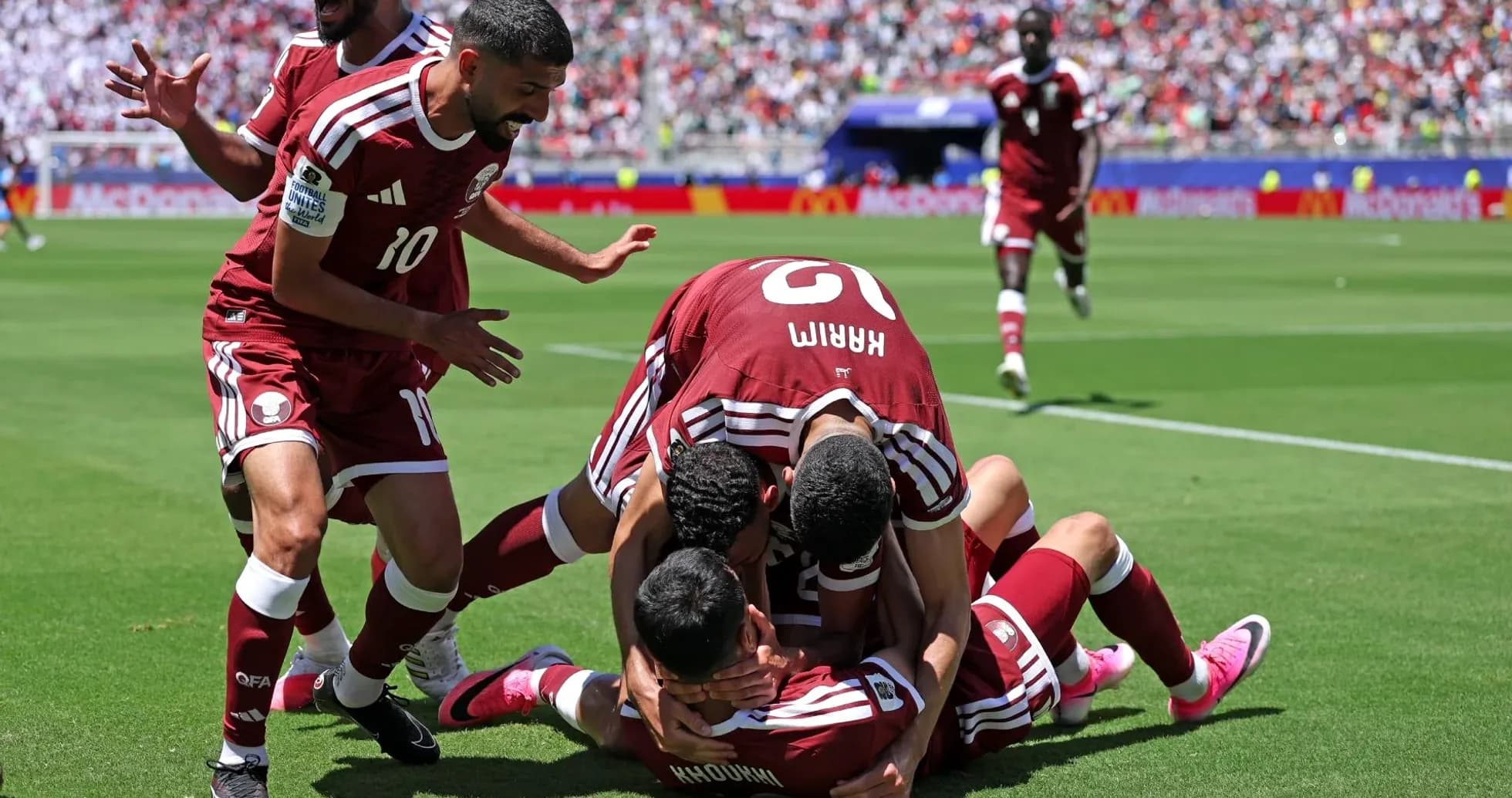
Khoukhi, now one of the World Cup’s early standout defenders with a rating of 7.2, did more than just defend. He scored Qatar’s only goal of the campaign so far, from his lone shot on target, while also blocking 1 shot and making 2 interceptions. His 34 passes at 70% accuracy suggest a defender willing to step into buildup, not just clear his lines.
Embolo, meanwhile, was everything Switzerland needed him to be: a penalty-box reference, a carrier and a creator. His 1 goal, 1 shot on target, 2 total shots and 5 key passes show a forward who doesn’t just finish moves but initiates them. The duel between Embolo’s movement into the inside-right channel and Khoukhi’s aggressive stepping out of the line framed much of the contest.
Engine Room – Xhaka vs Qatar’s double pivot
In midfield, the “engine room” battle revolved around G. Xhaka’s orchestration against Qatar’s central pair of Madibo and Gaber.
Xhaka’s numbers in this snapshot are modest but his role is unmistakable: he is the stabiliser that allows Freuler and Aebischer to push higher. Switzerland’s ability to maintain a 4-3-3 structure in possession, with Xhaka dropping between the centre-backs, constantly asked questions of Qatar’s first line of pressure.
Gaber’s 8 duels and 2 blocks, plus 1 tackle, tell of a player tasked with disrupting that rhythm. But the yellow card and his 60-minute limit hint that Qatar’s midfield press is costly in energy and fouls. Madibo, positioned slightly deeper, often had to plug the gaps that appeared when Gaber stepped out, leaving space for Xhaka to dictate tempo and for Freuler to arrive late between the lines.
IV. Statistical Prognosis – Margins, mentality, and what comes next
Following this result, both teams carry identical headline numbers: 1.0 goals scored and 1.0 conceded per match overall, 0 clean sheets, and no failures to score. The goal difference of 0 for each side is a neat mathematical reflection of how evenly matched they were across 90 minutes.
Yet the underlying hints are revealing. Switzerland’s ability to generate and convert a penalty, coupled with Embolo’s dual role as scorer and creator, suggests a side with a slightly higher attacking ceiling. Their away profile – 1 goal for and 1 against in 1 match on their travels – implies resilience, especially with a back four where Zakaria can both defend wide and step inside.
Qatar, on the other hand, look like a team built for narrow, emotionally charged contests. Their home-only data (1 match, 1 draw, 1 goal for, 1 against) and 0 clean sheets point to a side that will always be in the game but rarely out of danger. The disciplinary pattern – two key players, Abunada and Gaber, already on yellow cards in the tournament’s opening step – could become a strategic vulnerability as the group stage tightens.
From a pure xG-style reading, even without explicit numbers, the penalty conceded and the volume of Embolo’s involvement suggest Switzerland probably edged the quality of chances, while Qatar maximised set pieces and moments around Khoukhi’s aerial and positional strength.
The verdict from Santa Clara is of two squads whose tactical blueprints are already clear. Switzerland’s structured 4-3-3, anchored by Xhaka and sharpened by Embolo, looks marginally more repeatable over a group campaign. Qatar’s version, reliant on Khoukhi’s two-way excellence, Abunada’s shot-stopping and a feverish midfield press, is more volatile – capable of unsettling better-ranked sides, but constantly flirting with disciplinary and defensive risk.
In a group that may be decided by a single goal or a single point, those differences in stability, penalty reliability and card timing could be the thin line between progression and an early flight home.