Socceroos Progress with Draw Against Paraguay: Tactical Insights
The Socceroos are through. The job is done. But the questions are only just beginning.
Australia’s 0-0 draw with Paraguay sealed a place in the round of 32 at the FIFA World Cup, a solid, disciplined performance against a typically rugged South American side. On paper, it’s exactly what Tony Popovic would have wanted: clean sheet, qualification, no drama.
On the pitch, though, the story was different. The brightest attacking spark wore a defender’s number.
Bos shines while the forwards stall
Jordan Bos, thrown into the starting XI after Jacob Italiano’s late injury withdrawal, became the unexpected reference point of Australia’s attacking play. Popovic shuffled his full-backs, pushing Bos to the right and asking Melbourne City’s Aziz Behich to fill the gap on the left.
It looked like a risk. It turned into a revelation.
Bos drove at Paraguay with intent, offered width and energy, and repeatedly gave the Socceroos an outlet when the game threatened to suffocate in midfield. His performance delighted fans who had been waiting to see how Popovic would solve the wide areas.
It also worried two men who know the shirt well.
“Up front is a bit of a worry when we’re looking at Jordy Bos as one of the most threatening (for Australia),” Robbie Slater said on Stan Sport’s Added Time, cutting straight to the heart of the issue.
Former Socceroos striker Scott McDonald didn’t argue. For him, the concern is not that Bos impressed, but that no one ahead of him did.
No.9 debate refuses to go away
On a night that cried out for a centre-forward to grab the contest, the focus instead fell on tactical compromise.
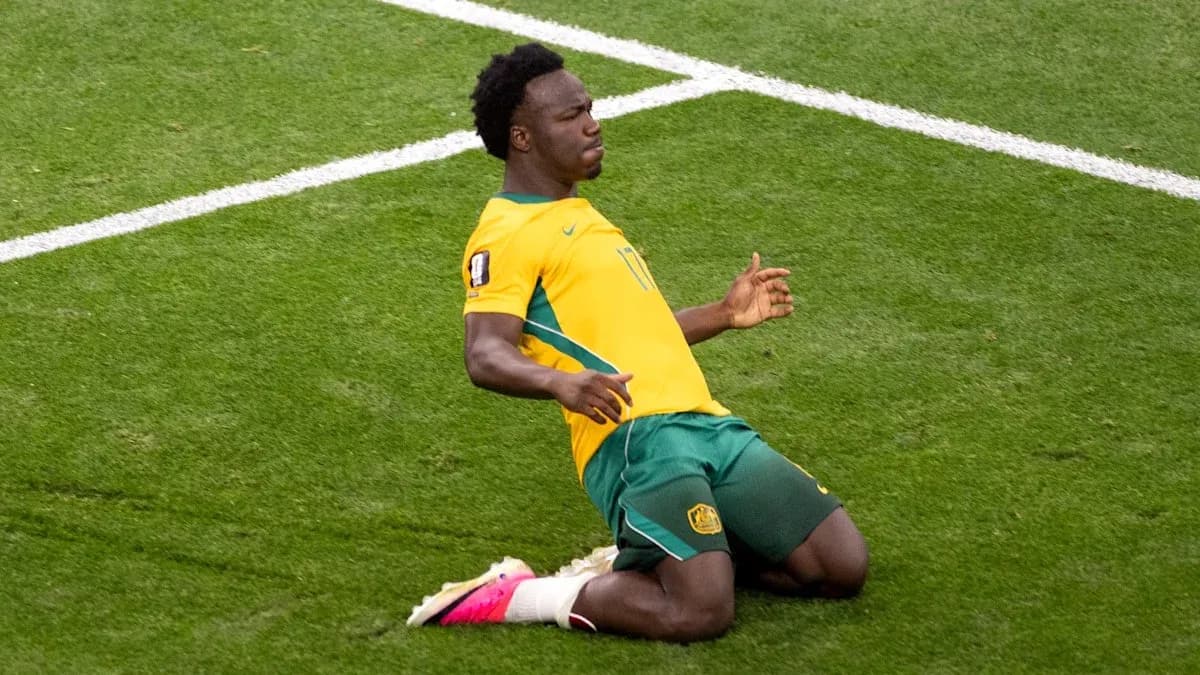
Mo Toure, the natural striker many expected to see, stayed on the bench. Nestory Irankunda, more at home as a winger, led the line as Australia’s No.9. It was a decision that raised eyebrows before kick-off and raised more after full-time.
“There is a problem in terms of the No.9. Not bringing (Mo) Toure on instead of Tete Yengi tells me today that there’s no trust there,” McDonald said.
That single choice from Popovic spoke loudly to a former striker. If Toure watches Yengi come on ahead of him, what does that do to the belief that his manager backs him?
“Does he go and start him (Toure) out of the blue in the next game? You just can’t tell with Tony. But as a striker, being Toure, I don’t like that. That doesn’t fill me with confidence that my coach trusts me.”
The pattern up front did little to ease those doubts. Irankunda toiled, chased, fought, but rarely threatened. McDonald’s sympathy for the 20-year-old was obvious.
“No matter who we put up there, it’s a thankless task up there,” he said. “Look at Nestory (on Friday), he had very little and was living off scraps.”
Paraguay’s back three squeezed the space, shut down the channels, and turned the central areas into a wrestling match. For a young forward who prefers to face his defender, drift wide and attack space, it was a brutal education.
Irankunda caught between roles
McDonald’s verdict on Irankunda as a long-term No.9 option was blunt.
He sees a talent, but not a natural centre-forward.
“Look, he’s gotta hold it up a little bit better,” McDonald said. “I think at times he struggled because it’s not his natural game.”
The problem wasn’t just Irankunda’s touch or positioning. It was the entire shape around him. Without runners close enough, he often found himself isolated, back to goal, with three Paraguayan defenders swarming and nowhere to turn.
“If there are some players getting closer to you, then what are you meant to do?” McDonald asked. Irankunda wanted to peel wide, to find grass and defenders he could square up, but Paraguay’s system and Australia’s set-up pinned him centrally.
“There was no space,” McDonald said. “They were aware of his threat also, with three taking care of him.”
That left a young attacker stuck in between identities. Too marked to run the channels, too inexperienced to dominate as a traditional target man.
“He probably sometimes needs to be more in central positions and wait for things to happen,” McDonald added, pointing to the cold reality of modern goalscoring.
“As we see the best strikers in the world – like Erling Haaland – they’re not interested any more. They just get into the right areas and allow others and trust others to do the dirty work then get on the end of things.”
Irankunda, by contrast, still wants to be the creator and the finisher. He wants the ball at his feet, on the edge of the box, taking shots and making things happen. That instinct makes him thrilling as a winger. As a No.9, it can drag him away from the positions where goals usually fall.
“So if you’re gonna play that role, you just need to play it a little bit more smarter and be a bit more patient,” McDonald said.
A familiar Australian problem
McDonald’s critique carried the weight of experience. He lived the life of a No.9. He knows the demands, the bruises, the compromises.
“I didn’t like it either,” he admitted of the current set-up. “I mean, for the majority of my career it was always you played off the big man or whatever.”
The message was clear: Australia’s search for a reliable, physically dominant centre-forward is nothing new. The World Cup has simply exposed it again.
“I’ve always said it, if you can head it, you’ve got a better chance of being a No.9 for the Socceroos. It’s as simple as that.”
Right now, the player providing the most consistent outlet is a full-back shifted to the right. Bos is thriving in the chaos. He gives Australia width, aggression, and a route up the pitch when the central lanes are blocked.
That’s a tactical win for Popovic. It’s also an uncomfortable truth. When your most dangerous weapon against a South American opponent is a converted full-back, the question writes itself.
As the knockouts loom and the opposition stiffens, can the Socceroos really go deep in this World Cup without a No.9 they trust?