Nottingham Forest vs Bournemouth: Tactical Analysis of 1-1 Draw
Nottingham Forest and Bournemouth produced a tactically balanced 1-1 draw at City Ground, with contrasting structures and clear momentum swings defining the final day of the Premier League season. Forest, under Vitor Pereira, set up in a classic 4-4-2 and leaned into verticality and direct occupation of the final line, while Andoni Iraola’s Bournemouth used a 4-2-3-1 to control territory and possession, especially after the break. The statistical profile – 45% possession and 1.87 xG for Forest against Bournemouth’s 55% and 1.0 xG – underlined a game where the visitors had more of the ball but the hosts carved out the higher-quality chances.
Forest’s Formation
Forest’s 4-4-2 was built around a clear spine. M. Sels in goal, a back four of N. Williams, Morato, N. Milenkovic and Cunha, a narrow midfield band of O. Hutchinson, I. Sangare, E. Anderson and M. Gibbs-White, and a front two of C. Wood and Igor Jesus created a vertically compact block. Out of possession, the shape resembled a 4-4-2 mid-block, with the two forwards screening Bournemouth’s double pivot of T. Adams and A. Toth and Gibbs-White stepping out situationally to press the first pass into midfield.
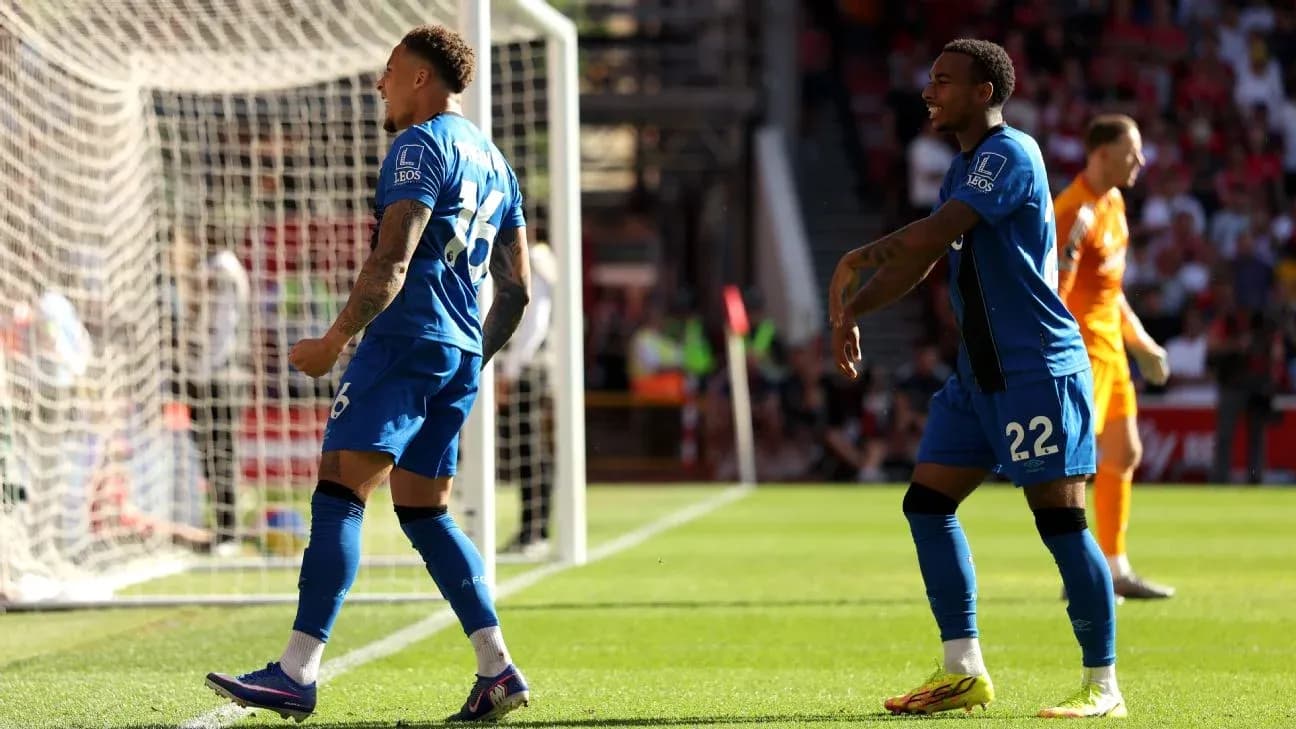
With the ball, Forest’s plan hinged on early progression into the front line and exploiting half-spaces. The 15 total shots (5 on goal, 5 blocked) from only 45% possession highlight how quickly they tried to turn regains into attacks. Hutchinson’s advanced right-sided positioning and Gibbs-White’s freedom to drift inside effectively turned the nominal 4-4-2 into a 4-2-3-1 in attack, with Sangare and Anderson as the double pivot. The opening goal sequence – Gibbs-White scoring at 34' assisted by Hutchinson – was emblematic: Hutchinson receiving high and wide, then finding Gibbs-White between the lines, attacking the space before Bournemouth’s back four could reset.
Bournemouth’s Approach
Bournemouth’s 4-2-3-1, by contrast, prioritised control. D. Petrovic in goal, a back four of A. Smith, James Hill, M. Senesi and A. Truffert, shielded by Adams and Toth, with Rayan, E. J. Kroupi and M. Tavernier behind Evanilson, created a structure designed to dominate the ball. Their 483 total passes (405 accurate, 84%) versus Forest’s 396 (307 accurate, 78%) and 55% possession reflect a side comfortable circulating across the back and through the double pivot, then trying to isolate Tavernier and Kroupi in wide channels.
In the first half, however, that possession did not translate into clear superiority. Forest’s front two and advanced wingers forced Bournemouth to build wide, limiting central progression. Bournemouth still generated 17 total shots (4 on goal, 7 blocked), but much of that volume came from outside the box (11 shots) – a sign that Forest’s central block, anchored by Sangare, effectively protected the zone in front of Milenkovic and Morato. The visitors’ best moments came when Truffert advanced from left-back to overload the flank, a pattern that would later produce the equaliser.
Tactical Adjustments
The second half saw a clear tactical shift. Trailing 1-0, Bournemouth increased their tempo and pushed their full-backs higher, with Adams more aggressive in stepping into the right half-space to support Rayan. The equaliser at 54' – Tavernier scoring from a Truffert assist – crystallised this adjustment: Truffert advanced into a wide crossing position, exploiting the space outside Forest’s right-back, and Tavernier arrived from the second line, attacking the box from the left to finish. It was a textbook 4-2-3-1 pattern: full-back overlaps, wide playmaker arrives late into the area.
From that point, Iraola leaned on his bench to refresh the attacking structure. At 57', A. Toth (OUT) was replaced by B. Gannon-Doak (IN), a move that rebalanced the double pivot and added more vertical running from midfield. Later, a triple substitution at 73' – Evanilson (OUT) for E. Unal (IN), E. J. Kroupi (OUT) for J. Kluivert (IN), and Rayan (OUT) for A. Adli (IN) – injected pace and directness across the front line. These changes tilted Bournemouth further towards a 4-2-4 in possession, with both wide players holding very high positions and Unal operating as a penalty-box reference.
Forest’s response to the momentum swing was structurally conservative but personnel-aggressive. At 62', C. Wood (OUT) made way for T. Awoniyi (IN), adding more depth running and physicality in behind. Within three minutes, Pereira reshaped his left side: Cunha (OUT) for L. Netz (IN) at 63' and, at 65', E. Anderson (OUT) for R. Yates (IN) and Sangare (OUT) for N. Dominguez (IN). Those double central-midfield changes signalled a shift towards more energy and ball-winning in the middle, with Yates and Dominguez tasked with disrupting Bournemouth’s rhythm and supporting full-backs under pressure.
The substitution of Hutchinson (OUT) for J. McAtee (IN) at 78' further underlined Forest’s attempt to regain some control in transition while keeping a creative presence between the lines. McAtee’s profile offered more central combination play compared to Hutchinson’s pure wide threat, which subtly rebalanced Forest towards shorter passing in the closing stages.
Discipline and Duels
Discipline and duels also shaped the tactical tone. Bournemouth’s James Hill received a yellow card at 33' for “Foul”, reflecting Forest’s ability to stress the visitors’ back line with direct passes into the forwards. Later, T. Awoniyi, who had just come on, was booked at 67' for “Foul” as Forest increasingly relied on physical duels and counter-pressing to break Bournemouth’s possession cycles. The foul count – 11 for Forest, 7 for Bournemouth – mirrors Forest’s more reactive, contact-heavy defensive approach versus Bournemouth’s more controlled, spacing-based defending.
Goalkeeping and Statistics
In goal, both keepers had relatively similar workloads. M. Sels (Nottingham Forest) made 3 saves, matching D. Petrovic (Bournemouth), who also recorded 3 saves. The goals prevented metric at -0.5 for each side indicates that both conceded slightly softer chances than the xG model would expect, but there was no standout overperformance or underperformance in shot-stopping. Instead, defensive structure and shot quality were more decisive than goalkeeping heroics.
Statistically, the draw feels fair but slightly frustrating for Forest. Their 1.87 xG from 15 shots, with 10 inside the box, suggests they created the more dangerous opportunities, particularly in the first half when their 4-4-2 transitions repeatedly found Gibbs-White and the forwards in promising central positions. Bournemouth, with 1.0 xG from 17 shots and a heavier reliance on attempts from outside the box, leaned more on volume and territorial dominance than on clear-cut chances.
Bournemouth’s superior passing numbers and possession underline Iraola’s long-term game model: 483 passes, 84% accuracy and 55% of the ball reflect a side comfortable dictating tempo. Forest’s 396 passes at 78% accuracy and 45% possession fit Pereira’s more direct, transition-oriented approach. Corner counts – 6 for Forest and 3 for Bournemouth – again show Forest’s ability to turn fewer phases of possession into tangible final-third pressure.
In tactical terms, the match became a contest between Forest’s vertical 4-4-2 efficiency and Bournemouth’s structured 4-2-3-1 control. Forest’s first-half execution gave them a deserved lead, but Bournemouth’s second-half adjustments down the left and aggressive use of substitutions earned them a point. The 1-1 at City Ground ultimately reflects a finely balanced strategic battle, with each coach imposing his model in different phases of the game.