Burnley vs Wolves: Tactical Identities in Final Premier League Clash
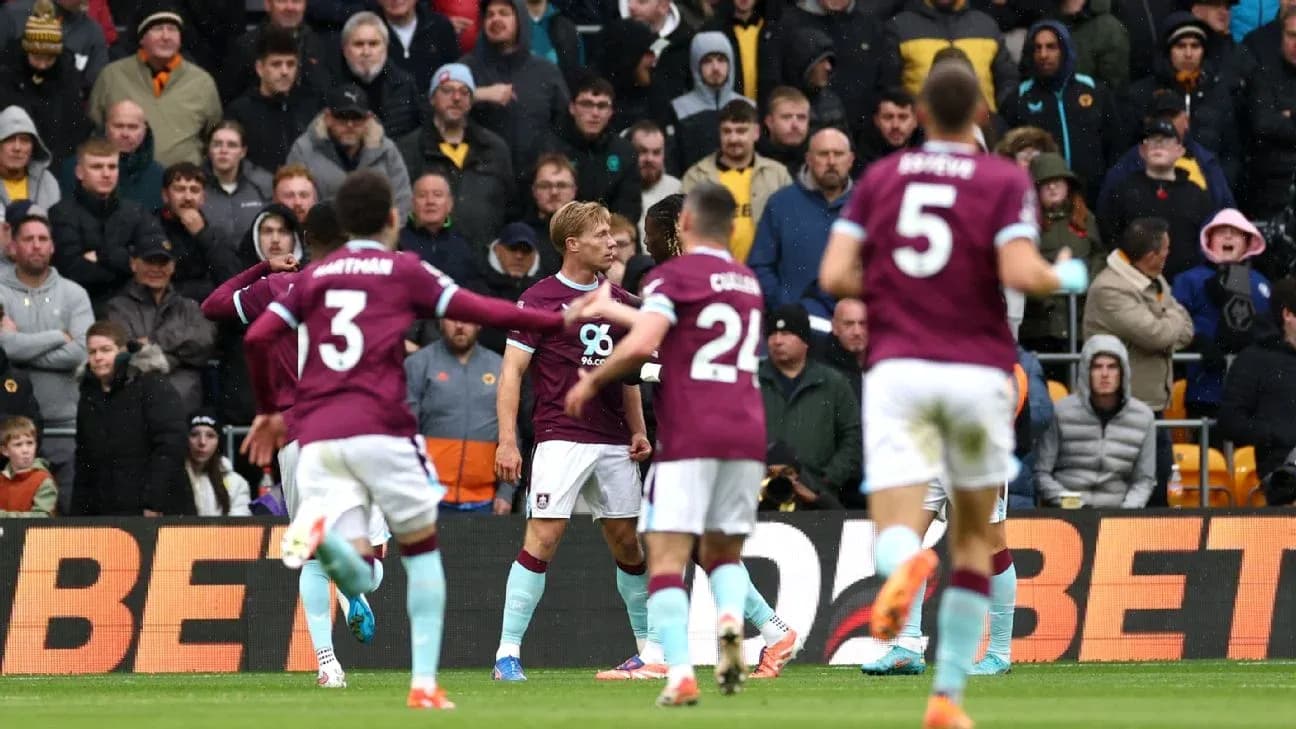
On the final afternoon at Turf Moor, two relegated sides met with pride and small consolations on the line. Burnley, 19th in the Premier League with 22 points and a goal difference of -37 (38 scored, 75 conceded), shared a 1-1 draw with bottom‑placed Wolves, who finished on 20 points and a goal difference of -41 (27 scored, 68 conceded). Following this result in Round 38, the table confirmed what the season had long suggested: both clubs are heading for the Championship, but they did so with sharply different tactical identities.
Burnley’s campaign has been defined by fragility without the ball and only sporadic cutting edge. Overall they averaged 1.0 goals for and 2.0 goals against per game, with Turf Moor offering only a slight improvement: 0.9 scored and 1.5 conceded at home. Wolves, meanwhile, have been even more blunt going forward, finishing with just 0.7 goals per game overall and a meagre 0.4 on their travels, though their defensive record of 1.8 goals conceded per match was marginally better than Burnley’s.
Against that backdrop, the 1-1 felt almost symbolic: Burnley’s attempt to build a proactive, possession‑based 4-2-3-1 against a Wolves side leaning into a compact, counter‑punching 3-4-2-1, each reflecting the season-long DNA that ultimately failed to keep them up.
Tactical Voids and Discipline
Both coaches entered this fixture with notable absences that shaped their options. Burnley were again without J. Beyer (hamstring) and J. Cullen (knee), two players whose absence has undermined their spine. Beyer’s injury has forced Mike Jackson to lean heavily on A. Tuanzebe and B. Humphreys at centre‑back, while Cullen’s absence removed a metronomic presence in midfield, leaving Florentino and L. Ugochukwu to carry the double‑pivot.
Wolves were even more depleted. L. Chiwome (knee), M. Doherty (muscle injury), E. Gonzalez (knee) and S. Johnstone (knock) all missed out, stripping Rob Edwards of depth at wing‑back, centre‑forward, and in goal. That context makes the selection of a back three of Y. Mosquera, S. Bueno and L. Krejci even more telling: Edwards trusted the defensive core that has, despite the league position, kept Wolves competitive in many matches.
Disciplinary trends across the season coloured the risk profile of this game. Burnley have lived on the edge: 100% from the spot (2 penalties scored from 2 overall) but a heavy yellow and red card load. Their yellow cards peak late, with 19.70% between 16‑30 minutes and another 19.70% between 91‑105, plus 18.18% between 76‑90, showing a team that often chases games and fouls under pressure. Red cards have been spread across 31‑45, 76‑90 and 91‑105, each accounting for 33.33% of their dismissals. The presence of J. Laurent – who has 1 red card and 7 yellows this season – on the bench underscored that Burnley’s most combustible midfielder was available if the game turned into a fight.
Wolves, too, have walked a disciplinary tightrope. André, Y. Mosquera and João Gomes all rank among the league’s most card‑prone players, with André and Mosquera each collecting 12 yellows and João Gomes 10. Team‑wide, Wolves’ yellow cards cluster heavily in the 46‑60 minute window (27.50%), followed by 61‑75 (20.00%) and 76‑90 (18.75%), pointing to a side that becomes increasingly stretched and cynical after the break. Yet both teams managed to avoid the sort of meltdown that has punctuated their seasons, a small sign of control in an otherwise chaotic year.
Key Matchups
Burnley’s main offensive threat was always going to be Z. Flemming, even if he nominally started as the lone forward in the 4‑2‑3‑1. With 11 goals in total this campaign, he has been their one reliable finisher, carrying a significant share of Burnley’s 38‑goal output. His style – late arrivals, clever movement between lines, and a willingness to duel (274 total duels, 114 won) – made him the “hunter” in this contest.
His direct opponents were Wolves’ back three, anchored by Y. Mosquera. Mosquera’s profile is that of an aggressive, front‑foot defender: 62 tackles, 17 blocked shots and 29 interceptions show a player who steps out rather than simply drops off. Against a forward like Flemming, this created a tactical knife‑edge: step too high and Burnley’s No. 19 could spin into space; sit too deep and Flemming would pick up pockets between the lines. S. Bueno’s more conservative positioning and L. Krejci’s left‑sided balance were vital in covering those moments when Mosquera engaged.
For Wolves, the attacking trident of Hwang Hee‑Chan, M. Mane and A. Armstrong offered vertical threat, but their season‑long total of 27 goals underlined the lack of a consistent “hunter.” Instead, Wolves’ best chance of piercing Burnley’s soft underbelly was through structured transitions, using Hwang’s runs off Armstrong and the late surges of R. Gomes from wing‑back.
The Engine Room
The midfield battle was a fascinating clash of archetypes. Burnley’s double pivot of Florentino and L. Ugochukwu offered ball‑winning and simple distribution, freeing H. Mejbri to roam as a high‑energy connector. Mejbri’s season numbers – 1 goal, 4 assists, 21 key passes and 34 dribble attempts with 20 successful – paint him as the creative agitator, but also as a disciplinary risk with 10 yellow cards and 1 penalty conceded. His tendency to play on the edge mirrored Burnley’s broader identity.
Across from them, Wolves fielded André and A. Gomes in central roles, supported by D. M. Wolfe. André’s 1306 passes with 91% accuracy and 18 key passes made him the metronome, but his 12 yellows and 47 fouls committed highlighted his enforcer streak. A. Gomes was the true ball‑winning engine: 108 tackles, 36 interceptions and 449 duels (227 won) anchored Wolves’ ability to break up Burnley’s phases and launch counters.
This “engine room” duel often decided the game’s rhythm. When Mejbri found pockets behind André, Burnley could sustain pressure and bring J. Anthony and L. Tchaouna into advanced positions. When André and A. Gomes shut those lanes, Wolves could spring quickly into Hwang and Armstrong, exploiting Burnley’s season‑long defensive average of 2.0 goals against per game.
Statistical Prognosis and Tactical Verdict
Following this result, the numbers still tell a story of two flawed sides whose tactical ideas outstripped their execution. Burnley’s 4‑2‑3‑1 remains their most used shape (13 league games), and it showed its potential here: a clear No. 10 in Mejbri, wide threats in Anthony and Tchaouna, and Flemming as a hybrid forward. Yet the season‑long issues – only 0.9 goals for at home, 9 home games without scoring, and just 4 clean sheets overall – underline a side that rarely married control with cutting edge or defensive solidity.
Wolves’ 3‑4‑2‑1, their primary system with 12 league uses, again delivered structural resilience. Conceding 1.8 goals per game overall is not disastrous for a bottom‑placed team; the real problem has been the attack, with 12 away matches without scoring and only 8 away goals all season. Even when the back three and double pivot function well, the lack of a ruthless finisher has repeatedly blunted their xG and turned balanced contests into narrow defeats or sterile draws.
From a purely statistical standpoint, Burnley’s slightly higher scoring rate and home advantage at Turf Moor made a marginally stronger case for them edging the contest, while Wolves’ more stable defensive record suggested they were better equipped to grind out a low‑scoring result. The 1‑1 scoreline fits that equilibrium: Burnley doing just enough in possession to find a goal, Wolves organised enough to avoid collapse but too limited in the final third to tilt the game decisively.
The tactical verdict is that both teams leave the Premier League with clear identities but glaring imbalances. Burnley must translate their attacking structure and Flemming‑centric threat into a more secure defensive base and a less chaotic disciplinary profile. Wolves, by contrast, have the framework of a robust mid‑block and an industrious engine room in André and A. Gomes, but they require a sharper “hunter” to convert their organisation into goals.
In the Championship, these same structures – Burnley’s 4‑2‑3‑1 and Wolves’ 3‑4‑2‑1 – can become promotion platforms if they address those voids. Turf Moor’s farewell to the Premier League, then, was less a dead rubber than a tactical epilogue: a reminder of what each side is, and a blueprint of what they must become.