Aston Villa Upsets Manchester City at Etihad Stadium
Etihad Stadium closed its Premier League season with a twist: Manchester City, second in the table on 78 points, were turned over 2–1 at home by fourth‑placed Aston Villa, who finished on 65. Following this result, the league’s most polished possession machine were undone by a side whose season-long identity has been built on vertical surges and ruthless transitions. The final‑day narrative became less about formality and more about how Unai Emery’s reshaped Villa could crack one of the division’s most formidable home structures.
City’s seasonal DNA at home is clear in the numbers. Across 19 league games at the Etihad they scored 45 goals at an average of 2.4 while conceding only 14 at 0.7. A goal difference of 31 at home (45 scored, 14 conceded) underpinned 14 wins and just 2 defeats. Yet Villa arrived with a different kind of credibility: on their travels they produced 24 goals at 1.3 per game, conceded 27 at 1.4, and had already shown they could trade punches with elite sides, finishing with an overall goal difference of 7 (56 for, 49 against).
Pep Guardiola’s selection told its own story. He moved away from his more common 4‑1‑4‑1 and 4‑3‑3 structures into a 4‑2‑2‑2, with J. Trafford behind a back four of R. Lewis, J. Stones, R. Dias and N. Ake. In front, Nico and Bernardo Silva formed the double pivot, with A. Semenyo and Savinho as narrow attacking midfielders behind a fluid front pair of P. Foden and T. Reijnders. On paper, it was an ultra‑aggressive box midfield, designed to overload central lanes and pin Villa’s 4‑2‑3‑1 deep.
Emery’s answer was a textbook Villa shape: a 4‑2‑3‑1 that has been the backbone of their season, used in 34 league matches. M. Bizot deputised for the absent E. Martinez (finger injury), shielded by a back four of A. Garcia, V. Lindelof, T. Mings and I. Maatsen. L. Bogarde and Douglas Luiz anchored midfield, with L. Bailey, R. Barkley and E. Buendia supporting lone striker O. Watkins. The missing spine of Martinez and B. Kamara (knee injury) might have suggested vulnerability, but Emery compensated with compact spacing and an emphasis on collective pressing triggers rather than individual dominance.
The tactical voids were more acute for Villa than for City. Losing Martinez removed a dominant penalty‑box presence and elite distributor; Bizot, while competent, does not bring the same command. Kamara’s absence forced Bogarde into a more conservative role, limiting his licence to step out. Yet structurally, Villa’s season had prepared them for this: they have kept 9 clean sheets overall, 3 of them away, by compressing space between lines and accepting that they will concede chances but trust their block to absorb pressure.
Disciplinary profiles also shaped the risk landscape. City’s yellow‑card distribution shows a late‑game edge: 20.90% of their yellows come between 76–90 minutes, with another 16.42% from 91–105, reflecting a team that often defends high and aggressively as games stretch. Villa’s heaviest yellow concentration is between 46–60 minutes at 29.31%, the classic window where Emery’s side raise the press after half‑time. Their only recorded red card of the league campaign arrives between 61–75 minutes, underlining how fine the line can be when they push the intensity dial.
Within that context, the “Hunter vs Shield” duel was stark. City’s overall attack has been powered by E. Haaland’s 27 league goals, supported by 8 assists, even though he did not start this particular match. His season tells us what City usually are: a side that generates a high volume of box touches and penalty‑area shots, with Haaland averaging 102 shots and 59 on target. Villa’s overall defence, conceding 1.3 goals per game, is robust but not elite; on their travels they allow 1.4. The fact that City only managed one goal in this fixture speaks to how effectively Villa compressed central spaces and disrupted the supply lines from the box midfield into the channels where Haaland, or in this case Foden and Reijnders, like to receive.
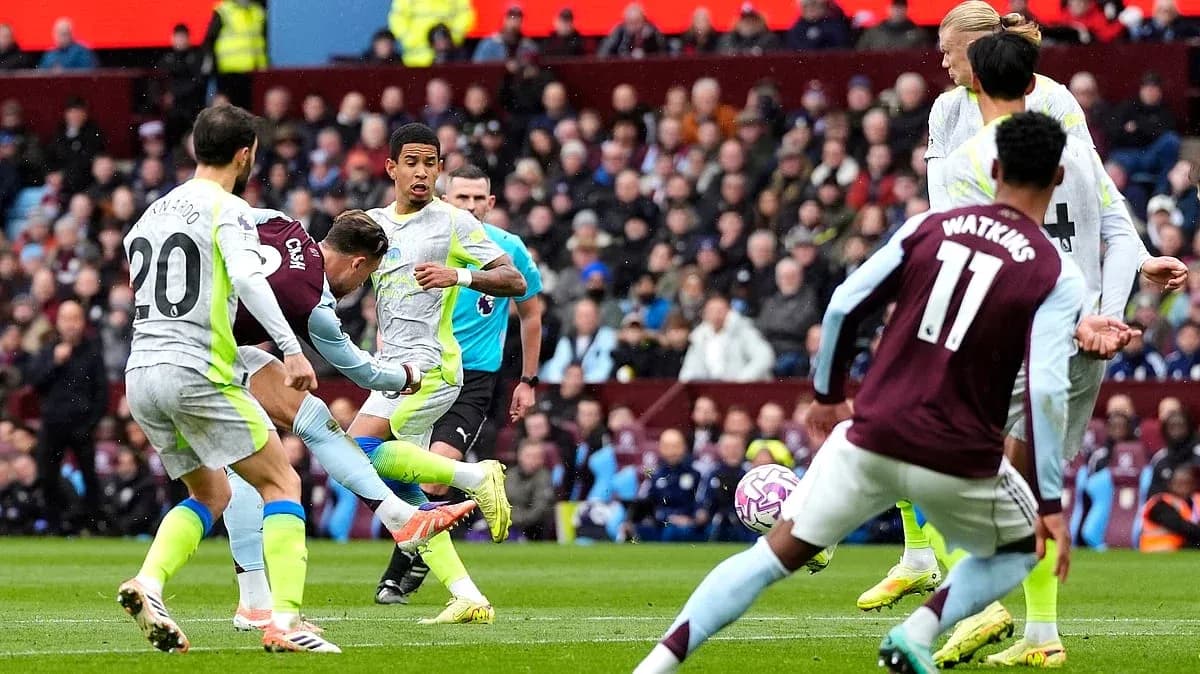
On the other side, the Hunter was very much present. O. Watkins, with 16 goals and 3 assists this league season, is the embodiment of Villa’s vertical threat. He thrives on early balls into the channels and quick combinations around the box. City’s overall defensive record – 35 conceded at 0.9 per game, with 16 clean sheets – usually smothers such forwards. But the 4‑2‑2‑2 left their full‑backs high and their centre‑backs often exposed in wide isolation, a scenario tailor‑made for Watkins’ diagonal runs and Bailey’s pace on the break.
The “Engine Room” confrontation was no less compelling. For City, creativity has been widely shared: R. Cherki’s 12 assists and P. Foden’s 5 speak to a multi‑source chance creation model, with both also strong dribblers (Cherki attempting 105 dribbles, Foden 47). In this match, Foden started higher, but the underlying pattern remained: City looking to overload half‑spaces, then slip runners through the lines. Bernardo Silva, who carries 10 yellows this season, again walked the line between tempo‑setter and tactical fouler, his 53 tackles and 22 interceptions emblematic of his dual role as playmaker and enforcer.
Villa’s answer in the middle came through Douglas Luiz and the absent‑but‑influential blueprint of M. Rogers, whose season of 10 goals and 6 assists from midfield underpins their capacity to break lines. Even without Rogers in this XI, the template was clear: one pivot (Luiz) to recycle, one to shuttle (Bogarde), and a trio of technicians ahead to connect quickly with Watkins. The numbers show Rogers as a volume operator – 1067 passes, 47 key passes, 441 duels – and Villa reproduced that ethos with Barkley and Buendia constantly rotating into pockets behind City’s double pivot.
From a statistical prognosis standpoint, this result sits at the sharp end of Villa’s away variance rather than as a complete outlier. On their travels they score 1.3 and concede 1.4; winning 2–1 at the Etihad is an overperformance against a City home defence that usually allows 0.7, but not an implausible one given Villa’s 8‑game winning streak ceiling and capacity for big‑game execution. City’s underlying profile – 2.0 goals scored per game overall, 0.9 conceded, 3 penalties taken and 3 scored with no misses – usually tilts xG models heavily in their favour, especially at home.
Following this result, the tactical takeaway is nuanced. City’s 4‑2‑2‑2 offers overwhelming possession and central overloads, but against a drilled 4‑2‑3‑1 like Villa’s it risks leaving the rest defence too thin, especially against a striker of Watkins’ movement and a wide threat like Bailey. Villa, even without Martinez and Kamara, proved that a compact mid‑block, disciplined second‑half pressing, and ruthless exploitation of transition moments can bend the numbers and silence one of Europe’s most reliable home machines.