Netherlands vs Japan: Tactical Analysis of the 2-2 Draw
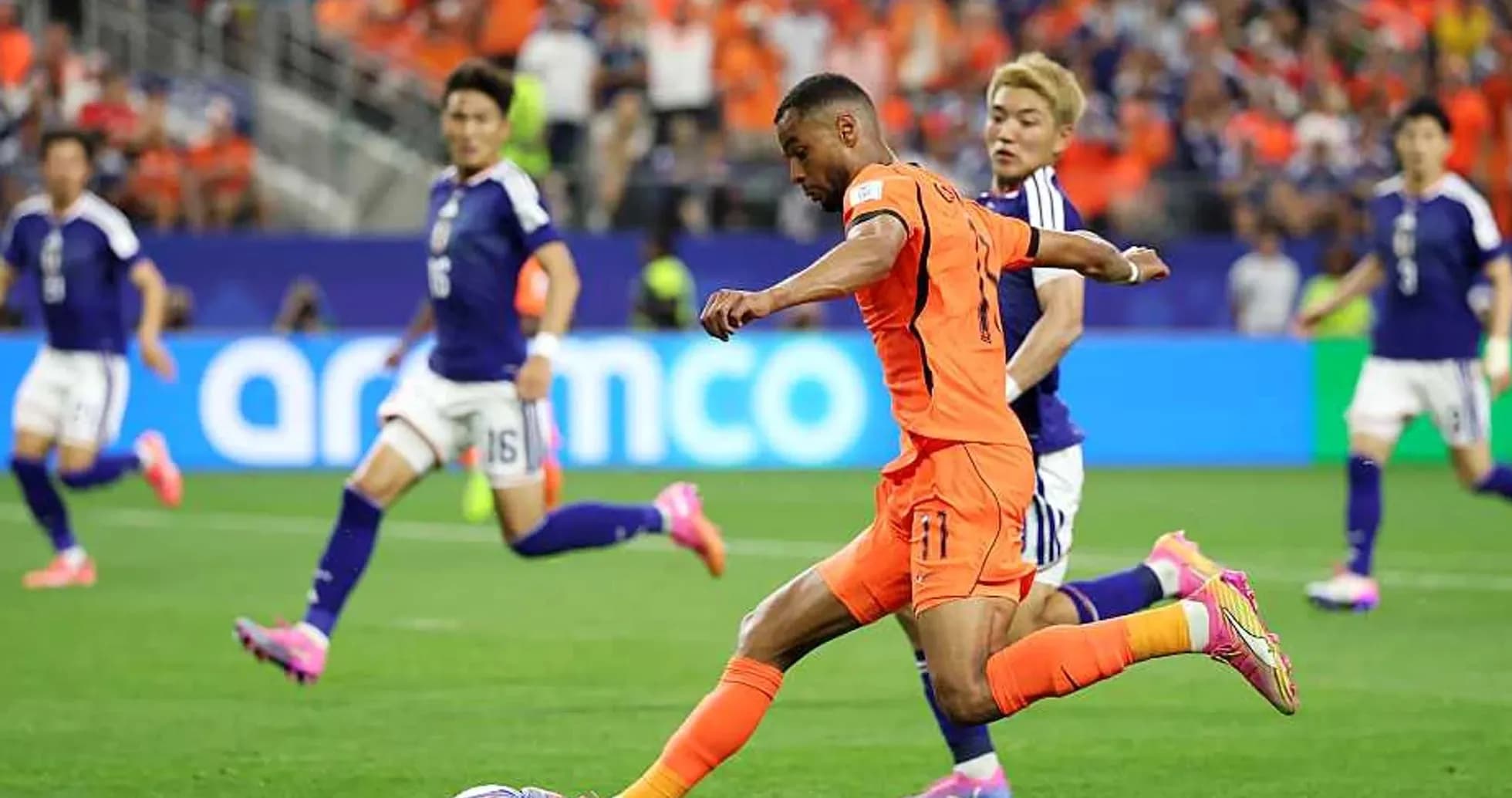
The 2-2 draw between Netherlands and Japan at AT&T Stadium unfolded as a clear clash of structures: Ronald Koeman’s 4-3-3 built on territorial control and circulation versus Hajime Moriyasu’s 3-4-2-1 geared towards vertical transitions and late attacking punches. Netherlands’ 60% possession, 525 passes and 88% passing accuracy framed them as the territorial aggressor, but Japan’s compactness, intelligent pressing triggers and selective risk-taking allowed them to turn a lower-possession game into an even contest on the scoreboard and in shot volume (10-10 in Total Shots).
I. Executive Summary of Tactical Shapes
Koeman’s 4-3-3 was textbook: Bart Verbruggen in goal behind a back four of Denzel Dumfries, Jan Paul van Hecke, Virgil van Dijk and Micky van de Ven. In front, Frenkie de Jong anchored the midfield with Ryan Gravenberch and Tijjani Reijnders as advanced interiors, supporting a front three of Crysencio Summerville, Donyell Malen and Cody Gakpo. The idea was clear: full-backs high, interiors between the lines, and wide forwards pinning Japan’s back three.
Moriyasu’s 3-4-2-1, with Zion Suzuki in goal, Tsuyoshi Watanabe, Shogo Taniguchi and Hiroki Itō as the back three, relied on wing-oriented pressure and vertical runs. Kaishu Sano and Daichi Kamada formed the central double pivot, flanked by Ritsu Doan and Keito Nakamura as nominal wide midfielders but often part of a flexible line of four. Takefusa Kubo and Daizen Maeda supported Ayase Ueda, rotating between half-spaces and depth runs.
II. Netherlands’ Possession Structure and Left-Side Bias
The statistical profile – 525 passes, 464 accurate (88%) and 10 of 10 shots coming from inside the box – underlines how Netherlands managed to move Japan back and repeatedly access dangerous zones. De Jong’s role was pivotal: dropping between or beside Van Dijk and Van de Ven to form a three-man first line, he allowed the full-backs to push high and the interiors to occupy pockets.
The left side became the primary progression lane. Van de Ven’s ability to carry forward, combined with Gakpo’s wide starting position, stretched Japan’s right side and forced Sano and Taniguchi into difficult decisions: step out and leave space behind, or hold and allow De Jong and Gravenberch to dictate. Gravenberch’s advanced positioning and late arrivals were particularly influential, reflected in his two assists – his timing into the right half-space created both the 51' goal for Van Dijk and the 64' strike for Summerville. Those patterns show a deliberate use of the interiors as final-third playmakers rather than mere link players.
Yet, despite the positional dominance, Netherlands’ xG of 0.79 suggests their shot quality was moderate. Ten shots all inside the box point to good occupation of the area but not necessarily clear one-on-ones or cutbacks from the byline. Japan’s back three, aided by disciplined wing support, kept many Dutch efforts contested.
III. Japan’s Defensive Scheme and Transition Threat
Japan’s 40% possession and 342 passes (287 accurate, 84%) reflect a side comfortable without the ball, but their structure was sophisticated rather than purely reactive. Out of possession, the 3-4-2-1 often flattened into a 5-4-1: Doan and Nakamura dropped alongside Sano and Kamada, with the outside centre-backs shuffling wide to track Dutch wingers and wing-backs.
The key defensive idea was to congest central lanes and deny De Jong direct vertical access. Ueda and one of the attacking midfielders (often Kubo) screened passes into De Jong, forcing Netherlands to build via the full-backs. When the ball went wide, Japan triggered lateral pressure: the wing midfielder jumped to the full-back, the near-side central midfielder slid across, and the outside centre-back was ready to step into the channel. This helped hold Netherlands to just one Blocked Shot despite their box presence, indicating Japan generally managed to contest but not fully smother attempts.
In transition, Japan were sharp. Their xG of 0.54 from 10 shots (six inside the box, four outside) shows a mixed shot profile, but the late equaliser from Kamada at 89' and Nakamura’s earlier goal at 57' both emerged from well-timed forward surges. Kubo’s role as a connective hub is underlined by his assist for Nakamura and his involvement before being replaced by Koki Ogawa at 75'. Once Junya Ito and Ogawa entered, Japan’s front line gained more depth and width, enabling more direct attacks into the channels behind Dumfries and Van de Ven.
IV. Substitutions and Momentum Shifts
Koeman’s triple change on 70' – Teun Koopmeiners (IN) for Reijnders (OUT), Quinten Timber (IN) for Summerville (OUT), and Memphis Depay (IN) for Malen (OUT) – signalled an attempt to both manage energy and sharpen control. Koopmeiners offered a more measured passing profile, while Depay provided a different reference between the lines compared to Malen’s depth running. Timber’s introduction for Summerville removed a direct dribbler but added more midfield stability.
However, these changes subtly altered Netherlands’ attacking dynamics. Without Summerville’s wide threat and Malen’s vertical runs, the Dutch attacks became more central and methodical, arguably easier for Japan’s compact block to read. Later, Nathan Aké (IN) for Gravenberch (OUT) at 81' further tilted the side towards protecting the lead rather than extending it, and Brian Brobbey (IN) for Gakpo (OUT) added physical presence but less link play on the left.
Moriyasu’s substitutions were more overtly attacking. Ito for Maeda at 66' increased right-side directness, while the triple change at 75' – Ogawa for Kubo, Takehiro Tomiyasu for Doan, and Yukinari Sugawara for Watanabe – reconfigured the back line and added fresh legs in wide and central defensive roles, allowing the wing areas to be more aggressive. Kento Shiogai for Ueda at 84' refreshed the central striker position just before Kamada’s late goal, keeping pressure on the Dutch back line.
V. Goalkeeper and Defensive Index
With one Goalkeeper Save for Netherlands and four for Japan, the defensive index tilts slightly towards Japanese resilience. Zion Suzuki (Japan) combined those four saves with 0.62 goals prevented, underlining how his interventions directly preserved the draw. Bart Verbruggen (Netherlands), with one save and 0.62 goals prevented, had less volume to handle but still contributed significantly in the limited moments Japan broke through.
Netherlands’ three yellow cards, all for Foul or Professional foul, hint at tactical infringements to halt transitions – particularly Micky van de Ven’s late caution at 90+1'. Japan, with no bookings, maintained discipline while still committing seven Fouls, matching Netherlands’ total.
VI. Statistical Verdict and Tactical Balance
The numbers capture a finely poised tactical battle. Netherlands: 60% Ball Possession, 10 Total Shots (six on goal), five Corner Kicks, 525 passes with 88% accuracy, xG 0.79. Japan: 40% Ball Possession, 10 Total Shots (three on goal), four Corner Kicks, 342 passes at 84%, xG 0.54. Both sides registered one Blocked Shot and seven Fouls.
In synthesis, Netherlands’ overall form in this match was that of a structurally sound, possession-dominant side that converted midfield control into territorial advantage but not decisive shot quality. Japan’s defensive index was strong: compact shape, effective transitions, and a goalkeeper performing above expectation. The 2-2 scoreline mirrors the tactical equilibrium – Dutch control versus Japanese efficiency and late-game punch – rather than a one-sided dominance in either direction.