Australia's Strategic Victory Over Türkiye: A Tactical Analysis
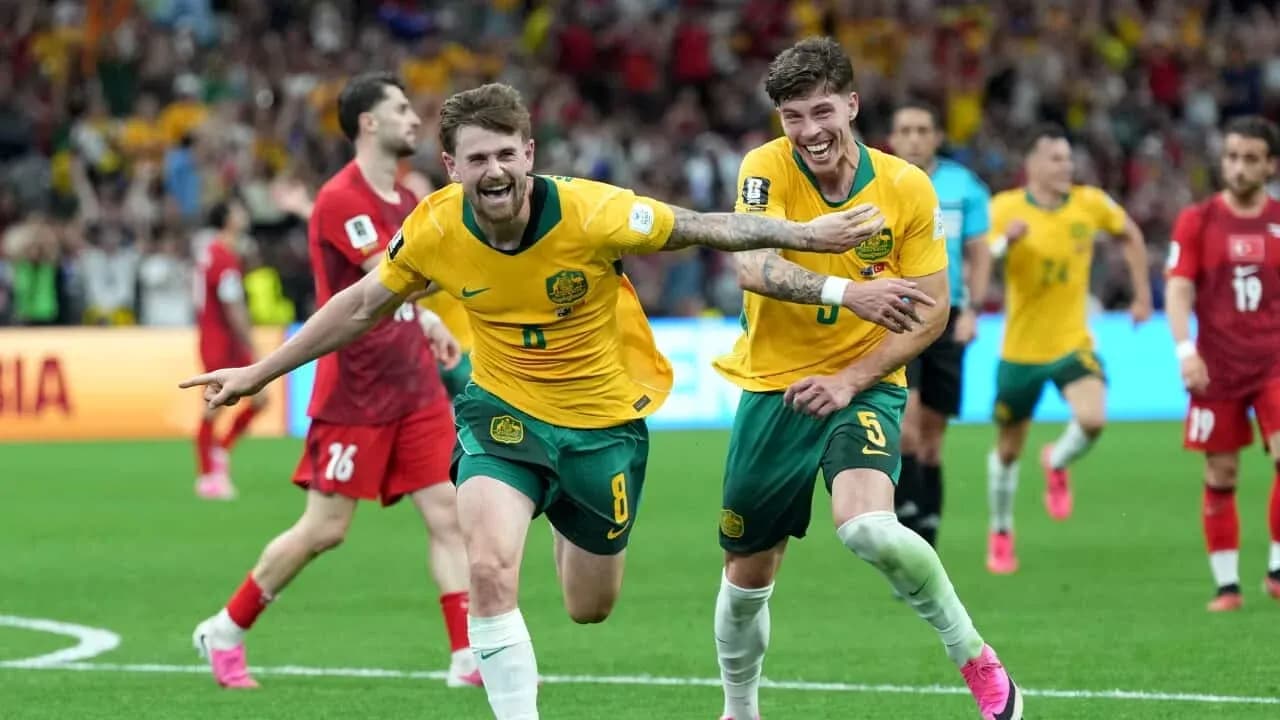
Under the closed roof of BC Place in Vancouver, Australia’s 2-0 victory over Türkiye felt less like an opening skirmish and more like a statement of intent. Following this result, Australia sit 2nd in Group D on 3 points with a goal difference of 2, perfectly mirroring the scoreline that has also defined Türkiye’s early struggle: 0 points, a goal difference of -2, and the sense of a plan that never quite ignited.
This was a clash of contrasting blueprints. Australia, listed as the home side, leaned into a 5-4-1 under Tony Popovic, a structure that spoke of control and compactness rather than chaos. Türkiye, in Vincenzo Montella’s familiar 4-2-3-1, arrived with technical flair between the lines but left with their attacking lines frayed and their defensive timings exposed.
Heading into this game, the numbers offered only the faintest sketch of identity, but they are already sharpening. Overall this campaign, Australia have played 1 match, winning 1, scoring 2 and conceding 0. At home, that same single fixture has produced 2 goals for and none against, an average of 2.0 goals scored and 0.0 conceded. Their goals arrived in two distinct waves: 50.00% between 16-30 minutes and 50.00% between 61-75 minutes, a split that hints at both early incision and mid-second-half control.
Türkiye’s picture is the mirror opposite. On their travels, they have played 1 match, lost it, and failed to score, with an away average of 0.0 goals for and 2.0 against. The pattern of their defensive concessions is brutally symmetrical: 50.00% of goals conceded between 16-30 minutes and 50.00% between 61-75 minutes. The same windows where Australia have struck are exactly where Türkiye have been opened up.
That intersection of strengths and weaknesses defined the narrative. Australia’s back five, anchored by Harry Souttar in the central lane, gave them a solid platform. With Alessandro Circati and Cameron Burgess flanking him, the defensive line was less about last-ditch heroics and more about occupying zones, funnelling play away from danger. Wide defenders Jacob Italiano and Jordan Bos were crucial to the system: nominally part of a back five, they were often the springboards that turned a rigid block into a rolling wave.
In front of them, the double pivot of Connor Metcalfe and Aiden O’Neill, alongside Paul Okon-Engstler and Nestory Irankunda, formed a hard-working midfield four that constantly adjusted its shape. The data underscores Okon-Engstler’s importance: in total this campaign he has 1 assist, 32 completed passes with 2 key passes, and 3 successful tackles. He also blocked 2 shots and made 3 interceptions, a two-way performance that made him the quiet metronome of Australia’s engine room.
Irankunda, meanwhile, brought the spark. In total this campaign he has 1 goal from 2 shots, both on target, plus 1 successful dribble from 1 attempt. His 7.5 rating and 61 minutes on the pitch mark him as Australia’s early breakout force, a wide midfielder who treats the half-space as a runway. When Australia transitioned, Irankunda and Okon-Engstler became the twin prongs: one stretching the play vertically, the other threading passes into Mohamed Touré, the lone forward.
For Türkiye, the structure on paper was promising. A back four of Zeki Çelik, Merih Demiral, Abdülkerim Bardakcı and Ferdi Kadıoğlu is built to both defend and progress. In midfield, İsmail Yüksek and Hakan Çalhanoğlu sat as the double pivot, with Arda Güler, Orkun Kökçü and Barış Alper Yılmaz supporting Kerem Aktürkoğlu up top. It is a line of names that suggests creativity and control.
Yet the statistics tell a story of a side still searching for balance. Overall this campaign, Türkiye have failed to score in their only match, with 0.0 goals for in total and 2.0 against. They have yet to record a clean sheet, and their only clear disciplinary mark is a late yellow card: 100.00% of their cautions have come between 76-90 minutes. That caution belongs to Yunus Akgün, whose cameo off the bench was a microcosm of Türkiye’s frustration. In 35 minutes he completed 21 passes at 90% accuracy, produced 2 key passes and 1 successful dribble, but also committed 1 foul and collected 1 yellow card. He sits, somewhat paradoxically, at the top of both the yellow and red card leaderboards in the data snapshot, underlining how thin Türkiye’s disciplinary record is so far.
The “Hunter vs Shield” dynamic in this fixture was therefore skewed in Australia’s favour. Their primary offensive threats, particularly Irankunda and the supply line from Okon-Engstler, targeted the exact periods where Türkiye are statistically most fragile. When Australia surged between 16-30 minutes and again between 61-75 minutes, Türkiye’s back line and double pivot were repeatedly asked to solve problems they had already shown they struggle with.
In the “Engine Room” duel, Okon-Engstler’s all-action display edged out Türkiye’s midfield. While Çalhanoğlu and Kökçü sought to dictate tempo, they were often forced to receive under pressure, their passing lanes narrowed by Australia’s compact 5-4-1 mid-block. The Australians did not need elaborate pressing triggers; their shape alone denied Türkiye the central corridors they crave.
Disciplinarily, Australia remain pristine. Heading into this game and following this result, they have recorded no yellow or red cards in any time range. Their defensive record is equally clean: 0 goals conceded overall, 1 clean sheet, and under every goals-against threshold (from 0.5 to 4.5) they are classified as “under”. Türkiye, by contrast, are “over” on every goals-against threshold from 0.5 to 1.5, reflecting the 2 goals conceded on their travels.
From a statistical prognosis standpoint, the early Expected Goals patterns—while not numerically provided—can be inferred from volume and timing. Australia’s ability to create and convert in those two key windows, combined with a defensive record of 0.0 goals conceded in total, points to a side whose xG allowed is likely low and whose chance quality in decisive moments is high. Türkiye’s failure to score, their 0.0 goals for in total and their matching concession windows suggest an xG profile that is too flat in attack and too spiky against them in transition.
Following this result, Australia’s seasonal DNA looks like that of a pragmatic tournament side: structurally conservative, ruthlessly efficient when the game tilts their way, and disciplined both with and without the ball. Türkiye, meanwhile, carry the weight of potential not yet realised—technically gifted in the final third, but without the protective shell or synchronized press to keep opponents from exploiting their soft underbelly at precisely the wrong times.