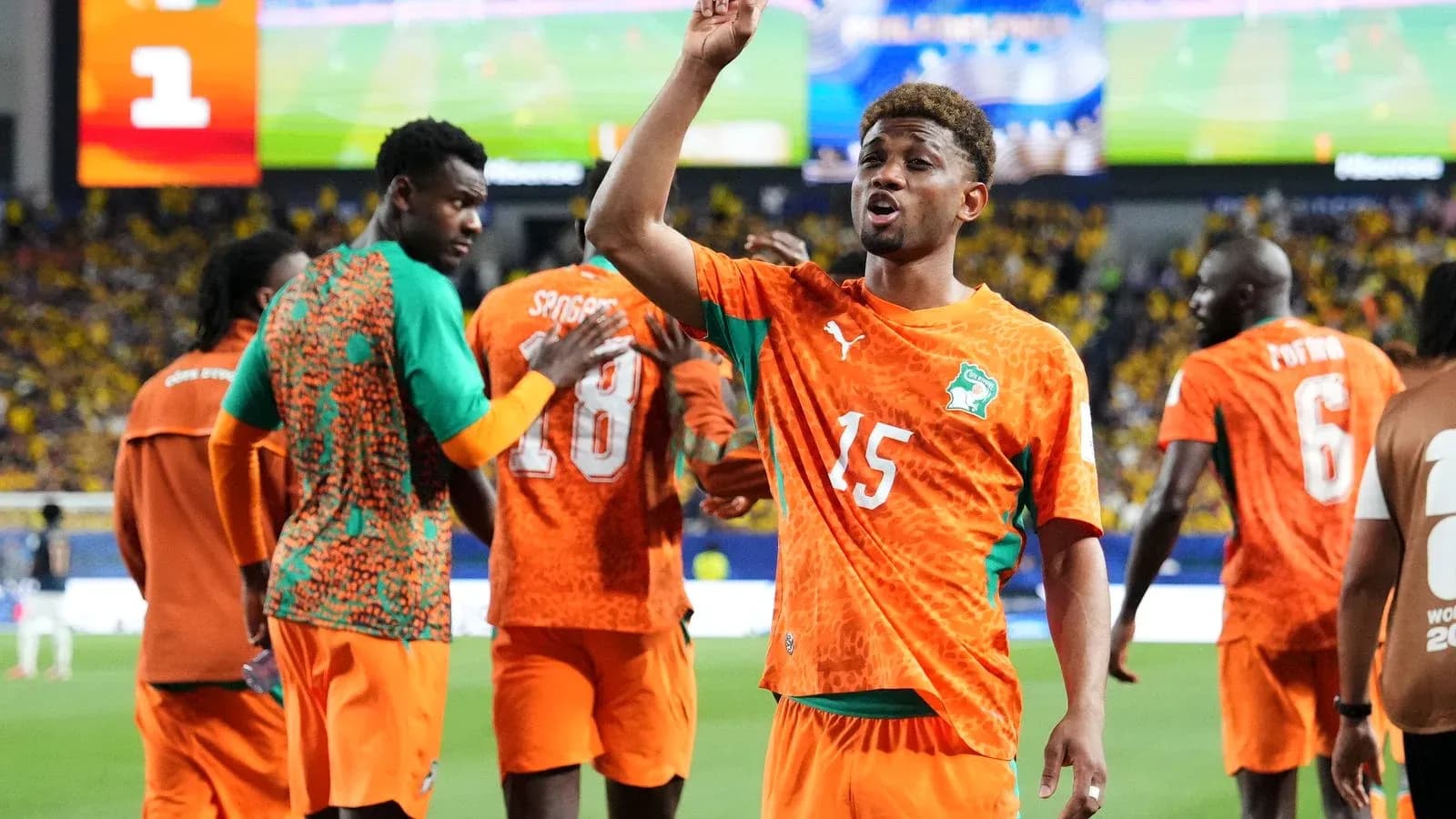
Ivory Coast Secures 1-0 Victory Over Ecuador in Controlled Match
Ivory Coast’s 1-0 win over Ecuador at Lincoln Financial Field was a controlled, methodical Group Stage performance built on structure rather than chaos. Both sides lined up in a 4-4-2, but Emerse Fae’s Ivory Coast used the shape more efficiently, translating slightly less possession (48%) into more penalty-box presence and a higher shot volume. The late winner from substitute Amad Diallo was the logical outcome of an evening where Ivory Coast consistently generated the cleaner looks, while Ecuador’s territorial phases rarely broke Ivory Coast’s central block.
Chance Creation
In terms of chance creation, Ivory Coast’s attacking plan was clear: use the double pivot of Franck Kessié and Seko Fofana to progress through the middle, then connect quickly with the front two. The hosts finished with 15 total shots to Ecuador’s 12, and crucially, 8 of those Ivorian attempts came inside the box versus Ecuador’s 5. That interior shot profile, combined with 4 shots on goal and an xG of 1.52, shows a team that repeatedly managed to play into dangerous central zones, even without overwhelming the ball share.
Ecuador's Performance
Ecuador, under Sebastian Beccacece, had marginally more of the ball (52% possession) and a slightly higher passing output — 492 total passes with 419 accurate (85%) compared to Ivory Coast’s 470 passes, 397 accurate (84%). But much of Ecuador’s circulation was in front of Ivory Coast’s midfield line. Their xG of 1.01 from 12 shots (only 1 on goal) underlines a structural problem: they reached shooting positions but failed to convert them into truly threatening efforts. The mirrored 4-4-2s highlighted the contrast — Ivory Coast’s was vertical and punchy; Ecuador’s was more about keeping the ball than breaking lines.
Defensive Structure
Out of possession, Ivory Coast’s defensive structure was anchored by the back four of Guéla Doué, Wilfried Singo, Emmanuel Agbadou and Ghislain Konan. The team conceded 12 shots but allowed only 1 on target, a key indicator of how effectively the back line and midfield shielded central areas and forced Ecuador into lower-quality attempts. The fouls count (10 for Ivory Coast, 13 for Ecuador) and the nature of Ivory Coast’s bookings — “Roughing” for Seko Fofana, “Tripping” for Franck Kessié and Guéla Doué — suggest a side willing to break play with controlled aggression in midfield and wide channels rather than being pulled apart structurally.
Goalkeeping
In goal, Yahia Fofana (Ivory Coast) had a relatively quiet but focused night, officially making 1 save. The low save count is less a reflection of passivity and more a testament to the outfield block in front of him; Ecuador’s inability to turn possession into shots on goal meant his primary task was command of area and distribution rather than shot-stopping heroics. At the other end, Hernán Galíndez (Ecuador) was busier, with 3 saves against 4 shots on goal. Given Ivory Coast’s xG of 1.52 and Ecuador’s goals prevented figure of 0.22, Galíndez (Ecuador) can be credited with keeping the scoreline respectable, particularly as Ivory Coast increased the tempo after the hour.
Substitutions
The substitutions were tactically decisive. For Ecuador, the introduction of Nilson Angulo for Alan Minda at 56' and later Jackson Porozo for Alan Franco at 62' hinted at a shift towards more direct, physically assertive play. However, the booking for Porozo on “Holding” at 73' encapsulated Ecuador’s struggle: defensive interventions became more reactive as Ivory Coast’s substitutes injected pace and fresh legs.
For Ivory Coast, the bench transformed the attack. At 56', Ange-Yoan Bonny (IN) came on for Elye Wahi (OUT), and Amad Diallo (IN) replaced Bazoumana Touré (OUT), effectively refreshing both the front line and one wide midfield lane. This double change tilted the attacking balance. Diallo’s movement between lines and Bonny’s presence up front gave Ivory Coast more dynamic options between and beyond defenders. Later, Ibrahim Sangaré (IN) for Seko Fofana (OUT) at 77' added fresh ball-winning and distribution in midfield, while Christ Inao Oulaï (IN) for Nicolas Pépé (OUT) at 77' and Odilon Kossounou (IN) for Guéla Doué (OUT) at 89' helped secure the right flank and protect the narrow lead once it was established.
Decisive Moment
The decisive moment came in the 90th minute: Amad Diallo finished from a delivery by Wilfried Singo, crowning Ivory Coast’s growing territorial and qualitative edge. Tactically, the goal reflected Ivory Coast’s match-long pattern — a full-back (Singo) pushing high from the 4-4-2 base to provide width and final-third service, with a substitute attacker exploiting the space created by Ecuador’s tiring back line. That the assist came from a defender underlines how Ivory Coast’s structure allowed controlled risk from the back without losing defensive integrity.
Discipline and Game Management
Discipline and game management also shaped the tactical picture. Ivory Coast accumulated three yellow cards — Seko Fofana for “Roughing” at 28', Franck Kessié for “Tripping” at 38', and Guéla Doué for “Tripping” at 40' — all in the first half, illustrating an aggressive approach to breaking Ecuador’s rhythm early. Ecuador’s lone booking, Jackson Porozo for “Holding” at 73', came as they chased the game and increasingly resorted to physical containment of Ivory Coast’s forwards.
Statistical Verdict
Statistically, the verdict supports the eye test of a narrow but deserved Ivory Coast win. They generated the better chances (xG 1.52 to 1.01), produced more shots on goal (4 to 1), and matched Ecuador in blocked shots (3 each), indicating both sides were able to get efforts away under pressure. Ecuador’s slight edge in possession and pass completion did not translate into final-third incision, while Ivory Coast’s more direct, vertically oriented use of the ball produced a higher-quality attacking output.
From a broader tactical lens, Ivory Coast’s 4-4-2 showed strong defensive index characteristics: limited shots on goal conceded, controlled fouling, and effective use of full-backs in attack without compromising the back line. Ecuador’s overall form in possession was tidy, but their inability to convert structural possession into penalty-area pressure ultimately decided the contest.