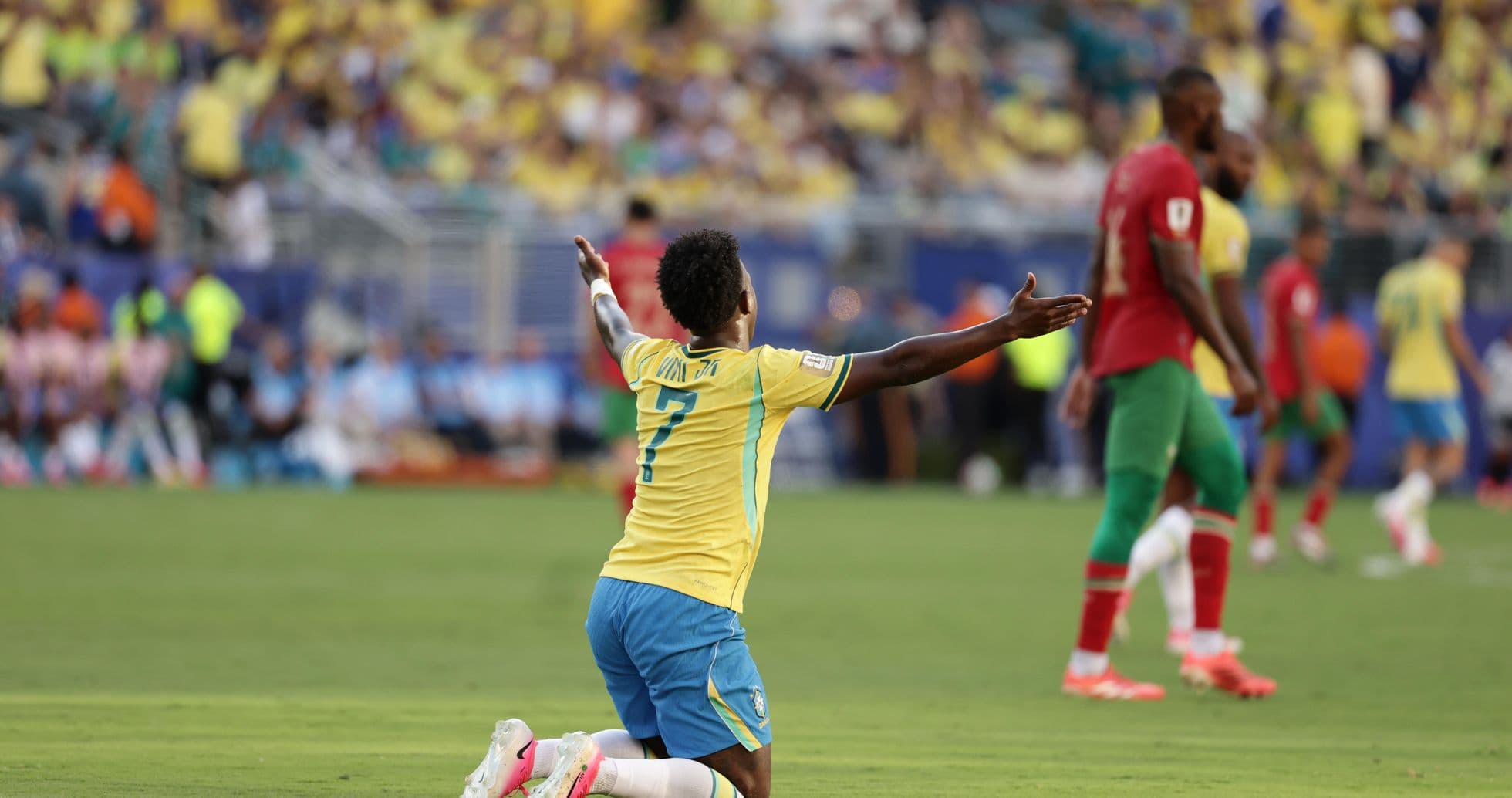
Brazil and Morocco Share Points in World Cup 2026 Clash
MetLife Stadium in East Rutherford hosted a meeting that felt more like a knockout rehearsal than an opening skirmish. Brazil and Morocco, both carrying the weight of expectation into World Cup 2026, walked away from their Group Stage – 1 clash level at 1–1 after 90 tense minutes. Following this result, both sit on 1 point, Brazil ranked 2nd in one table snapshot and 3rd in the Group C-specific listing, Morocco 2nd in Group C, each with an overall goal difference of 0 from 1 goal scored and 1 conceded.
I. The Big Picture – Two 4‑2‑3‑1s, two identities
On paper, it was a mirror: both sides lining up in a 4‑2‑3‑1. In reality, the shapes expressed very different footballing identities.
Carlo Ancelotti’s Brazil leaned into control and vertical punch. Alisson anchored a back four of Douglas Santos, Gabriel, Marquinhos and Ibanez, with Casemiro and Bruno Guimarães forming the double pivot. Ahead of them, Lucas Paquetá, Raphinha and Vinícius Júnior floated behind lone striker I. Thiago. The structure was clear: Casemiro to shield, Bruno to connect and progress, and the three attacking midfielders to create overloads between the lines.
Morocco, under Mohamed Ouahbi, mirrored the formation but not the mentality. Bono stood behind a back line of N. Mazraoui, C. Riad, I. Diop and A. Hakimi, with N. El Aynaoui and A. Bouaddi in the engine room. The three between the lines – B. El Khannouss, A. Ounahi and Brahim Díaz – orbited around central forward I. Saibari, whose role was part finisher, part reference point for counters.
Heading into this game, Brazil’s season numbers already hinted at a side still calibrating. Overall they had played 1 match, with 0 wins, 1 draw and 0 defeats. At home, they had played 1, drawn 1, scored 1 and conceded 1, giving an overall goals-for average of 1.0 and an overall goals-against average of 1.0. Morocco, on their travels, mirrored that balance: 1 away match played, 1 draw, 1 goal scored and 1 conceded, with an overall goals-for average of 1.0 and an overall goals-against average of 1.0. Two teams, one shared statistical footprint.
II. Tactical Voids – Discipline, risk and the missing edge
Absences were not officially listed, so the tactical voids were less about who was missing and more about which spaces each side chose not to occupy.
For Brazil, the main void came when Casemiro and Ibanez both walked the disciplinary tightrope. Team statistics show that heading into this game, Brazil’s yellow-card profile was spiky: 2 yellows, all concentrated in the 31–45 minute window, accounting for 100.00% of their cautions. Ibanez and Casemiro, each booked once, embodied that trend. It was a team that flicked into aggression late in the first half – useful for breaking rhythm, dangerous for structural stability.
Those bookings forced Ancelotti into early recalculations. Ibanez’s 45 minutes and Casemiro’s 45 suggested either planned rotation or a coach unwilling to risk a red. The knock-on effect was a Brazil that, in the second half, had to protect its central corridor with slightly less bite, leaning more on Bruno Guimarães’ positioning and Marquinhos’ anticipation.
Morocco, by contrast, navigated the match with a clean disciplinary slate. No yellow and no red cards in their season profile meant Ouahbi could keep his structure intact, trusting El Aynaoui and Bouaddi to maintain balance without fear of dismissal. The risk was the opposite of Brazil’s: in trying to stay controlled, Morocco occasionally allowed Brazil’s creators too much time between the lines.
III. Key Matchups – Hunter vs Shield, Engine Room vs Engine Room
Hunter vs Shield began with two emerging headline acts. For Brazil, Vinícius Júnior arrived as their most decisive offensive figure. Heading into this game, he had 1 goal from 1 appearance, with 1 shot on target, 30 passes at 86% accuracy, 2 key passes and 8 dribble attempts. He is Brazil’s chaos agent, the one who can turn a static 4‑2‑3‑1 into a swirling 4‑2‑4 in a single carry.
Morocco’s answer was I. Saibari. Also on 1 goal from 1 appearance, he had converted his only shot on target, completed 24 passes at 91% accuracy and contributed 1 tackle. Saibari’s threat was more hybrid – part false nine, part target, capable of dropping into the pocket that Casemiro normally patrols.
The Shield in this duel was not a single player but a system. Brazil’s overall defensive record – 1 goal conceded at home from 1 match, with an overall average of 1.0 goals conceded – suggests solidity but not invulnerability. Morocco’s numbers away are identical: 1 conceded in 1, overall average 1.0. The real difference lay in how they defended those zones.
Marquinhos and Gabriel formed a Brazilian axis that preferred to defend high, trusting Casemiro to clog the central lane. When Saibari dropped off, he dragged one of the pivots with him, potentially opening space for A. Ounahi or B. El Khannouss to run beyond. Morocco’s back line, with C. Riad and I. Diop, was more conservative, often holding deeper and asking El Aynaoui to step up into Vinícius’ path.
In the Engine Room, Bruno Guimarães and Casemiro squared off conceptually with El Aynaoui and Bouaddi. Bruno’s season line – 38 passes at 89% accuracy, 1 key pass, 2 tackles, 1 blocked shot and 6 duels won from 13 – underlined his dual role as tempo-setter and ball-winner. Casemiro added 18 passes at 94% accuracy, 1 tackle, 1 block and 1 interception in just 45 minutes, but his yellow card tempered his aggression.
On the other side, El Aynaoui and Bouaddi had to manage the spaces around Brahim Díaz, Morocco’s creative lodestar. Brahim, with 1 assist, 19 passes at 100% accuracy, 2 key passes, 3 dribble attempts (1 successful) and 3 fouls drawn, was the conduit between midfield and Saibari. His ability to receive between the lines and slip passes into the box tested Brazil’s mid-block whenever Casemiro was pinned deeper.
IV. Statistical Prognosis – Margins, xG logic and the road ahead
Even without explicit xG values, the statistical and structural cues point towards a finely balanced matchup that could easily have tilted either way. Both teams, following this result, have identical overall profiles: 1 match, 1 draw, 1 goal scored, 1 conceded, no clean sheets, no failures to score and no penalties taken or missed (penalty totals are 0 for both, with 0% conversion and 0% missed).
That symmetry suggests that, in xG terms, this was likely a near-par contest: each side creating enough to justify a goal, but not enough dominance to break the deadlock twice. Brazil’s attacking ceiling, driven by Vinícius Júnior and supported by Bruno Guimarães’ passing, feels marginally higher. Morocco’s collective discipline and the emergent axis of Brahim Díaz and I. Saibari give them a more cohesive, if slightly less explosive, attacking pattern.
Defensively, Brazil’s vulnerability lies in that 31–45 minute disciplinary spike. If opponents can drag them into a stretched game just before half-time, the risk of cautions – and the structural reshuffles that follow – increases. Morocco, with their clean card record so far, may be better placed to manage game states over 90 minutes, especially in tight group fixtures.
The tactical preview for the rest of Group C, then, is of two contenders walking a narrow line. Brazil will look to sharpen their control, reduce the need for last-ditch interventions and lean even more on Vinícius’ individual brilliance. Morocco will double down on structure and transitions, trusting Saibari’s efficiency and Brahim’s incision.
Following this result, nothing is decided – but the outlines are clear. Brazil bring the higher attacking upside; Morocco bring the more stable defensive temperament. In a tournament where knockout football looms after the group, that balance between risk and control will decide who turns these 1–1s into the wins that matter.