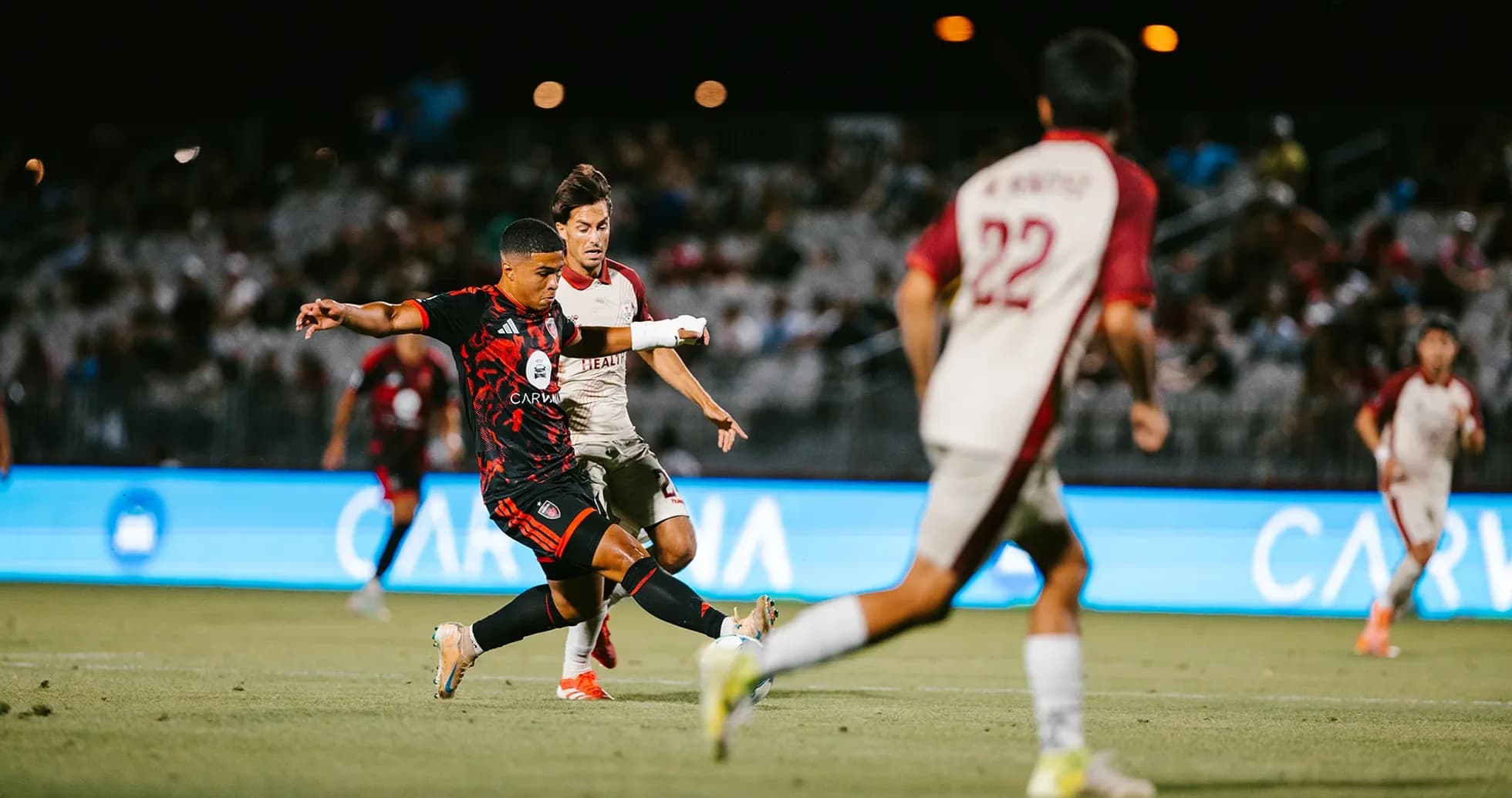
Monterey Bay Dominates Loudoun United 4-1 in USL Championship
Under the Monterey lights at Cardinale Stadium, this USL Championship Group Stage meeting felt, even before kick-off, like a crossroads for both Monterey Bay and Loudoun United. Heading into this game, the table painted a stark picture: Monterey Bay sat 12th in USL 1 with 8 points from 11 matches, a side defined by struggle and streaks of defeats; Loudoun United were just ahead in 11th with 9 points from 10, built on stubborn draws rather than statement wins. By the final whistle, a 4-1 home victory had rewritten the tone of Monterey Bay’s season.
I. The Big Picture – A season bending night
Monterey Bay came into the fixture with a total record of 2 wins, 2 draws and 7 losses from 11 matches. Their total goal difference stood at -8, the product of 11 goals for and 19 against. At home, though, there was always a hint of a different personality: 6 matches played, 2 wins, 1 draw, 3 defeats, with 7 goals scored and 7 conceded. The numbers said fragile, but not broken.
Loudoun United, meanwhile, were the league’s great equivocators. Overall they had played 10 matches, winning only 1 but drawing 6 and losing 3. Their total goal difference was -5, from 12 goals for and 17 against. At home they were specialists in stalemate; on their travels, they had 1 win, 1 draw and 2 defeats, scoring 3 and conceding 7. The away averages told a story of narrow margins: 0.8 goals for away, 1.8 against.
The 4-1 scoreline flipped some of those narratives. Monterey Bay, whose biggest home win this season was already a 4-1 result, matched that high watermark again, suggesting that when their attacking patterns click at Cardinale Stadium, they do so with force. For Loudoun, another 4-1 away defeat slotted grimly into a pattern: their heaviest away losses this season have come by that same scoreline.
II. Tactical Voids and Discipline – Edges at the margins
Injury and suspension data offered no official absentees, so both Jordan Stewart and Anthony Limbrick were, on paper, working with full decks. That made the starting XIs more revealing.
For Monterey Bay, J. Jackson anchored the side from the back, with J. Garcia, N. Gordon and Z. Farnsworth forming the core of the defensive line. The presence of O. Glasgow and W. Leggett hinted at width and verticality, while the central spine of N. Ross, R. Nakamura and S. Lletget gave Stewart a blend of control and late-arriving threat. Up front, R. Bidois and I. Paul were tasked with turning half-chances into the kind of clinical moments Monterey had too often lacked this season.
Loudoun’s structure looked more conservative. E. Bandre in goal sat behind a back unit built around N. Adnan, A. Essengue, S. Mazzaferro and K. Awuah. In front, L. Piras, J. Murphy and B. Akinyode suggested a compact midfield, designed to keep the game in front of them. The creative and finishing burden fell on R. Aman, P. Santos and T. Ulfarsson, a trio expected to turn limited service into decisive actions.
Disciplinary patterns this season hinted at where the game might turn once emotions rose. Monterey Bay’s yellow card distribution showed a late-game spike: 27.27% of their yellows have come between 61-75 minutes, with another 24.24% between 76-90. Their only red card this season arrived in the 61-75 window as well. Loudoun United, by contrast, are at their most combustible even later: 36.67% of their yellows fall between 76-90 minutes, with 26.67% in the 46-60 period. This was always likely to be a match that frayed at the edges as fatigue set in.
III. Key Matchups – Hunter vs Shield, Engine vs Enforcer
Without individual scoring charts available, the “Hunter vs Shield” battle became more collective: Monterey Bay’s home attack against Loudoun’s away defence.
At home, Monterey Bay average 1.2 goals for and 1.2 against. On their travels, Loudoun United concede 1.8 per match while scoring only 0.8. The intersection is clear: a home side that, when it does score, tends to do so in bursts, against an away team that struggles to keep the door shut for 90 minutes. The 4-1 outcome was an exaggerated but logical extension of those trends.
In midfield, the “Engine Room” duel centred on Monterey’s control unit of Ross, Nakamura and Lletget against Loudoun’s stabilisers, particularly B. Akinyode and J. Murphy. Monterey’s season-long averages – 1.0 total goals for and 1.7 against per match – have often left their midfield firefighting. But at Cardinale Stadium, where they have 2 clean sheets and only 7 goals conceded in 6 games, that same engine can tilt the pitch in their favour. When the hosts get a foothold, their biggest home wins (twice 4-1) show how quickly they can turn territory into a flood of chances.
For Loudoun, the counter-argument lay in structure and patience. They had kept 2 away clean sheets already this season and failed to score away only once. The plan was clear: let Akinyode screen, keep distances tight, and trust the front three of Aman, Santos and Ulfarsson to exploit transitions. But conceding twice before half-time, as the 2-0 interval scoreline reflects, forced them out of that script.
IV. Statistical Prognosis – xG echoes and defensive realities
We do not have explicit xG numbers, but the season profiles act as rough proxies. Monterey Bay’s total average of 1.0 goals scored and 1.7 conceded suggested that, on a neutral day, a low-scoring draw or narrow defeat might be their baseline. Loudoun’s total averages of 1.2 goals for and 1.7 against told a similar story of tight margins and defensive frailty.
What tilted this match so heavily toward Monterey was the alignment of their attacking ceiling with Loudoun’s defensive floor. At home, Monterey’s biggest win is 4-1; Loudoun’s biggest away loss is 4-1. Those are not coincidences but indicators of volatility: when Monterey’s attack connects, and when Loudoun’s compact shape is breached early, the game can spiral.
Monterey’s penalty record this season – 1 total, scored, with 100.00% conversion and no misses – underlines a clinical edge in high-leverage moments. Loudoun, too, are perfect from the spot with 2 penalties scored and none missed. In a tighter contest, that reliability from 12 yards could have been decisive; here, the open-play gulf made it academic.
Following this result, Monterey Bay do more than just add three points. They reclaim the identity hinted at by their biggest wins: a side that, at Cardinale Stadium, can overwhelm visitors with waves of pressure and ruthless finishing. Loudoun United, meanwhile, are left to confront a recurring nightmare on their travels – when they are forced to chase, their defensive structure can unravel, and the scoreline can get away from them fast.