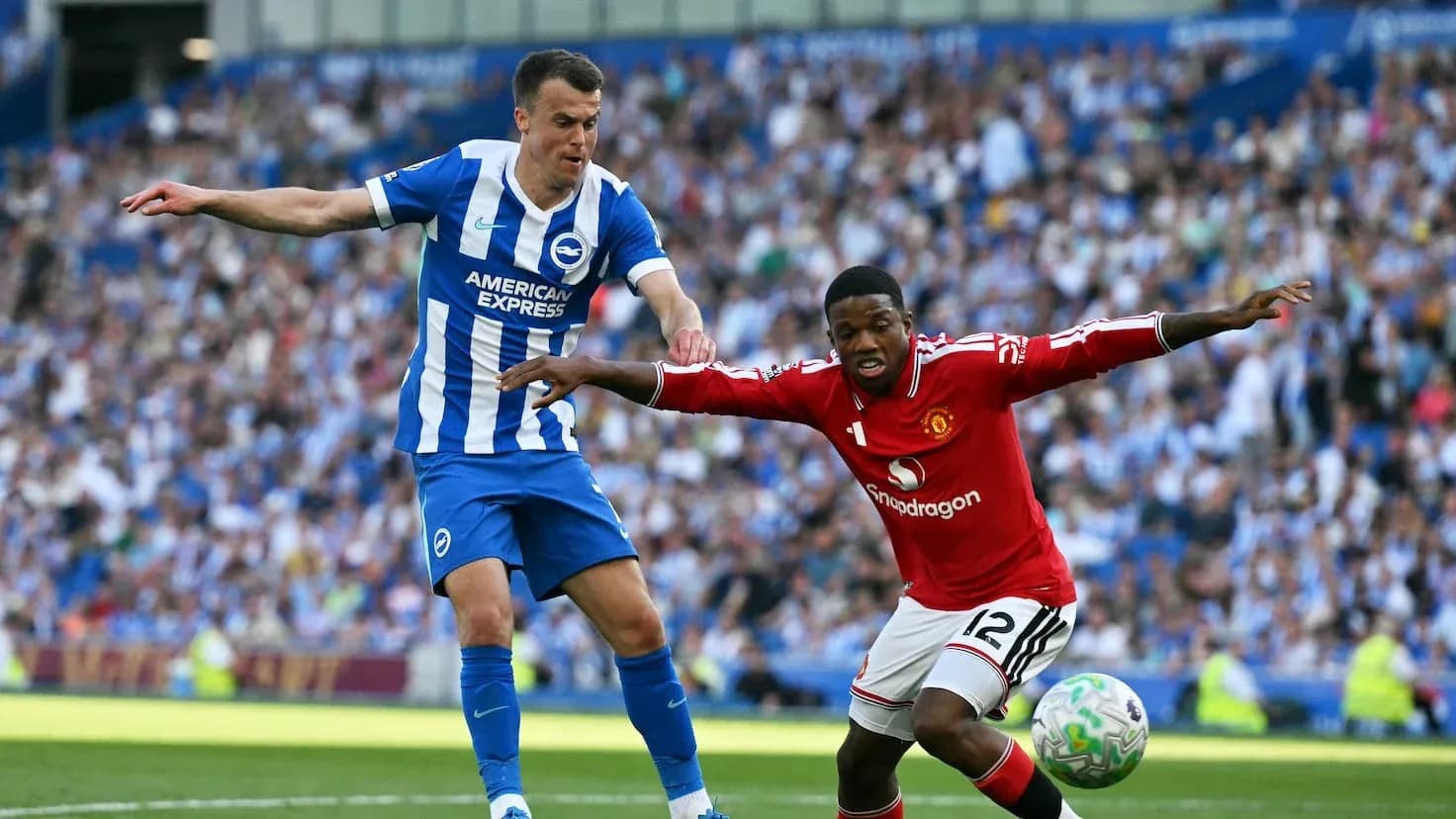
Manchester United's Tactical Masterclass Secures 3-0 Victory Over Brighton
Manchester United’s 3-0 win at Amex Stadium was built on a clear tactical edge in both boxes rather than territorial dominance. Brighton actually edged possession 51–49 and attempted more shots (13–11), but United’s structure in and out of possession turned similar volume into far higher quality chances, reflected in a 1.82–0.81 xG split and a ruthless first-half display that effectively decided the contest.
Both sides lined up in a 4-2-3-1, but the interpretations were markedly different. Brighton, under Fabian Hurzeler, used M. Wieffer and L. Dunk as the main first-phase outlets, with full-backs M. De Cuyper and F. Kadioglu pushing high to pin United’s wide players. P. Gross and J. Milner formed a double pivot that tried to progress through the inside channels, while J. Hinshelwood and D. Gomez supported D. Welbeck between the lines. This produced territorial control and 463 passes (397 accurate, 86%), but much of it was in front of United’s compact block.
Michael Carrick’s United accepted a slightly smaller share of the ball (447 passes, 369 accurate, 83%) in exchange for control of space. The double pivot of M. Mount and Kobbie Mainoo sat narrowly, screening central access into Welbeck and cutting off Brighton’s preferred vertical lanes. Behind them, H. Maguire and L. Martinez held a relatively deep line, inviting Brighton wide and trusting their box defending against crosses and cut-backs. With only 1 blocked shot faced compared to Brighton’s 5, United’s defensive shape consistently forced Brighton into less threatening shot profiles.
In possession, United’s 4-2-3-1 morphed into a flexible 2-3-5. L. Shaw advanced aggressively on the left, with P. Dorgu stepping inside from the nominal left-midfield slot to form a narrow triangle with B. Fernandes and Mount. On the right, N. Mazraoui offered width while A. Diallo drifted into the right half-space. B. Mbeumo stretched Brighton’s back line with runs across the channels, particularly targeting the space between Dunk and Kadioglu. The first goal on 33 minutes encapsulated this: Dorgu attacked the inside-left lane, combining with Fernandes, who provided the assist as Dorgu arrived in the box at the right moment. The pattern was a repeated theme—United overloading the left half-space and finishing from central zones.
Brighton’s inability to control transition moments was decisive. With both full-backs advanced and Gross often stepping higher to link play, rest defence was fragile. When possession was lost, the first counter-pressing wave was too easily bypassed, exposing van Hecke and Dunk to direct runs. The second goal at 44 minutes, finished by Mbeumo from an A. Diallo assist, came from exactly this dynamic: United broke quickly into the vacated space, with Diallo driving at the retreating line and timing the release for Mbeumo’s run.
At 2-0 down by half-time (0-2 in the scoreline), Hurzeler’s adjustments were aggressive but structurally risky. The 46-minute substitution saw Y. Minteh (IN) come on for M. De Cuyper (OUT), pushing Brighton into an even more attacking posture with a winger added to the line. However, this further weakened their rest defence. United punished it almost immediately: at 48 minutes, Fernandes scored the third, assisted by Dorgu, again exploiting the left half-space. VAR confirmed the goal at 50 minutes, but the underlying pattern was clear—United repeatedly found the same seam in Brighton’s structure.
Defensively, United’s discipline and compactness were notable. They committed only 8 fouls to Brighton’s 11 and picked up a single booking: 45+3' Kobbie Mainoo (Manchester United) — Foul. That caution underlined United’s willingness to break up potential Brighton surges through the middle when the structure was briefly compromised. Yet overall, the back four plus double pivot kept Brighton’s central creators at arm’s length, forcing them into wider, lower-value shots; Brighton’s 9 shots inside the box were mostly under pressure and from suboptimal angles.
Goalkeeper usage further underlined the tactical story. B. Verbruggen (Brighton) made 5 saves and, with 0.32 goals prevented, limited the damage from United’s 7 shots on target; without him, the scoreline could have been heavier. His workload reflected how frequently United reached clean finishing positions. At the other end, S. Lammens (Manchester United) faced only 2 shots on target and made 2 saves, a product of the protection in front of him rather than a demanding shot-stopping display.
Brighton’s flurry of triple substitutions on 59 minutes—S. March (IN) for D. Gomez (OUT), C. Baleba (IN) for J. Milner (OUT), and C. Kostoulas (IN) for D. Welbeck (OUT)—aimed to add energy, direct running, and more verticality. Later, G. Rutter (IN) replaced J. Hinshelwood (OUT) at 74 minutes to inject another forward option. These changes tilted Brighton further towards a 4-2-4 in possession, but without altering the core issue: United’s block remained narrow and compact, and Brighton lacked the individual 1v1 breaking power in central areas to destabilise it.
Carrick’s own substitutions at 62 and 74 minutes—S. Lacey (IN) for P. Dorgu (OUT), J. Zirkzee (IN) for Mbeumo (OUT), L. Yoro (IN) for Mazraoui (OUT), and T. Fletcher (IN) for Mount (OUT), followed by T. Malacia (IN) for Shaw (OUT) at 82 minutes—were game-state management. With a 3-0 lead and a superior xG, United shifted to a more conservative posture, freshening legs in midfield and full-back to maintain defensive intensity and prevent late Brighton pressure from turning into high-quality chances.
Statistically, the verdict reinforces the tactical picture. Brighton’s 13 shots and marginal possession edge suggest competitiveness, but the 0.81 xG and only 2 shots on target indicate sterile dominance. United, with fewer shots, generated 1.82 xG and 7 shots on target, a sign of clearer patterns and better exploitation of space. Brighton’s 5 blocked shots show United’s back line and midfield reacting quickly to close shooting lanes, while United’s single blocked effort highlights how clean their looks were once they broke through. With both goalkeepers posting 0.32 goals prevented, the difference lay not in shot-stopping but in structural control: United consistently engineered high-value opportunities and denied Brighton the same, turning a fairly balanced possession game into a decisive 0-3 away win.