Manchester City vs Aston Villa: Tactical Analysis of the 1-2 Defeat
Manchester City’s 1-2 defeat to Aston Villa at Etihad Stadium was defined less by volume of possession or shots and more by Villa’s structural clarity and efficiency in key transition moments. Pep Guardiola’s 4-2-2-2, with J. Trafford in goal, tried to dominate through a double pivot and two narrow attacking midfielders, while Unai Emery’s 4-2-3-1, anchored by M. Bizot in goal, prioritised compactness, verticality, and the direct threat of O. Watkins.
City’s build-up featured R. Dias and J. Stones as the central launch points, with N. Ake and R. Lewis providing the width from the back line. In front, Nico and B. Silva formed a relatively flat double pivot, tasked with both circulation and protection against Villa counters. Ahead of them, A. Semenyo and Savinho operated as narrow attacking midfielders, trying to overload the half-spaces and connect with a front pair of P. Foden and T. Reijnders.
The structure initially worked. City’s 52% possession and 458 total passes (405 accurate, 88%) reflect a side largely in control of territory. Their 16 total shots, including 10 inside the box and 6 blocked, show they were able to reach dangerous zones, but the lack of clean finishing and Villa’s last-line interventions kept the shot quality down. A. Semenyo’s 23rd-minute goal, a “Normal Goal” for Manchester City, came from this positional dominance: City pinned Villa back, and Semenyo attacked space from midfield to give the hosts a 1-0 platform.
Villa, however, were never structurally broken. The double pivot of L. Bogarde and Douglas Luiz screened the back four intelligently, while the full-backs A. Garcia and I. Maatsen balanced their positioning, rarely both advancing at the same time. Ahead of them, L. Bailey, R. Barkley, and E. Buendia supported O. Watkins with clear transition lanes. Villa accepted a marginal possession deficit (48%) but were cleaner with the ball: 436 passes, 394 accurate at 90%, signalling composure under pressure and well-drilled exit routes.
Turning Point
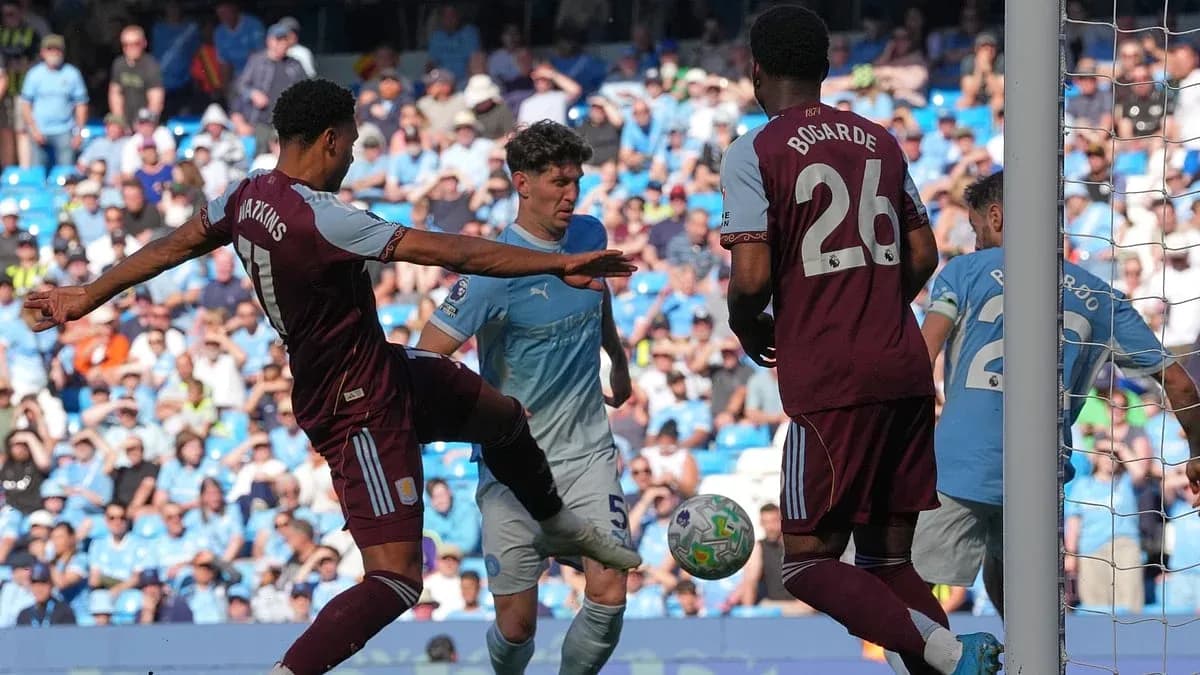
The turning point came immediately after half-time. Emery’s first adjustment was at right-back: M. Cash (IN) came on for A. Garcia (OUT) at 46', adding more athleticism and aggression on the flank. Within a minute, O. Watkins struck a “Normal Goal” for Aston Villa at 47', punishing City’s rest defence. City’s 4-2-2-2, with both full-backs advanced and the double pivot stretched, left space for direct play into Watkins, who exploited the channels between centre-back and full-back.
Guardiola responded with a double change on the hour: R. Cherki (IN) for A. Semenyo (OUT) at 58' and M. Kovacic (IN) for B. Silva (OUT) at 59'. The intention was clear: fresh creativity between the lines and more progression from deep. Yet Villa’s second major blow arrived before these adjustments could fully settle. At 61', Watkins again finished a “Normal Goal” for Aston Villa, this time assisted by R. Barkley, who had found a pocket between City’s lines. The move was emblematic of Villa’s plan: win the ball, find Barkley or Buendia between the lines, then release Watkins early. VAR confirmed the goal at 63', underlining the clinical nature of Villa’s transitions.
Control of Central Spaces
From there, Emery tightened control of central spaces. A triple substitution at 73' — Y. Tielemans (IN) for Douglas Luiz (OUT), P. Torres (IN) for V. Lindelof (OUT), and A. Onana (IN) for L. Bogarde (OUT) — rebalanced the team. Tielemans added composure in possession, Torres gave more assured distribution from the back, and Onana refreshed the legs in midfield. Villa’s 12 total shots (9 inside the box) show that, even while defending deeper for stretches, they consistently turned regains into high-value chances.
City’s late wave of substitutions at 77' and 78' — J. Doku (IN) for T. Reijnders (OUT), R. Ait-Nouri (IN) for N. Ake (OUT), and J. Gvardiol (IN) for J. Stones (OUT) — reshaped the back line and added 1v1 threat wide. Doku’s introduction tilted the game towards the right flank, with Savinho and Cherki trying to exploit half-spaces. However, Villa’s defensive block, now with Torres and a refreshed midfield, absorbed pressure effectively.
Goalkeeping Performances
Defensively, both goalkeepers were decisive within their frameworks. J. Trafford (Manchester City) made 3 saves and, according to the statistics, contributed 0.28 goals prevented, reflecting some important interventions even as he conceded twice. M. Bizot (Aston Villa) registered 2 saves and also 0.28 goals prevented, underlining his role in protecting the lead when City ramped up pressure, especially as shots began to arrive more frequently from inside the area.
Discipline and Expected Goals
Discipline subtly shaped the closing stages. Rico Lewis (Manchester City) received the game’s only card at 82' — a Yellow Card for “Foul” — as City pushed higher and risked more aggressive counter-pressing to recover the deficit. That single caution underscores how Villa managed to defend with structure rather than desperation, avoiding bookings entirely.
The expected goals data confirms the tactical story. City’s xG of 1.25 against Villa’s 1.58 shows that, despite more total shots and marginally higher possession, City did not consistently manufacture better chances than Villa. Villa’s attacks were fewer but sharper, aligning with their transition-focused 4-2-3-1. City’s 6 blocked shots highlight Villa’s commitment to last-ditch defending inside their own box, while Villa’s 2 blocked efforts show they still forced City’s back line into emergency interventions.
A late twist nearly changed the narrative: at 90+2', a potential goal by Phil Foden for Manchester City was disallowed after a VAR review, preserving the 1-2 scoreline. That moment encapsulated City’s afternoon — territorial dominance, structural reshuffles, and late pressure — but ultimately insufficient clarity in both boxes against an Aston Villa side whose tactical discipline, vertical threat, and in-game adjustments were better aligned with the demands of the contest.