Getafe's Tactical Masterclass in 3-1 Victory Over Mallorca
Getafe’s 3-1 win over Mallorca at Coliseum was a clinic in structural clarity: a compact 5-3-2 that maximised territory and penalty-box presence despite conceding 60% possession. The match state – 2-0 by 41' and 3-0 by 63' – allowed José Bordalás Jiménez’s side to lean into their defensive identity and counter-attacking punch, while Mallorca’s 4-2-3-1 spent long stretches circulating the ball in front of a low block without consistently breaking its last line.
The scoring pattern explains the tactical story. At 14', M. Satriano (Getafe) struck first, finishing a move created by the right wing-back: Allan Nyom overlapped aggressively from the 5-3-2’s wide lane, and his delivery found Satriano for 1-0. The mechanism was clear – Getafe’s wing-backs pushed high on early transitions, turning a back five into a front three and attacking the space outside Mallorca’s full-backs.
By 41', Satriano had doubled the lead with another “Normal Goal”, this time unassisted, but again rooted in direct play rather than long passing sequences. With only 6 total shots (4 on goal), Getafe’s xG of 1.62 underlines how selectively they attacked: when they did enter the box (5 of 6 shots inside), they did so with numbers and high-quality positions. The 2-0 half-time score, despite Getafe’s 40% possession, reflected a game where Mallorca’s control was largely sterile.
Defensive Structure
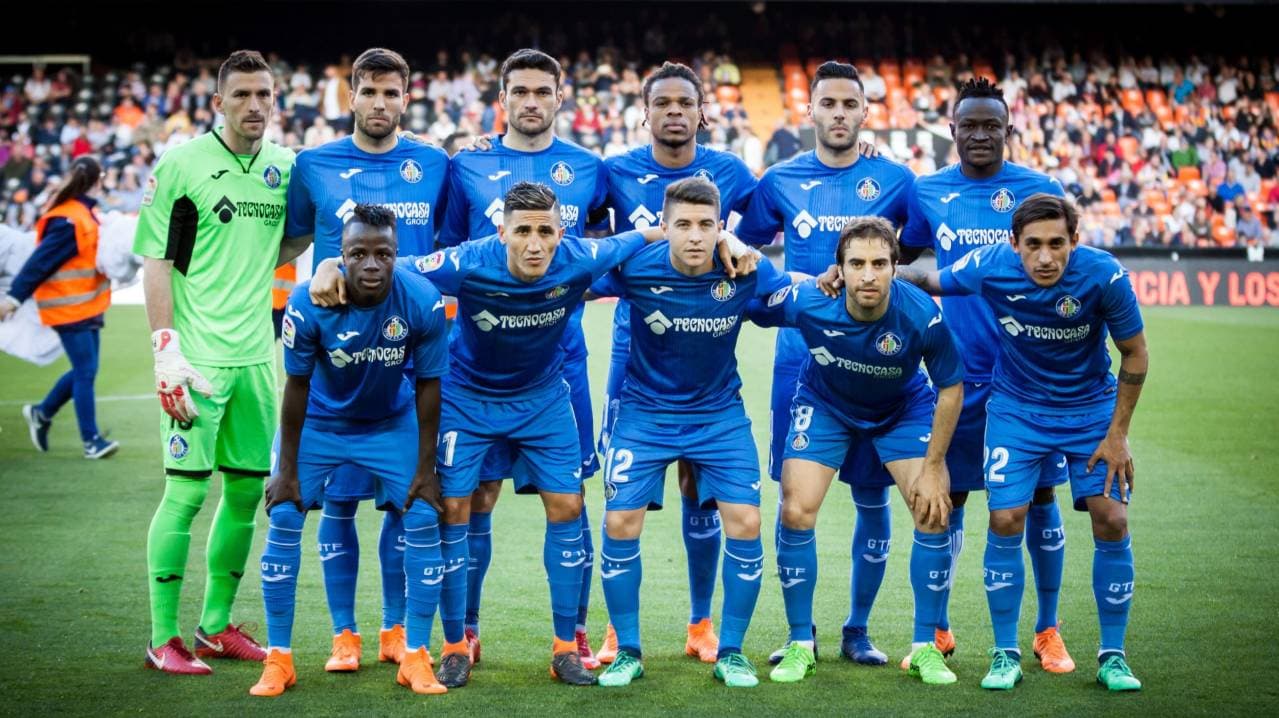
Defensively, Getafe’s 5-3-2 was built around central density. The back three of Djene, Domingos Duarte and Z. Romero stayed narrow, with Juan Iglesias and Nyom initially pinning Mallorca’s wingers and full-backs wide. The midfield trio of L. Milla, D. Caceres and M. Arambarri screened the half-spaces, repeatedly forcing Mallorca’s No. 10 S. Darder and striker V. Muriqi to receive with their backs to goal. Mallorca finished with 9 shots but only 2 on target and an xG of 0.39, which speaks to how rarely they were allowed clean looks from central zones.
The third Getafe goal at 63' was the purest expression of their structure. Z. Romero, stepping from the left of the back three, scored after a set or second-phase action, assisted by L. Milla. That a centre-back could arrive to finish while the team remained defensively secure shows how well-drilled the rest defence was: the remaining defenders and midfielders were positioned to immediately collapse on any loss of possession.
Personnel Adjustments
From there, Bordalás adjusted the personnel but not the principles. At 64', Davinchi (IN) came on for Allan Nyom (OUT), maintaining the right flank’s work rate and defensive coverage in the wing-back channel. At 71', S. Boselli (IN) replaced Djene (OUT), a like-for-like change in the back line to preserve the integrity of the back three without altering the shape. Mario Martín, already a starter in the front line, later picked up a booking but continued to work between the lines as a pressing trigger rather than a classic playmaker.
Mallorca’s changes were more aggressive but arrived from a position of scoreboard weakness. At 46', P. Torre (IN) came on for Z. Luvumbo (OUT), shifting the attacking midfield profile from a direct runner to a more associative left-sided creator. That change paid off partially at 65', when O. Mascarell scored for Mallorca, assisted by P. Torre, for 3-1. It was one of the rare moments when Mallorca managed to connect central progression with a late-arriving midfielder, exploiting a brief lapse in Getafe’s compactness after their own substitution sequence.
Further attacking substitutions at 66' – T. Asano (IN) for J. Virgili (OUT) and Antonio Sánchez (IN) for S. Darder (OUT) – were designed to inject pace and verticality. Later, at 79', A. Prats (IN) replaced M. Morlanes (OUT), effectively tilting the 4-2-3-1 toward a more forward-heavy, risk-on structure. Yet the underlying problem persisted: Getafe’s block forced Mallorca wide and into crosses or low-value shots, and the visitors’ 493 passes (406 accurate, 82%) rarely translated into destabilising actions between the lines.
Goalkeeping Performance
In goal, D. Soria had a relatively quiet but telling evening: just 1 save recorded, aligned with Mallorca’s low on-target output. The negative goals prevented figure for Getafe’s goalkeeping stats (-0.93) suggests that the single goal conceded slightly outperformed the shot’s xG, but the defensive unit in front of him largely kept danger at arm’s length. For Mallorca, L. Roman also made only 1 save, which underlines how ruthlessly efficient Getafe were: 4 shots on target, 3 goals, and an xG that they significantly overperformed.
Discipline Profile
The discipline profile reinforced the tactical intensity. Getafe committed 17 fouls and took 3 yellow cards, all for “Foul”: Domingos Duarte at 78', Davinchi at 80', and Mario Martín at 86'. These bookings reflected a deliberate willingness to break up transitions and protect the box, especially once the lead was established. Mallorca, with 18 fouls and 4 yellow cards (Omar Mascarell 31', Pablo Maffeo 43', Pablo Torre 74', Antonio Sánchez 81', all for “Foul”), mirrored that physical edge but without the same territorial payoff.
Statistically, the contrast is stark: Mallorca’s 60% possession, higher passing volume and 82% accuracy point to overall form in terms of ball circulation, but Getafe’s defensive index was superior – fewer shots conceded on target, better box protection, and more dangerous chances created per attack. Getafe’s 314 passes (225 accurate, 72%) were functional rather than decorative, used to spring the front two and wing-backs into space rather than to dominate the ball.
In synthesis, this was a match where structure beat control. Getafe’s 5-3-2, anchored by disciplined spacing and targeted wing-back surges, converted limited attacking volume into decisive goals. Mallorca’s 4-2-3-1 produced possession and passing metrics but struggled to translate them into high-quality chances against a low block that rarely broke shape, leaving the 3-1 scoreline a faithful reflection of the tactical balance.