Espanyol's Tactical Mastery Leads to 2-0 Victory Over Athletic Club
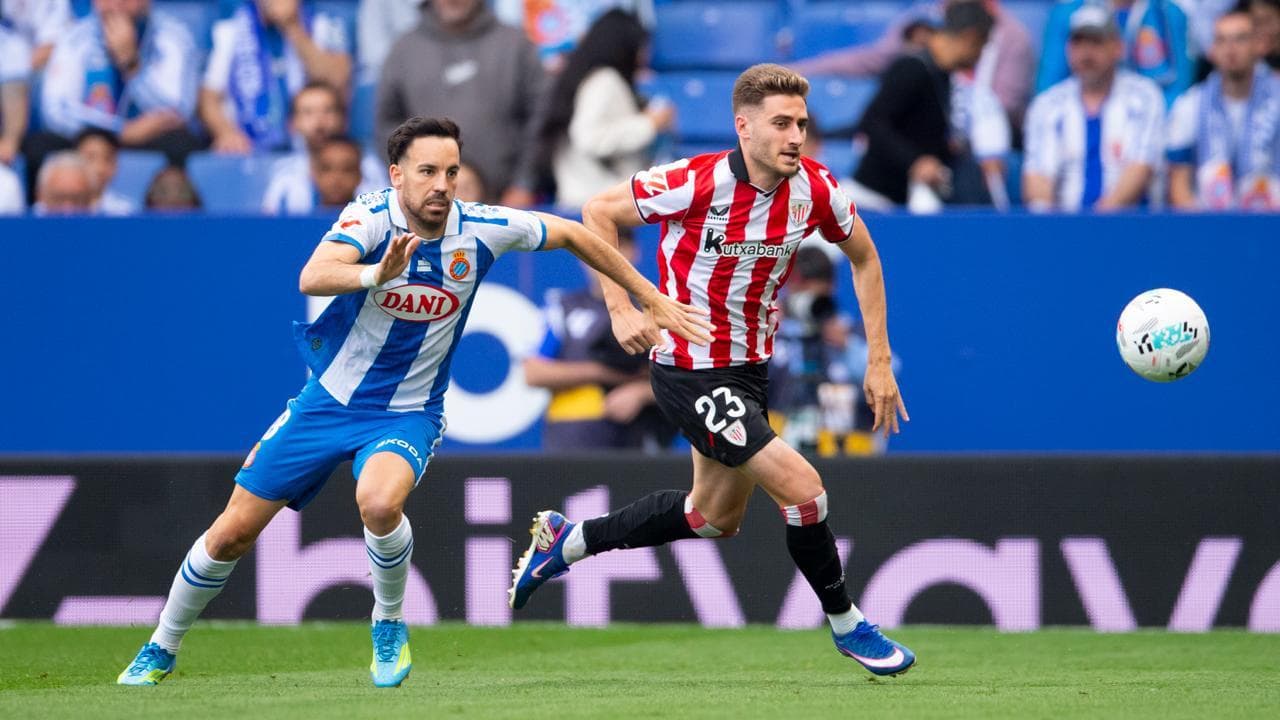
Espanyol’s 2-0 win over Athletic Club at RCDE Stadium was built on structural control rather than sheer chance creation. In a La Liga match where both sides posted similar xG (Espanyol 0.76, Athletic Club 0.82), Manolo Gonzalez’s 4-4-2 imposed the rhythm, using possession and field position to suffocate Ernesto Valverde’s 4-2-3-1 and then punish a tiring back line after the hour.
Espanyol’s base shape was a classic 4-4-2: M. Dmitrovic behind a back four of O. El Hilali, C. Riedel, L. Cabrera and C. Romero, with a midfield band of R. Sanchez, U. Gonzalez, P. Lozano and A. Roca supporting the front pair Exposito and R. Fernandez Jaen. The structure was compact and horizontally tight, designed to deny space between the lines to I. Williams and the three attacking midfielders.
Athletic Club’s 4-2-3-1 had U. Simon in goal, a back four of J. Areso, D. Vivian, A. Laporte and A. Boiro, a double pivot of I. Ruiz de Galarreta and A. Rego, with A. Berenguer, U. Gomez and R. Navarro behind lone striker I. Williams. On paper this offered more vertical connections, but in practice the visitors were often forced to play into crowded central zones and then recycle backwards.
The raw numbers underline Espanyol’s territorial dominance: 63% possession, 492 passes to Athletic Club’s 273, and a clear technical edge in circulation (386 accurate passes at 78% versus Athletic Club’s 180 at 66%). Espanyol’s back four and double pivot used short, secure passing to progress, rather than forcing vertical balls. The full-backs, especially O. El Hilali, stepped into midfield to create temporary three-versus-two overloads against the visiting double pivot, helping Espanyol to keep the ball in the opposition half and pin the Basque side back.
Despite that control, chance quality remained modest for both sides. Espanyol produced 12 total shots (5 on target), with a fairly balanced shot map: 7 from inside the box and 5 from outside. That distribution reflects a patient approach that still had to rely on low-to-medium value looks rather than repeated clear one-on-ones. Athletic Club actually generated 10 shots inside the box out of 11 attempts, but often from suboptimal angles or under pressure, which is consistent with their slightly higher xG (0.82) but lack of goals.
Defensively, Espanyol’s line management was decisive. The centre-backs Riedel and Cabrera held a relatively high block but rarely allowed I. Williams to isolate them in transition. The 4-4-2 flattened quickly without the ball, with the wide midfielders dropping to form a second line of four that screened passes into A. Berenguer and U. Gomez. Athletic Club’s 9 corner kicks to Espanyol’s 8 show the visitors did reach the final third, but Espanyol defended their box aggressively, limiting clean headers and second-ball shots.
In goal, the data paints an interesting picture. Dmitrovic made 4 saves, slightly more than U. Simon’s 3, yet Espanyol’s goals prevented figure sits at -0.9, indicating that Dmitrovic marginally underperformed the post-shot xG he faced. The same -0.9 for Athletic Club’s goalkeeper suggests U. Simon also conceded more than the shot quality strictly warranted. In tactical terms, that means both keepers were exposed to a small number of relatively dangerous efforts; Espanyol simply converted theirs, while Athletic Club did not.
The match turned decisively on Gonzalez’s use of the bench. At 63', he reshaped the attacking structure: P. Milla (IN) came on for A. Roca (OUT), and Jofre (IN) came on for R. Sanchez (OUT). Those changes injected vertical running and more direct occupation of the half-spaces. Almost immediately, Espanyol’s 4-4-2 morphed into something closer to a 4-2-3-1 in possession, with P. Lozano and U. Gonzalez deeper and P. Milla and Jofre operating between the lines.
The opening goal at 69' was the product of this renewed dynamism and Romero’s proactive full-back play. P. Milla (Espanyol) scored, assisted by C. Romero, capitalising on Espanyol’s sustained territorial pressure and the visitors’ difficulty in resetting their defensive line after the triple substitution wave on both sides around the hour mark. Athletic Club had just altered their own structure with Y. Alvarez (IN) for D. Vivian (OUT), G. Guruzeta (IN) for I. Williams (OUT) and M. Jauregizar (IN) for I. Ruiz de Galarreta (OUT), moves that shifted them towards a more attacking posture but briefly destabilised their defensive coordination.
Valverde’s subsequent changes — A. Gorosabel (IN) for J. Areso (OUT) at 71' and N. Serrano (IN) for U. Gomez (OUT) at 78' — were attempts to refresh the right flank and add penetration, but they did not significantly alter the pattern. Athletic Club maintained their shot volume (4 on target from 11 total) but could not tilt the territorial balance or press Espanyol into errors high up the pitch.
Gonzalez then managed the final phase astutely. At 84', R. Terrats (IN) came on for Exposito (OUT) and K. Garcia (IN) for R. Fernandez Jaen (OUT), trading a pure striker for an extra midfielder and a fresh forward. That adjustment further solidified central control while keeping a direct threat in behind. At 90+1', C. Pickel (IN) replaced U. Gonzalez (OUT), adding fresh legs in midfield to protect the lead.
The second goal at 90' encapsulated Espanyol’s game plan and bench impact: K. Garcia (Espanyol) scored, assisted by R. Terrats. Two substitutes combined, exploiting an Athletic Club side forced to commit men forward and now more stretched between the lines. With Espanyol still composed in possession and Athletic Club’s press fragmented, the home side found the spaces they had been patiently probing for all evening.
Discipline-wise, the absence of recorded yellow or red cards — despite 9 fouls by Espanyol and 14 by Athletic Club — suggests a match that was physically competitive but tactically controlled, with few reckless interventions in key zones. That suited Espanyol, who benefited from continuity in their defensive structure and from not having to adjust to bookings in the back line or double pivot.
Statistically, the verdict is of a match where the scoreline (Espanyol 2-0 Athletic Club) slightly flatters the hosts relative to pure chance quality, but accurately reflects their strategic superiority. Espanyol’s higher possession, passing volume and accuracy, plus an 8-9 corner count that stayed competitive despite ceding some box entries, show a team that dictated tempo and territory. Athletic Club’s marginal xG edge and higher number of shots inside the box highlight that they did find moments, but their attacks were too episodic and too reliant on individual actions rather than sustained positional dominance.
In synthesis, Espanyol won this game through structural clarity, intelligent in-game management from Manolo Gonzalez, and the decisive contributions of substitutes, turning a balanced xG contest into a controlled 2-0 result at RCDE Stadium.