Villarreal vs Sevilla: Tactical Analysis of 2-3 Defeat
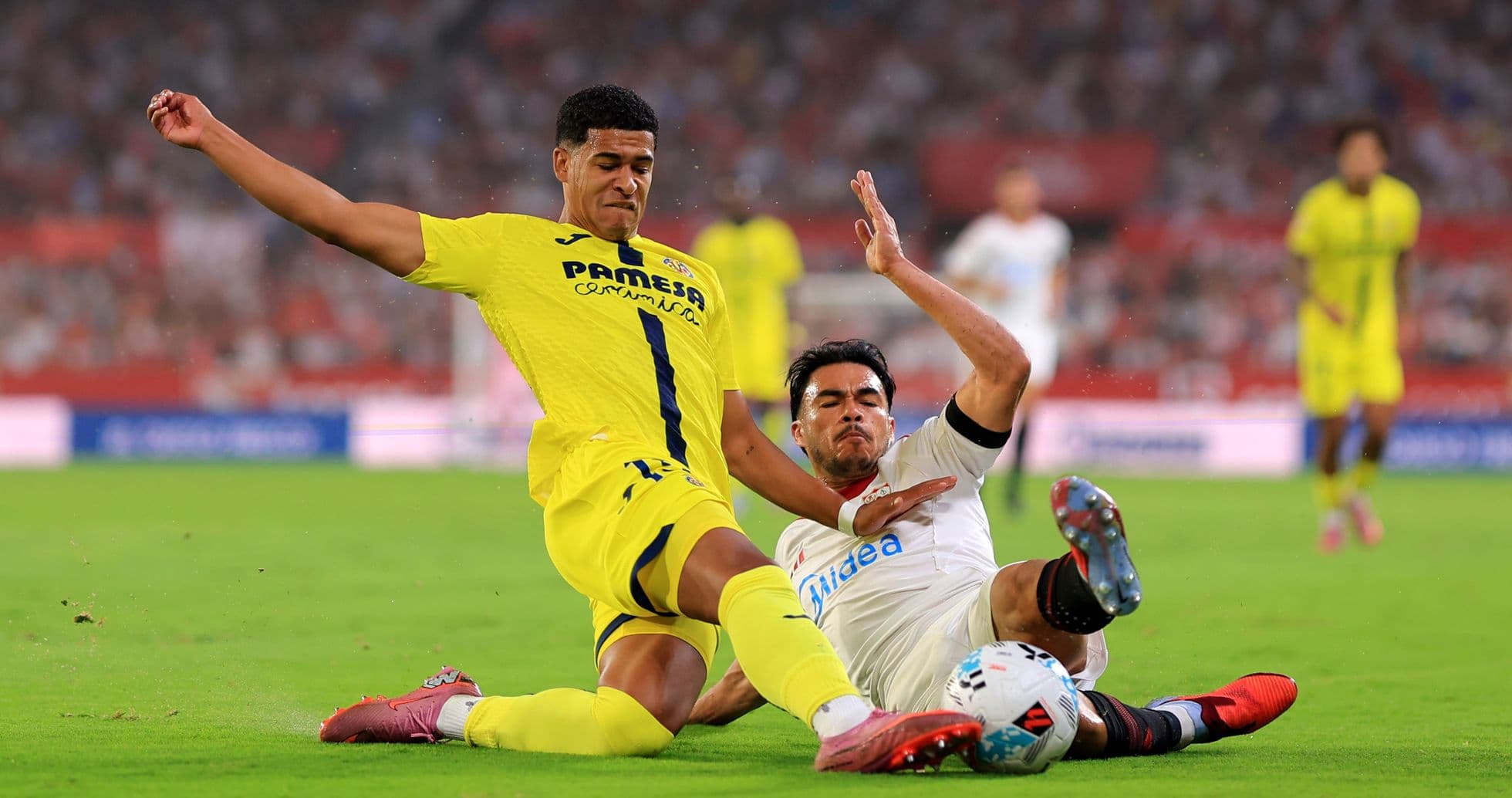
Villarreal’s 2-3 home defeat to Sevilla at Estadio de la Ceramica unfolded as a clash of contrasting structures and game plans. Marcelino’s 4-4-2 imposed territorial and possession control, but Luis Garcia Plaza’s 5-3-2 absorbed pressure, attacked efficiently in transition, and ultimately punished Villarreal’s structural fragilities, particularly after the break.
Executive Summary
Across 90 minutes, Villarreal dominated the ball (63% possession), circulated it with a high passing tempo (554 passes, 499 accurate, 90%), and created a steady but not overwhelming stream of chances (6 total shots, 4 on goal, xG 0.81). Sevilla, with only 37% of the ball and a more direct approach (325 passes, 276 accurate, 85%), generated more volume and threat in the final third (13 total shots, 5 on goal, xG 0.88). The match was level 2-2 at half-time before Sevilla’s structural tweaks and clinical transitions delivered the decisive 72nd-minute winner.
Scoring Sequence & Disciplinary Log
The match’s tactical story is anchored in three Sevilla goals and two Villarreal strikes, all arriving in distinct game states:
- 13' Gerard Moreno (Villarreal) — assisted by Georges Mikautadze Villarreal’s 4-4-2 began aggressively. Moreno, dropping between Sevilla’s midfield and back five, combined with Mikautadze. The Georgian’s movement off the front line pulled a central defender out, and his assist allowed Moreno to finish, exploiting the early disorganization in Sevilla’s back line.
- 20' Georges Mikautadze (Villarreal) — assisted by Alberto Moleiro Villarreal’s wide midfielders were key. Moleiro, operating from the left half-space, found Mikautadze between the lines. Sevilla’s wing-back line was pinned, and the back three were slow to step out. Mikautadze’s goal reflected Villarreal’s early superiority in positional play and their ability to progress centrally.
- 36' Oso (Sevilla) — assisted by Lucien Agoume Sevilla’s response came from exploiting wide and second-ball situations. With Villarreal’s full-backs high, Sevilla advanced via Agoume in midfield. Oso, starting as the left-sided defender in the back five, stepped aggressively into the half-space to join the attack, finishing after Agoume’s service. It underlined Sevilla’s willingness to break their nominal defensive line to overload zones.
- 45' Kike Salas (Sevilla) — assisted by Roberto Vargas Just before half-time, Sevilla leveled. A set-piece or wide delivery situation (via Vargas) found Salas, one of the central defenders, attacking the box. Villarreal’s zonal structure and marking of Sevilla’s centre-backs were exposed, as Salas converted to make it 2-2 at the interval.
- 72' Amadou Adams (Sevilla) — assisted by Djibril Sow The winner encapsulated Sevilla’s second-half plan: transition and verticality. After Villarreal’s double change on the hour, Sow found space to progress play and feed Adams. The forward’s movement into the channels against a stretched back four created the angle to score Sevilla’s third.
Disciplinary log (all cards, in chronological order):
- 81' Ayoze Pérez (Villarreal) — Foul
- 90+2' Renato Veiga (Villarreal) — Foul
- 90+3' José Ángel Carmona (Sevilla) — Time wasting
Totals: Villarreal 2 yellow cards, Sevilla 1 yellow card, overall 3 cards.
Tactical Breakdown & Personnel
Marcelino’s 4-4-2
Villarreal’s structure was classic Marcelino: A. Tenas in goal behind a back four of A. Pedraza, Renato Veiga, P. Navarro and A. Freeman; a midfield line of Alberto Moleiro, P. Gueye, Dani Parejo and Nicolas Pepe; and a front two of Gerard Moreno and Georges Mikautadze.
In possession, Villarreal built with a 2-4 base: full-backs advanced, Parejo and P. Gueye operated as central pivots, and Moleiro plus Pepe inverted to occupy half-spaces. Moreno dropped between lines, while Mikautadze stretched depth. This framework produced their early two goals and sustained pressure: 6 total shots, 4 on target, and 6 corners. Their passing rhythm (554 passes, 90% accuracy) reflects dominance of territory and circulation, but the relatively low xG of 0.81 indicates that Sevilla successfully limited Villarreal’s access to premium shooting zones.
Out of possession, the front two pressed Sevilla’s first line, with the wingers jumping to wing-backs and the central midfielders trying to screen passes into Sow and Agoume. However, the high positioning of full-backs and the aggressive pressing left large spaces behind the line, particularly for Sevilla’s defenders stepping out (Oso, Salas) and for forwards attacking in transition. Villarreal conceded 13 shots despite their possession share, a sign of structural vulnerability when their press was broken.
A. Tenas registered 2 goalkeeper saves, with goals prevented at -0.22, suggesting he slightly underperformed against the quality of chances faced. The combination of modest shot volume faced but three goals conceded underlines how clean Sevilla’s chances were when they arrived.
Key substitutions:
- 60' Thomas Partey (IN) came on for P. Gueye (OUT)
- 60' Tajon Buchanan (IN) came on for N. Pepe (OUT)
- 70' S. Comesana (IN) came on for D. Parejo (OUT)
- 70' Ayoze Pérez (IN) came on for G. Mikautadze (OUT)
These changes shifted Villarreal towards a more control-oriented midfield (Partey, S. Comesana) and more direct wide threat (Buchanan, Ayoze Pérez). Yet, by removing Mikautadze and Parejo, Villarreal lost some of their best connectors between midfield and attack. The team became more cross-oriented and less precise in central combinations, which Sevilla’s compact 5-3-2 handled better.
Luis Garcia Plaza’s 5-3-2
Sevilla lined up with O. Vlachodimos in goal; a back five of Oso, G. Suazo, K. Salas, C. Azpilicueta and José Ángel Carmona; a midfield trio of D. Sow, L. Agoume and R. Vargas; and a front two of N. Maupay and Amadou Adams.
Defensively, the 5-3-2 compressed central lanes, conceding wide zones to Villarreal but protecting the box. The wing-backs matched Villarreal’s wide midfielders, while the three centre-backs plus the nearest midfielder tracked Moreno’s drops and Mikautadze’s runs. Sevilla committed only 9 Fouls and received 1 yellow card, indicating a controlled, positional defensive display rather than a reactive or reckless one.
In transition, Sow and Agoume were crucial. They provided the first vertical pass after regain, often targeting Adams’ runs or using Vargas as a wide outlet. Sevilla’s 13 shots, 5 on goal, and xG of 0.88, despite only 37% possession, show how effective their counter-attacking and set-piece routines were. Salas and Oso scoring from advanced positions highlight the fluidity of their back five, with defenders stepping into attacking roles when space opened.
Vlachodimos faced 4 shots on target and made 1 save, with goals prevented at -0.22, mirroring Tenas’ underperformance figure. However, the defensive block in front of him limited Villarreal to few truly clear chances after the early storm.
Key substitutions for Sevilla:
- 68' J. Sanchez (IN) came on for R. Vargas (OUT)
- 72' A. Sanchez (IN) came on for N. Maupay (OUT)
- 86' N. Gudelj (IN) came on for D. Sow (OUT)
- 86' Castrin (IN) came on for A. Adams (OUT)
After taking the lead, these changes rebalanced the side: fresh legs in midfield (J. Sanchez, N. Gudelj) to protect central zones and an additional defender (Castrin) to reinforce the back line, while A. Sanchez offered an outlet for clearances. Sevilla’s late “Time wasting” yellow for José Ángel Carmona at 90+3' reflects their game management phase once the tactical battle had tilted in their favor.
The Statistical Verdict
The raw numbers confirm the tactical narrative: Villarreal controlled the ball but not the game. Their 63% possession, 554 passes at 90% accuracy, and 6 shots (4 on target, xG 0.81) describe a side that circulated well but struggled to convert territory into high-value chances, especially after the first 25 minutes. Their 11 Fouls and 2 yellow cards (both for Foul) reflect a team occasionally forced into recovery actions once transitions were lost.
Sevilla, with 37% possession and 325 passes at 85% accuracy, embraced a low-block and transition model. Generating 13 shots, 5 on target, and a slightly higher xG of 0.88, they extracted more attacking value from fewer phases of possession. Their 9 Fouls and a single yellow card for Time wasting show a disciplined, structurally sound defensive performance rather than one reliant on disruption.
Goalkeeper metrics are revealing: both A. Tenas and O. Vlachodimos posted goals prevented of -0.22, hinting that each conceded marginally more than the shot quality suggested. Yet, the decisive factor was not goalkeeping but structure: Sevilla’s 5-3-2 adapted over the 90 minutes, while Villarreal’s 4-4-2 lost central control after substitutions and never fully rebalanced against Sevilla’s increasingly confident transitions.