Alaves' Tactical Masterclass in 1-0 Victory Over Barcelona
Alaves’ 1-0 win over Barcelona at Estadio Mendizorrotza was a study in extreme defensive control and strategic sacrifice of the ball. In a La Liga fixture where Barcelona owned 77% possession and attempted 676 passes, Quique Sanchez Flores’ side leaned fully into a 5-3-2 block, compressing the central lane and daring Hansi Flick’s team to solve them from wide or long range. Barcelona never did, failing to register a single shot on target despite eight total attempts and four efforts from outside the box.
Decisive Tactical Moment
The match’s decisive tactical moment came right on the edge of half-time. In the 45th minute, Alaves executed one of their few structured forays from deep. With the back five intact, the midfield three stepped up in unison, and A. Blanco broke a line with a vertical contribution that found I. Diabate between Barcelona’s centre-backs. Diabate’s finish for 1-0 rewarded Alaves’ insistence on attacking quickly and directly once they had lured Barcelona’s block high. It also allowed them to reset after the break into an even more conservative version of the 5-3-2, with the wing-backs dropping almost level with the central defenders.
Barcelona's Structure
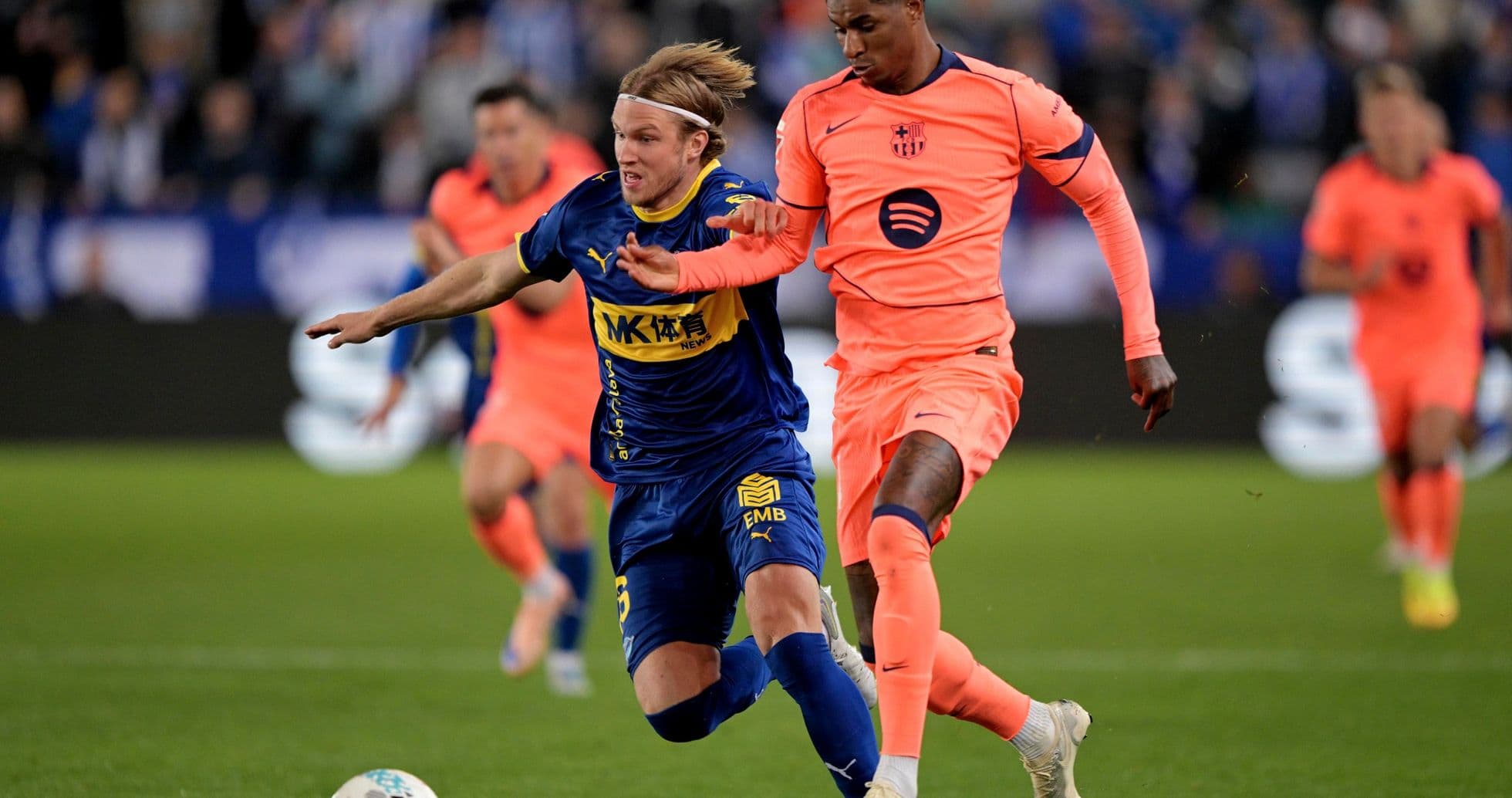
From there, the game became about Barcelona’s structure against a settled low block. Flick’s 4-2-3-1 had clear possession principles: J. Kounde and A. Balde (before his 79th-minute substitution, when J. Cancelo came in and Kounde slid more centrally in build-up) held width, M. Casado and M. Bernal formed a double pivot, and the band of three – R. Bardghji, D. Olmo, M. Rashford – rotated behind R. Lewandowski. On paper, this should have created overloads between the lines. In practice, Alaves’ back five plus the narrow midfield three denied access into the central pocket.
Alaves’ front two, T. Martinez and I. Diabate, were less about pressing triggers and more about screening. They allowed Barcelona’s centre-backs and pivots to circulate the ball but blocked vertical passes into Olmo and Lewandowski. When the ball went wide, the outside centre-backs – N. Tenaglia and A. Perez – stepped out aggressively, supported by wing-backs V. Parada and A. Rebbach, turning potential one‑v‑ones into 2‑v‑1 or 3‑v‑2 situations. The statistical profile underscores this: Barcelona managed eight shots, but none on goal, and only four inside the box. Alaves’ compactness forced rushed or low-percentage attempts.
Substitutions and Tactical Storyline
The substitutions reinforced the tactical storyline rather than changing it. On 62 minutes, Flick made a triple change: F. Torres (IN) came on for R. Bardghji (OUT), Pedri (IN) came on for M. Casado (OUT), and X. Espart (IN) came on for P. Cubarsi (OUT). Pedri’s introduction was meant to add line-breaking passing and late box entries from midfield, while Torres offered more direct wing threat. Structurally, this tilted Barcelona even more towards a 2-3-5 in possession, with Bernal often anchoring alone and full-backs high. Yet Alaves’ block held, and the passing statistics tell the story: Barcelona completed 605 of 676 passes (89%), but these were largely in front of the Alaves block, not through it.
Alaves’ own use of the ball was minimal but purposeful. They attempted only 190 passes, completing 112 (59%). The low volume and accuracy reflect a deliberate risk profile: clear first, play forward early second, and accept a high turnover rate if it meant pushing Barcelona back 30–40 metres. Their nine total shots, seven inside the box, show that when they did break, they created relatively clean looks compared with Barcelona’s sterile dominance. The xG figures support this balance: Alaves at 0.66 xG versus Barcelona’s 0.59, despite the visitors’ territorial control.
Second-Half Substitutions
The second-half substitutions from Sanchez Flores were clearly about energy and maintaining the integrity of the block. At 64 minutes, A. Manas (IN) came on for I. Diabate (OUT), and P. Ibanez (IN) came on for D. Suarez (OUT), freshening the front line and midfield legs for pressing and recovery runs. At 80 minutes, C. Protesoni (IN) came on for V. Parada (OUT), ensuring that the left side of the back five retained intensity in wide duels as Barcelona pushed more crosses and switches. The single Alaves yellow card – 81' Abderrahman Rebbach (Alaves) — Persistent fouling – captures the tactical edge of their defending: repeated, controlled infringements to break rhythm rather than reckless challenges.
Barcelona's Disciplinary Record
Barcelona’s disciplinary record also mirrored their frustration. They collected two yellow cards: 46' Marcus Rashford (Barcelona) — Foul and 89' Joao Cancelo (Barcelona) — Foul. Both came in phases where Barcelona were either reacting to transitions or trying to regain the ball quickly after turnovers, underscoring how rarely they could convert possession into stable counterpressing situations in the Alaves half.
Statistical Verdict
From a statistical verdict, this was a classic low-block upset grounded in defensive execution rather than goalkeeper heroics. Alaves’ goalkeeper A. Sivera was officially credited with 0 Goalkeeper Saves, with a goals prevented figure of 0.12, highlighting that Barcelona’s shot quality was poor enough that the defensive line, not the keeper, did most of the work. Conversely, W. Szczesny for Barcelona made 3 Goalkeeper Saves and also registered 0.12 goals prevented, meaning that without him the scoreline could plausibly have been worse for the visitors.
The possession split – 23% for Alaves, 77% for Barcelona – and the pass counts might suggest dominance from the away side, but when set against the xG (0.66 vs 0.59), shot-on-target count (3 vs 0), and the distribution of shots inside the box (7 vs 4), it becomes clear that Alaves’ game plan was tactically superior. They accepted territorial inferiority to control the most dangerous zones, converted one of their few high-quality chances, and then managed the game with a disciplined, well-drilled 5-3-2 that Barcelona’s 4-2-3-1, even with attacking substitutions, never truly disorganized.