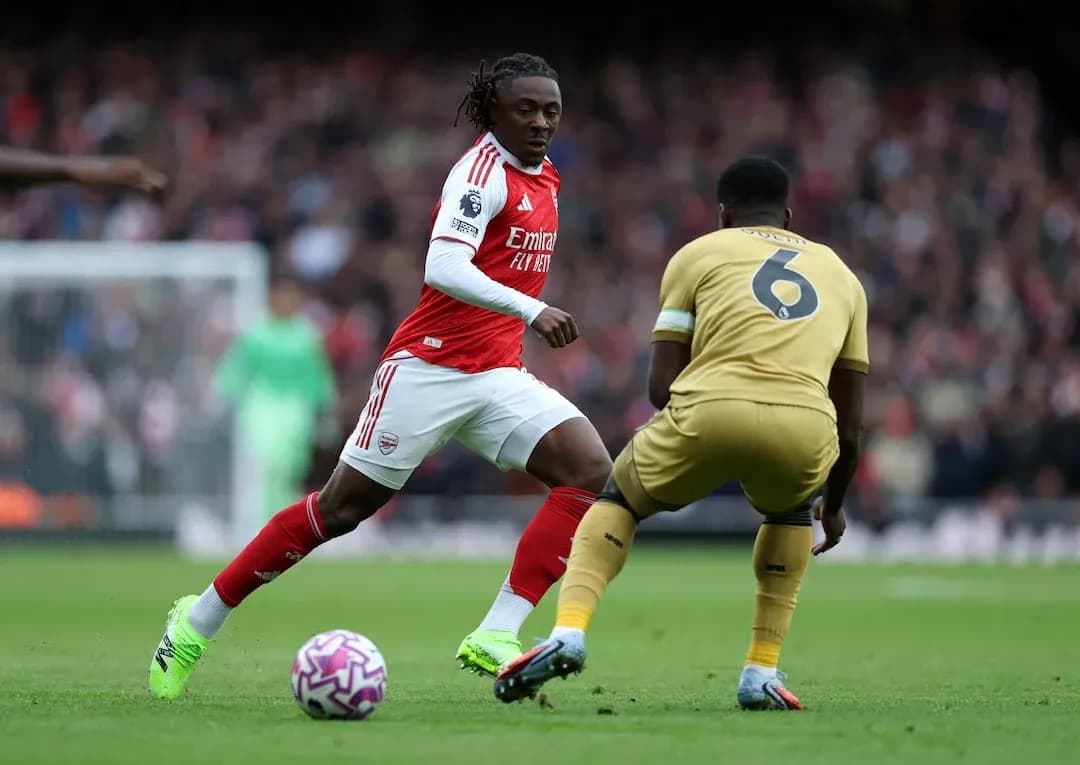
Arsenal Clinches 2-1 Victory Over Crystal Palace in Premier League Finale
Selhurst Park hosted a tactically sharp 2-1 away win for Arsenal over Crystal Palace on the final day of the Premier League season (Regular Season - 38). Arsenal’s control without the ball ever becoming sterile was the defining theme: 61% possession, 17 shots and a 2.4 xG profile underpinned a performance built on structure rather than chaos. Palace, in a 3-4-2-1, stayed in the game through compactness and late attacking changes, generating 8 shots and 1.1 xG, and were one incisive move away from stealing a point in the closing stages.
Goals
Arsenal struck first on 42': Gabriel Jesus finished a move assisted by G. Martinelli to give the visitors a 0-1 lead that reflected their territorial dominance. Immediately after the interval, Arsenal punished Palace’s reshuffle; on 48', N. Madueke, supplied by K. Havertz, made it 0-2 with a clinically executed second goal that seemed to kill the contest. Palace, however, kept the game live and were rewarded on 89' when J. Mateta, fed by Y. Pino, converted to reduce the deficit to 1-2 and set up a tense finale.
Disciplinary Ledger
The disciplinary ledger was light but telling. Arsenal collected the only card of the afternoon: at 74', Gabriel Jesus (Arsenal) — Foul. That single booking, against a backdrop of 12 Arsenal fouls to Palace’s 9, underlined how often Arsenal’s forwards and midfielders were asked to halt transitions as Palace increasingly attacked direct space in the second half.
Crystal Palace Structure
Oliver Glasner’s 3-4-2-1 for Crystal Palace was designed to congest central lanes and protect the three centre-backs. D. Henderson (Crystal Palace) anchored the structure behind a back three of C. Riad, J. Lerma and N. Clyne. The wing-backs D. Munoz and R. Cardines were key to Palace’s plan: hold a relatively low block, then spring forward once possession was regained. The central pairing of W. Hughes and D. Kamada tried to screen Arsenal’s No. 10 zone and passing lanes into Gabriel Jesus.
In practice, Palace’s first-half problem was progression. Despite 8 shots all coming from inside the box, they struggled to connect phases: 317 passes, 252 accurate at 79% shows a side that, when they did play, were relatively clean, but simply had fewer and shorter sequences. With only 3 corner kicks and 3 shots on goal, Palace’s attacks tended to be sporadic surges rather than sustained pressure. Henderson’s 5 saves and 0.48 goals prevented underline how much he had to compensate for Arsenal’s ability to access the box; his interventions, particularly against Arsenal’s 7 shots on goal, kept the scoreline competitive.
Arsenal Structure
Mikel Arteta’s Arsenal used a 4-2-3-1 that functioned more like a 2-3-5 in settled possession. K. Arrizabalaga (Arsenal) had a relatively calm afternoon with 2 saves, protected by a back four of R. Calafiori, P. Hincapie, C. Mosquera and M. Zubimendi. The double pivot of C. Norgaard and M. Lewis-Skelly provided the platform: they circulated at high efficiency (512 total passes, 455 accurate, 89%) and repeatedly shifted Palace’s block side to side, waiting for the wing and half-space gaps to appear.
Ahead of them, the line of three — G. Martinelli wide left, M. Dowman initially central then later replaced, and N. Madueke from the right — constantly inverted and rotated around Gabriel Jesus. The opening goal encapsulated Arsenal’s structure: Martinelli receiving in an advanced pocket after a patient spell of circulation, then sliding a decisive ball into Jesus, whose movement between Palace’s outside centre-back and wing-back was too sharp for the back three to track. The second goal at 48' was a similar story: Havertz, just introduced for C. Norgaard at 46' (C. Norgaard (OUT), K. Havertz (IN)), provided a vertical reference between the lines, feeding Madueke, who attacked the space outside Palace’s right centre-back to finish.
Second Half Changes
Glasner’s reaction at half-time was aggressive and reshaped the game’s dynamics. At 46', T. Mitchell (IN) came on for D. Munoz (OUT), Y. Pino (IN) for I. Sarr (OUT), and A. Wharton (IN) for D. Kamada (OUT). These three changes pushed Palace into a more assertive posture: Mitchell offered more secure defending on the left, Pino added 1v1 threat between the lines, and Wharton gave extra ball progression from midfield. Arsenal mirrored that restyling with their own structural tweaks: Havertz for Norgaard at 46' and Gabriel for R. Calafiori at 46' allowed Arsenal to maintain a high line and keep a stronger aerial and physical presence at the back.
As the second half wore on, Palace’s strategy became more direct. At 62', E. Guessand (IN) entered without a specified outgoing player, adding an extra forward presence and encouraging quicker deliveries into the box. Simultaneously, M. Merino (IN) replaced M. Dowman (OUT) for Arsenal at 62', a move that shored up central control and added height on defensive set-plays. The pattern was clear: Palace committed more numbers forward; Arsenal added structure and ball retention.
Final Phase
The final phase was defined by substitution-driven momentum swings. Arsenal’s front line was refreshed at 75' when E. Eze (IN) replaced Gabriel Jesus (OUT), and later at 83' when V. Gyökeres (IN) came on for N. Madueke (OUT). These moves were designed to preserve the press from the front and maintain an outlet against Palace’s late pressure. Palace’s own decisive attacking change came at 77', when J. Mateta (IN) replaced J. S. Larsen (OUT), giving them a more traditional penalty-box reference. It was Mateta who capitalised on Palace’s improved flank play, finishing Y. Pino’s service at 89' to bring the score back to 1-2.
Statistical Overview
Statistically, Arsenal’s superiority was clear. Their 17 total shots to Palace’s 8, and 7 shots on goal versus 3, matched the xG split of 2.4 to 1.1. The 61%-39% possession share and 512-317 pass advantage reflect a side in control of territory and tempo. Yet the identical goals prevented figures for both goalkeepers (0.48 each) underline that the game remained within one moment of variance right to the end.
From a season-pattern perspective, Arsenal’s high-volume shot profile and strong passing accuracy aligned with a possession-dominant identity, while Palace’s compact low-to-mid block and late direct surge fit a reactive model. The narrow 1-2 score at Selhurst Park therefore felt like a faithful statistical and tactical expression of both teams’ broader trends: Arsenal dictating, Palace resisting, and fine margins deciding the final-day narrative.