Tactical Analysis of France's Defeat to England at Hard Rock Stadium
France’s 6-4 defeat to England at Hard Rock Stadium, Miami Garden, was shaped less by chance and more by the structural choices both coaches made and how they interacted with the game’s momentum swings. The 3rd Place Final became a tactical rollercoaster: England built a 4-0 half-time lead through ruthless verticality and set-piece efficiency, while France’s second-half resurgence exposed the fragility of England’s defensive structure once the game became transitional.
From the outset, England’s plan without the ball was to compress the central lane around Declan Rice. With 54% possession and 515 total passes (467 accurate, 91%), they used Rice as a single pivot shield, allowing the back four to hold relatively aggressive positions. The early goal by Rice at 3' underlined how high England’s midfield line was: quick regains, immediate pressure on France’s first pass, and a willingness from Marcus Rashford and Bukayo Saka to drive inside rather than hold the touchline.
France, by contrast, were more direct in their initial phase. With 445 passes (405 accurate, 91%) and only 46% of the ball, Didier Deschamps’ side looked to connect quickly into Kylian Mbappé and Michael Olise. However, England’s early 4-0 lead – built on efficient use of space in and around France’s back line – revealed a French structure that was too flat between the lines. Warren Zaïre-Emery and Adrien Rabiot were often caught in no-man’s land: neither fully protecting the centre-backs nor able to step out aggressively onto Rice and Eberechi Eze.
England’s attacking pattern was simple but devastating. They produced 19 total shots, with 16 inside the box and 11 on goal. The volume and quality of these chances reflected how consistently they managed to access the half-spaces and wide channels behind France’s full-backs. Djed Spence and Jarell Quansah pushed high to support Saka and Rashford, pinning France’s back line and forcing Ibrahima Konaté and Maxence Lacroix into constant lateral defending. Set pieces and second balls were critical: Ezri Konsa’s goal at 18' came from England’s ability to keep France penned in and attack the box with numbers.
France’s defensive metrics underline the pressure: they committed 14 fouls to England’s 8, an indicator of being a step late in duels and forced into recovery tackles. Yet despite conceding six times, France limited England to the same total shots (19) and actually posted a slightly higher xG at 2.87 compared to England’s 2.58. That gap points to France creating fewer but clearer chances once they adjusted at half-time.
The break was the tactical hinge of the match. Deschamps’ quadruple substitution at 46' – with Bradley Barcola, Ousmane Dembélé, Dayot Upamecano and Lucas Digne all introduced via the vector of Désiré Doué, Rayan Cherki, Konaté and Theo Hernández – radically changed the game’s dynamics. France shifted from a more controlled, possession-oriented structure to a high-tempo, wing-driven attack. Barcola’s introduction in particular stretched England’s right side, while Dembélé’s directness forced England’s full-backs to turn and run toward their own goal instead of stepping into midfield.
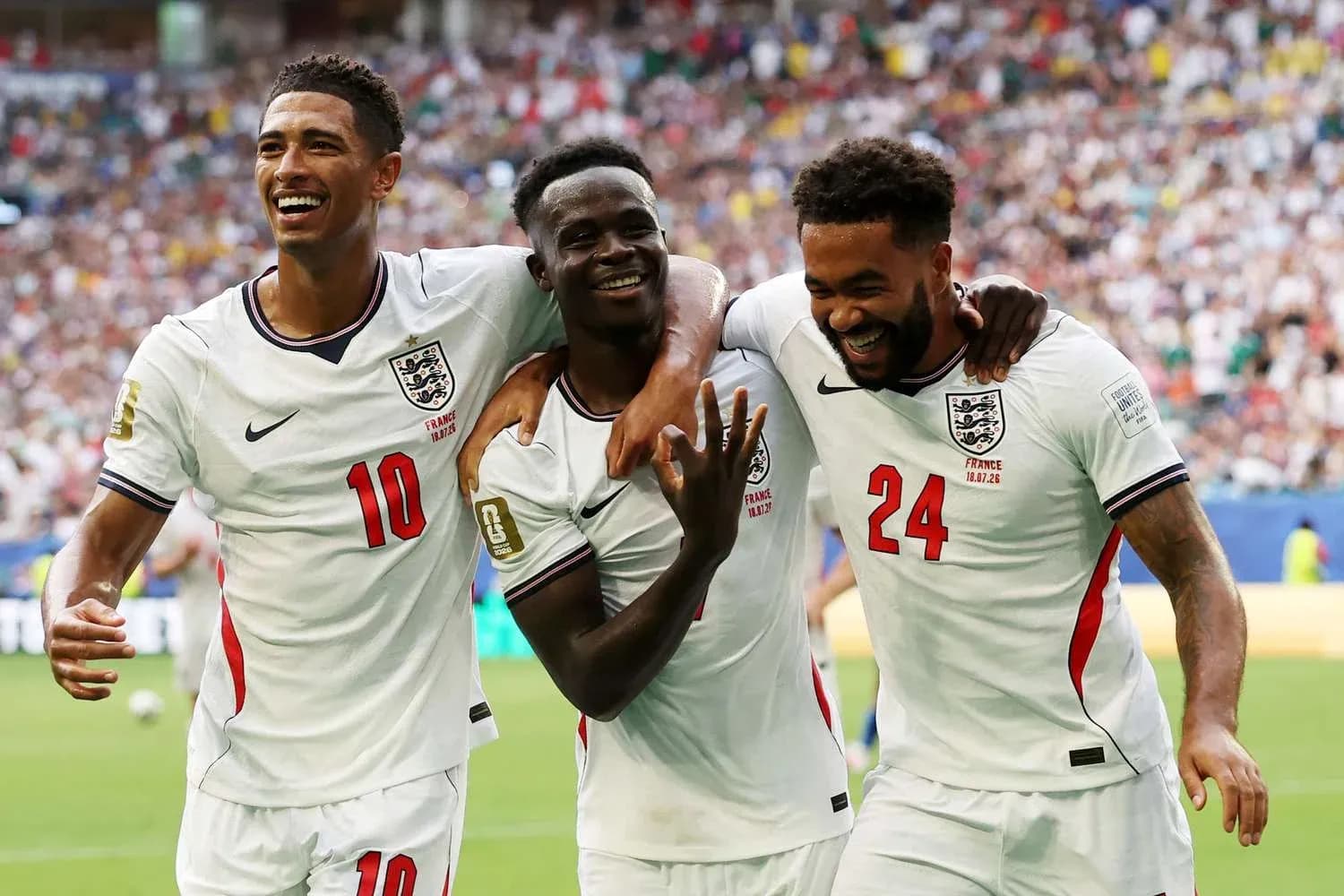
The impact was immediate. France’s 12 shots inside the box came heavily in the second half, fuelled by Mbappé’s more central positioning and the improved service from wide. His goals at 48' and 66', both assisted by Olise, were emblematic of a clearer vertical pattern: win the ball, find Olise between the lines, then attack the space behind England’s defensive line with Mbappé’s runs. Barcola’s goal at 54' further punished England’s inability to reset their defensive block once the first line was broken.
England’s response was to lean even more into transitions. Thomas Tuchel’s changes – Ollie Watkins for Rashford, Jude Bellingham for Eze, Elliot Anderson for Ivan Toney, and Reece James for Quansah – were aimed at restoring control and adding fresh legs in midfield and defence. Instead, they contributed to a more stretched game. England still carried threat, reflected in their six blocked shots and their ability to reach 19 total attempts, but the structure in front of their back line deteriorated as the match progressed.
Goalkeeping and box management were decisive in how the scoreline inflated. Mike Maignan (France) faced 11 shots on goal and made 4 saves, with goals prevented at 0.05 – a statistical signal that England finished close to expectation and that France’s defensive screen offered limited protection. Dean Henderson (England), by contrast, dealt with 9 shots on goal and made 5 saves, also with 0.05 goals prevented. Despite conceding four, his interventions in the second half – particularly as France surged – prevented the game from tilting into complete chaos.
In possession, both teams were technically clean – each at 91% passing accuracy – but used that base differently. England’s extra 70 passes and marginally higher xG from fewer shots inside the box show a side that built more patiently and sought high-value central entries, especially through Rice and Saka. France’s shot profile, with a balanced 12 inside and 7 outside the box, reflected a more varied approach: mid-range efforts early, then high-quality box entries once the wide players were reconfigured.
Set pieces and discipline also mattered tactically. England’s 4 corner kicks to France’s 3 supported their territorial control in the first half. The relatively low foul count for England (8) compared to France (14) aligned with England spending more time dictating where the game was played, especially before the break, and France being forced into emergency defending.
Ultimately, the statistical verdict is of a wild but logically constructed contest. England’s superior possession, shot volume on goal, and slightly lower xG combined with clinical finishing to deliver six goals. France’s higher xG and second-half dominance showcased how structural changes and aggressive wing play can transform a game, but the 4-0 half-time deficit was too steep. The match became a tactical lesson in the cost of an unprotected back line against a side built to attack quickly through the middle and half-spaces, and in how even well-calibrated second-half adjustments can only partially repair early structural damage.