Portugal's World Cup Dilemma: Ronaldo's Decline and Team Dynamics
At some point, even the greats force a reckoning. For Portugal, that moment is no longer creeping into view. It’s here, standing in the penalty area, wearing the armband and the No 7 shirt.
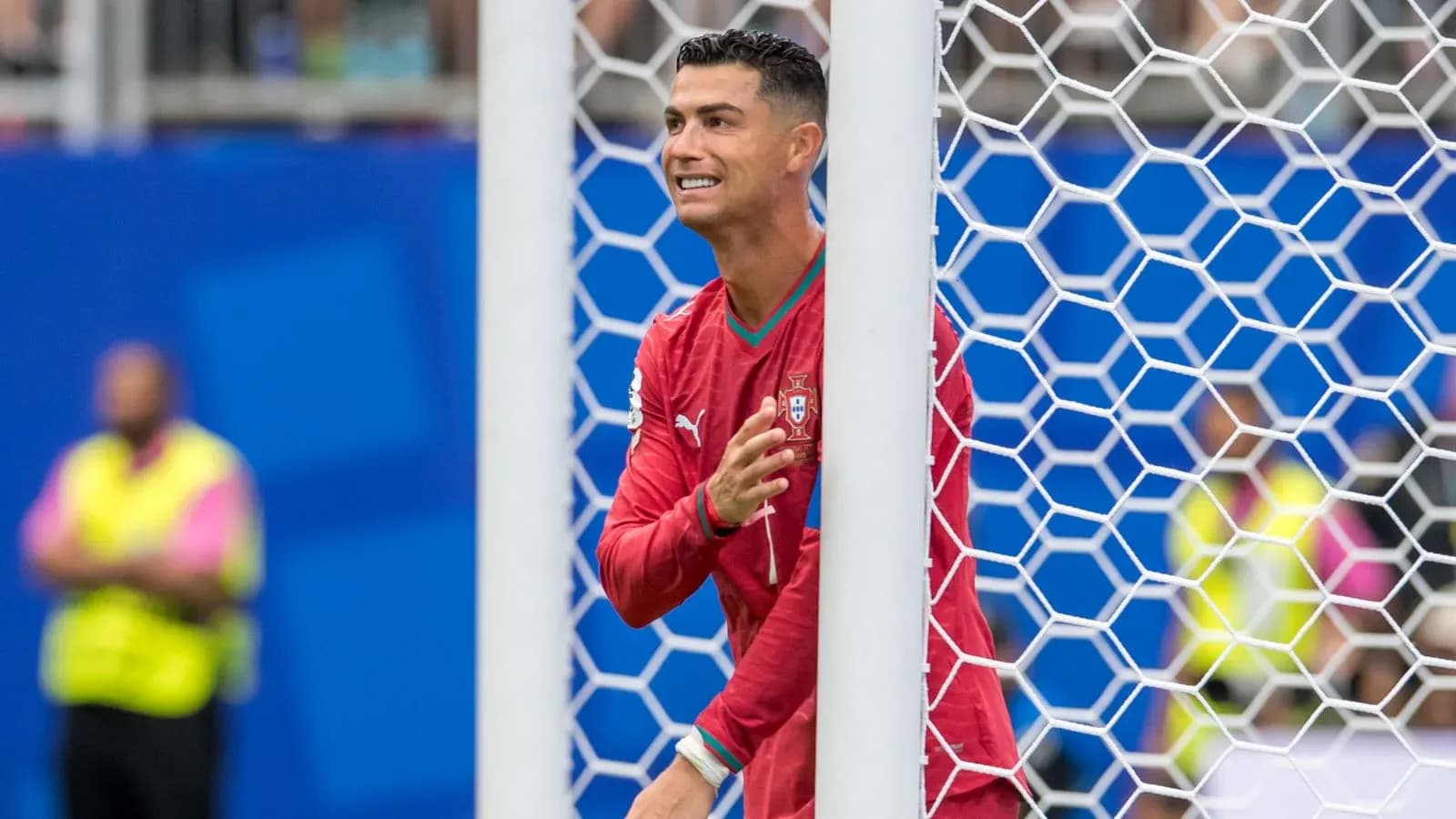
Cristiano Ronaldo, 41 years old and at a record-breaking sixth World Cup, walked out in Houston as captain against DR Congo with the usual spotlight, the usual expectation and, this time, a very unusual return: almost nothing.
He knew what had happened the day before. Kylian Mbappe had scored twice. Erling Haaland had scored twice. Lionel Messi, the eternal measuring stick, had scored three. The stage was set for Ronaldo to answer.
He didn’t.
Twenty-nine touches. One shot. No goals. A scowl that told its own story as Portugal drifted to a flat, frustrating draw.
Again, Ronaldo was the headline. Not for what he did, but for what he didn’t. His goalless run in major international tournaments now stretches to 10 games. Messi, over his last 10 in such competitions, has nine goals. The contrast is brutal.
Even the basics cut deep. Of Portugal’s starting XI in Houston, only Bernardo Silva – withdrawn at half-time – had fewer touches than Ronaldo. For a man whose presence is supposed to shape games, he barely brushed against this one.
The Numbers Don’t Lie – But They Complicate
Roberto Martinez, though, isn’t pointing the finger at his captain.
“It makes no sense to get the best goalscorer in world football out in a game that you need goals,” he insisted. For Martinez, Ronaldo’s value is still framed in those familiar terms: his experience in the box, the attention he draws from defenders, the space that supposedly opens up for others.
“And every player has a responsibility or a piece of quality on the pitch. And clearly when you look for goals, you need to have Cristiano.”
It’s a bold defence when you look at the talent around him. Bernardo Silva, Bruno Fernandes, Pedro Neto, Vitinha, Joao Neves, Joao Cancelo, Nuno Mendes – a creative unit many coaches would build a team around. These are players who dominate games for elite clubs, who live in the final third, who are used to supplying elite forwards.
So are they failing him? Or is the problem now shared?
The data over each star’s last 10 competitive international matches offers an uncomfortable answer. Compared to Messi, Mbappe and Harry Kane, Ronaldo is simply not getting – or not generating – the same quality of chances.
Only Kane has taken fewer shots than Ronaldo’s 30 in that span. Ronaldo’s expected goals (xG) sits at 5.36. Kane’s is 7.15. Mbappe’s is 8.76. Messi’s xG isn’t available, but the eye test and his output speak loudly enough.
Those numbers hint at a drop in the quality of opportunities falling Ronaldo’s way. That’s where the question of service comes in. Across those 10 games with Ronaldo on the pitch, Portugal have produced a team xG of 12.76. England, with Kane, reached 16.39. France, with Mbappe, surged to 21.99.
Per 90 minutes, that works out at 1.32 for Portugal, 1.34 for England, and a hefty 1.72 for France. Mbappe is playing in a side that creates significantly more danger than Portugal do for Ronaldo.
Look closer at the source of Ronaldo’s chances and the picture sharpens. His xG from team-assisted shots in this barren spell is just 2.55. Kane’s equivalent sits at 3.2. Mbappe’s explodes to 5.78.
For all the creative names on the Portugal teamsheet, their main striker is often working off scraps.
When the Finishing Desert Belongs to the Striker
Yet this can’t just be about supply lines. The numbers don’t let Ronaldo off that easily.
Fernandes, Silva, Neves and the rest could reasonably argue that they have created enough for a player of Ronaldo’s pedigree to make a dent. Not a glut of chances, but enough. A header here, a one-on-one there. Moments he used to devour.
He hasn’t.
The most damning statistic is his ‘post-shot’ xG – a measure of what happens after the ball leaves the boot or the head. It reflects how well a player finishes the chances he actually gets.
Kane and Mbappe are still sharpening the knife. Kane is outperforming his post-shot xG by 2.05. Mbappe is ahead by 2.25. They are squeezing more goals out of their chances than expected.
Ronaldo, by contrast, is at -2.8. Almost three goals fewer than the model expects from the positions he’s shot from. That’s not bad luck. That’s a decline in clinical edge from a man once considered the most ruthless finisher in the sport.
The problems don’t stop there. Ronaldo isn’t compensating with involvement in the build-up either.
His touch map and heatmap against DR Congo paint a bleak picture: limited involvement, clustered actions, and too many touches in isolated pockets on the left where Neto and Mendes should be stretching and tearing at defenders. Instead of linking play or creating overloads, he’s occupying space that blunts others.
He has never been Messi, drifting into midfield to dictate. He has never been Kane, dropping off the front to slide passes through. He has always been the finisher at the end of the move.
But when the finishing isn’t there, and he isn’t offering variety in his positioning or his play, the trade-off starts to look brutal for the team around him.
Martinez’s Gamble with a Golden Generation
This is the knot Roberto Martinez has tied himself into.
He cannot rip up his entire creative structure to suit one man, not when that one man no longer guarantees goals. Yet he refuses to remove Ronaldo from the XI because of what he believes the veteran still brings: presence, gravity, the threat that defenders still feel, even if the numbers suggest they shouldn’t fear quite as much as they once did.
So Portugal are caught in the middle.
They have a golden generation of technicians and playmakers, a squad that should be dictating tournaments, not merely surviving them. They also have a legend whose aura still fills stadiums but whose output no longer fills scoreboards.
As long as Ronaldo starts, the team bends around him. As long as Martinez builds around that idea, Portugal live with the risk that another World Cup slips away in a fog of nostalgia and “what ifs”.
What if they had moved on sooner? What if they had trusted the collective over the icon? What if the most difficult conversation in Portuguese football had happened before this World Cup, and not during it?