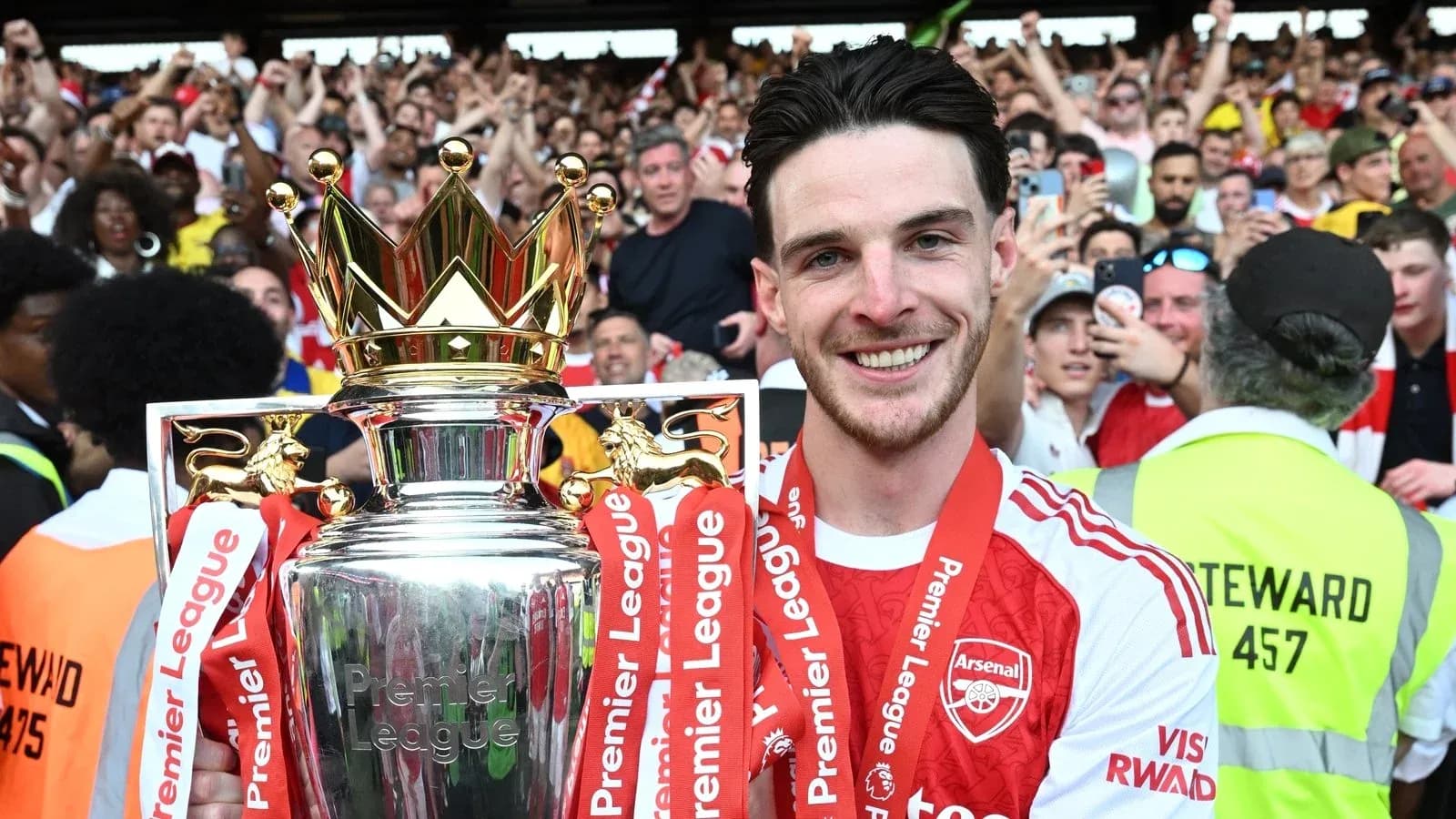
Declan Rice's Heavy Workload Raises Concerns for England
Aaron Cresswell calls Declan Rice “a freak of nature”. It has never felt more like a warning than a compliment.
Since the start of the 2020-21 season, Rice has played 360 games for club and country. West Ham’s European runs, England’s endless tournaments, Arsenal’s push on two fronts. Season after season, month after month, he has just kept going. Until Wednesday night in Los Angeles, when England beat Croatia 4-2 and Rice, for once, looked human.
A rare off-night
This was his 63rd appearance of the 2025-26 campaign. It showed. The legs still moved, but the clarity that usually defines Rice’s game did not. England’s midfield shape disintegrated in the first half, with too much open grass between Rice and Elliot Anderson. The gaps invited trouble. Luka Modric, even at 40, does not need a second invitation.
Rice dropped too deep, then got dragged out of position. England’s structure bent with him. Thomas Tuchel, usually so precise with his central unit, watched his base wobble. His verdict afterwards was diplomatic: “Declan had some unusual ball losses.” For Rice, that phrase is almost an oxymoron.
The tactical issues can be fixed on the training pitch. The more pressing problem arrived in the 72nd minute.
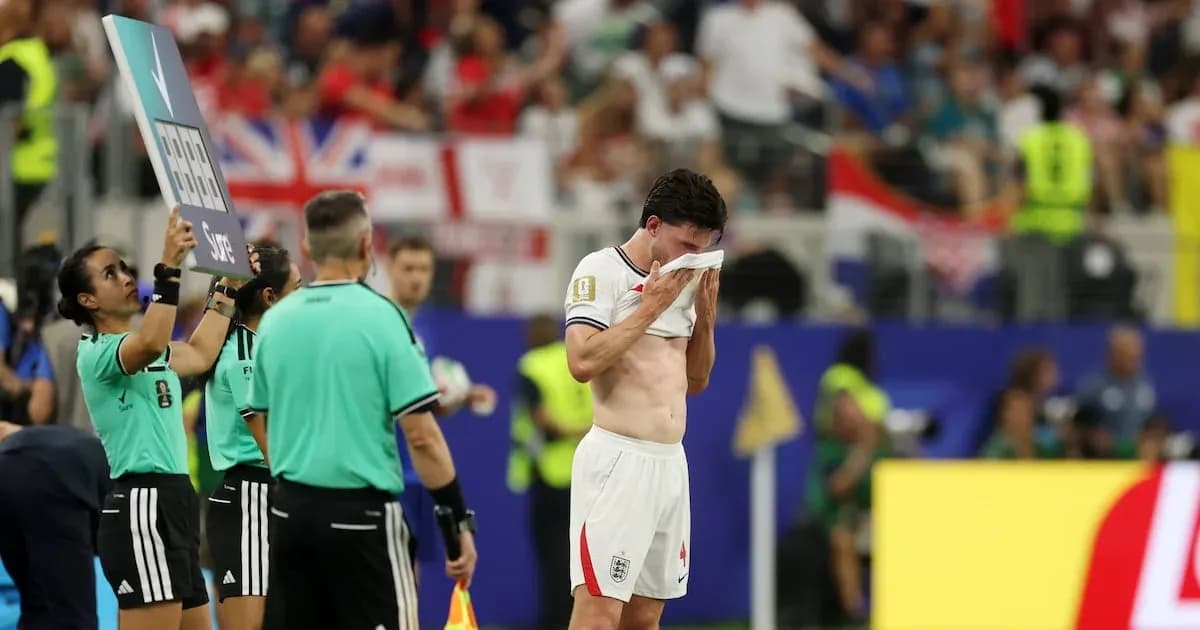
England were 3-2 up, clinging on against a Croatia side that had just been handed a lifeline. This is exactly the kind of situation in which Rice normally digs in, eats up ground, and shuts a game down. Instead, the board went up and the vice‑captain walked off, feeling discomfort in his lower back and upper hamstring.
Tuchel insisted it was precautionary. Rice was quick to insist he would be ready for Ghana on Tuesday. The message from both was clear: don’t panic. Yet the sight of England’s most reliable outfield player leaving the pitch with a tight game in the balance will have chilled more than a few spines.
Because England know what they are without Rice. And it has rarely been pretty.
No like-for-like solution
The numbers tell the story. In the past six years, England have almost always looked diminished whenever Rice has not played. There is no one else in this squad who can screen the defence, dictate the tempo, and deliver from set pieces in quite the same way.
Kobbie Mainoo has the silk. He can take the ball in tight areas, turn, and pass through pressure. But he does not yet have Rice’s frame, his aerial dominance, or his capacity to patrol huge spaces on his own. Jordan Henderson brings experience, but at 36 he was not called upon even as the game against Croatia became stretched and frantic. If Tuchel wanted to maintain intensity, he did not turn to Henderson. That felt telling.
When Rice went off, the first solution was to pull Jude Bellingham back into a deeper role. On paper, it made sense. In reality, it almost cost England. The balance went again, Croatia poured forward, and for eight anxious minutes the game felt on the brink of slipping away.
Then Tuchel tried something else. Djed Spence came on for Bellingham, Reece James stepped out of right back and into midfield. Suddenly, there was a glimpse of an alternative.
Reece James, the emergency 6?
This is not a wild experiment plucked from nowhere. James has done this before. On loan at Wigan in 2018-19, he played in midfield. At Chelsea, he has spent most of his career marauding from right back or right wing back, but Enzo Maresca changed the script during his 18 months at Stamford Bridge.
Maresca pushed James inside. At first, there were doubts. Was this really the best use of one of the league’s most dangerous attacking full backs? Then came results. James anchored the midfield when Chelsea beat Paris Saint-Germain in last year’s Club World Cup final. He was outstanding again alongside Moisés Caicedo in a 3-0 dismantling of Barcelona last November. Five days later, he dominated Rice himself when Arsenal came to the Bridge.
Tuchel, who once managed James at Chelsea, initially resisted the idea. For England, he said, James was a right back. That stance softened as Maresca’s experiment began to look less like a gamble and more like a blueprint. James is powerful, positionally astute, and strikes the ball cleanly over short and long distances. He can tackle, he can pass, he can read danger.
So when Tuchel named his World Cup squad and left out Adam Wharton and Alex Scott, he did so with a clear justification: “Reece James can play in the 6 because he does on a high level for Chelsea.” Wednesday night, in that brief cameo against Croatia, was the first real test of that plan in an England shirt.
If Rice’s minutes have to be managed, James may be the closest thing England have to a credible stand‑in at the base of midfield.
Versatility and its limits
Tuchel has built this squad around flexibility. If James steps out of the back four, there are options to cover him. Spence can slot in. So can Ezri Konsa or Jarell Quansah. One possible configuration would see Konsa acting as a third centre back alongside John Stones and Marc Guéhi, allowing Nico O’Reilly to surge from left back and provide width and thrust on the opposite flank.
On the tactics board, it works. On grass, it comes with a major caveat: James’s body.
The Chelsea captain has a long, painful history with his hamstrings. The latest setback came in March and cost him almost two months. Chelsea have had to manage his workload with care. England are trying to do the same.
Tino Livramento’s calf injury, which forced Tuchel to call up Trevoh Chalobah, has already stripped away one layer of protection at full back. James is first choice on the right, but he cannot start every game. He certainly cannot be expected to start at right back and then carry the burden of a full‑time midfield role if Rice is compromised.
Tuchel’s World Cup planning has been stalked by fitness concerns. The early trip to Florida for a pre‑tournament camp in the sun was designed to harden bodies for what lay ahead. Yet even that could not change the reality of Rice’s season. He joined late after playing in the Champions League final for Arsenal. He keeps pushing himself to the edge.
At some point, the bill arrives.
The cost of carrying Rice
If England go all the way to the final and Rice plays every possible game, his tally for the season will hit 70 appearances. Seventy. For a central midfielder who covers more ground than almost anyone else on the pitch, the demands are extreme.
This is why the sight of him stretching his back and hamstring against Croatia felt so ominous. England need Rice. They know it. Their opponents know it. Tuchel knows it most of all.
But needing him and being able to rely on him are not the same thing. The numbers, the miles, the minutes – they are catching up. England cannot simply hope he will defy physiology for another month.
Tuchel has built a squad rich in versatility. He has James as a potential 6, Mainoo as a progressive option, Henderson as an experienced head. He has the tools to redraw his midfield if he has to.
The real question, as the tournament begins to bite, is whether he is brave enough to use them before Declan Rice’s body makes the decision for him.