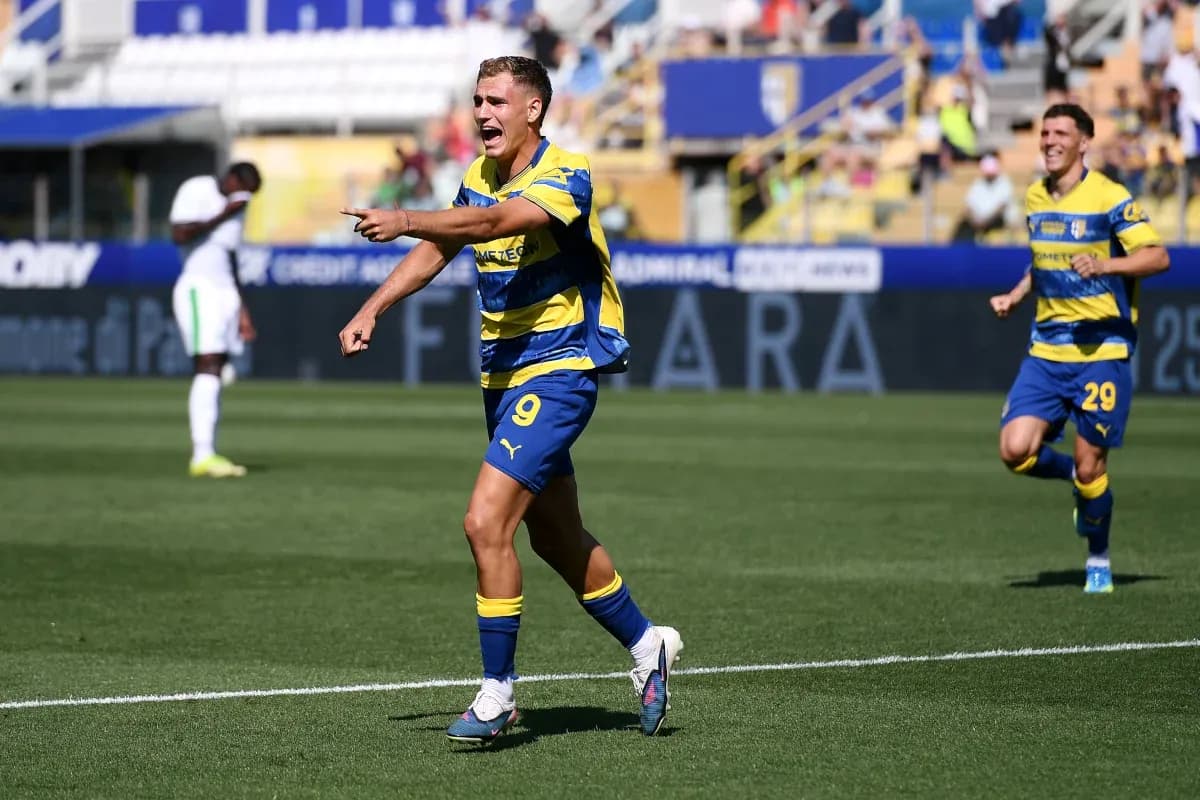
Parma Secures Serie A Survival with 1-0 Win Over Sassuolo
The curtain came down on Parma’s Serie A return at a sun‑soaked Stadio Ennio Tardini, and it ended with a statement of defiance. Following this result, a 1–0 home win over Sassuolo, Carlos Cuesta’s side closed a turbulent campaign with a performance that distilled their seasonal identity: low‑scoring, late‑surging, and structurally stubborn.
Parma finish 13th on 45 points, their overall goal difference at -18, the mathematical echo of a season built on defensive grit more than attacking flair. Across 38 matches they scored 28 and conceded 46; at home, just 16 scored and 25 conceded from 19 games underline a side that rarely cuts loose but is hard to blow away. Sassuolo, 11th with 49 points and an overall goal difference of -4 (46 for, 50 against), arrive as the more expansive outfit, their 46 goals reflecting a front line that can hurt anyone, even if a porous back line often undermines that ambition.
I. The Big Picture – Structure over spectacle
Cuesta doubled down on Parma’s structural DNA with a 3‑5‑2: E. Corvi behind a back three of A. Circati, M. Troilo and L. Valenti, wing‑backs S. Britschgi and E. Valeri stretched high, and a central trio of C. Ordonez, H. Nicolussi Caviglia and M. Keita tasked with both screening and springing transitions. Up front, the physical fulcrum of Mateo Pellegrino was paired with D. Mikolajewski, a partnership built on duels and depth runs rather than intricate combination play.
Opposite, Fabio Grosso stayed loyal to Sassuolo’s season‑long blueprint: a 4‑3‑3 with S. Turati in goal, a back four of W. Coulibaly, T. Macchioni, J. Idzes and U. Garcia, and a midfield trio led by the all‑action K. Thorstvedt, flanked by L. Lipani and I. Kone. The front three of D. Berardi, A. Pinamonti and A. Laurienté promised invention and goals; heading into this game, Sassuolo’s overall scoring average of 1.2 goals per match, including 1.1 on their travels, marked them as the more dangerous attacking unit.
Yet the match narrative quickly aligned with Parma’s season statistics. They are a team that lives on fine margins: overall they average just 0.7 goals for and 1.2 against, with only 6 of their 38 games seeing over 1.5 goals. This was another tight affair, a tactical arm‑wrestle where territory and structure mattered more than shot volume.
II. Tactical voids and discipline – who was missing, and who had to tread carefully
Both squads came into the day scarred by absences. Parma’s creative layer was heavily stripped: A. Bernabé (muscle injury), B. Cremaschi (knee), N. Elphege (thigh), M. Frigan and G. Oristanio (both knee), J. Ondrejka (leg) and G. Strefezza (ankle) all missed out. That is a cluster of ball‑carrying and final‑third craft removed from Cuesta’s toolbox, explaining his reliance on a more functional, hard‑running midfield and direct service into Pellegrino.
Sassuolo were no less depleted. D. Bakola and F. Cande (both knee), D. Boloca (muscle), E. Pieragnolo (knee), S. Walukiewicz (leg), plus inactive defenders F. Romagna and A. Vranckx, all sat this out. The absence of Boloca’s control and Pieragnolo’s thrust forced Grosso into a more orthodox, less adventurous back four, with Thorstvedt and Lipani carrying extra responsibility in progression.
Disciplinary trends hung over the contest like a quiet threat. Parma’s season card map shows a team that heats up after the break: 21.21% of their yellows arrive between 46–60 minutes and another 21.21% between 76–90, with a notable red‑card spike around 31–45 minutes (40.00% of their reds in that window). M. Troilo, Serie A’s leading red‑card recipient this season, epitomises that edge: in total he collected 7 yellows, 1 yellow‑red and 1 straight red, but also blocked 18 shots and made 18 interceptions. He is both shield and live wire.
Sassuolo, by contrast, are late‑game agitators. A striking 28.92% of their yellows land in the 76–90 minute range, and their reds are clustered in disruptive bursts: 25.00% between 16–30 minutes, 50.00% between 46–60, and 25.00% late on. Nemanja Matić, even from the bench here, embodies that combative control: in total 7 yellows and 1 red, but also 1721 passes at 86% accuracy and 43 tackles.
III. Key matchups – Hunter vs Shield, and the battle for the engine room
The headline duel was always going to be “Hunter vs Shield”: Sassuolo’s scorers against Parma’s low‑block resilience.
Andrea Pinamonti came in with 9 league goals and 3 assists, built on 57 shots (30 on target) and 17 key passes. He even won a penalty this season but missed from the spot, a reminder that his finishing, while prolific, is not infallible. Alongside him, Domenico Berardi’s 8 goals and 4 assists, plus 33 key passes, give Sassuolo a dual‑threat creator‑finisher from the right. Laurienté, Serie A’s second‑best provider with 9 assists and 7 goals, adds 54 key passes and 80 dribble attempts (29 successful), making the front three one of the league’s most layered attacking units.
Parma’s answer lay in the back three, with Troilo the emblem. Over the season he paired his disciplinary record with 27 tackles, 18 blocks and 18 interceptions, reading crosses and cut‑backs with a calm that belies his 22 years. Circati and Valenti flanked him to create a compact triangle in front of Corvi, denying Pinamonti the central spaces he thrives in. The 1–0 scoreline and clean sheet fit the broader pattern: Parma kept 13 clean sheets overall, including 5 at home, leaning on structure rather than shot volume.
In midfield, the “engine room” battle pitted Parma’s workmanlike trio against Sassuolo’s creative core. Nicolussi Caviglia and Keita were tasked with harrying Thorstvedt, whose season numbers (4 goals, 4 assists, 32 key passes, 44 tackles) mark him as Sassuolo’s two‑way heartbeat. Thorstvedt’s 287 duels (149 won) and 1055 passes at 82% accuracy show a player who both carries and circulates. Limiting his ability to connect with Berardi and Laurienté was central to Parma’s plan.
Cuesta’s 3‑5‑2, used in 19 league matches, is designed for exactly this kind of attritional midfield war: wing‑backs pinning full‑backs, a narrow central trio collapsing on the ball, and quick vertical releases into Pellegrino. The Argentine’s season line – 9 goals, 1 assist, 22 shots on target from 53 attempts, 22 key passes, and a huge 546 duels with 233 won – underlines why. He is not just a finisher but a reference point, winning free‑kicks (71 fouls drawn) and giving Parma a way to breathe.
IV. Statistical prognosis – why 1–0 felt almost inevitable
Following this result, the numbers feel almost pre‑written. Parma’s overall attacking average of 0.7 goals per match, with just 0.8 at home, collides with Sassuolo’s away defensive record of 1.3 goals conceded per game. That intersection points towards a narrow home scoring window rather than a flurry. At the other end, Sassuolo’s away scoring average of 1.1 meets Parma’s home defensive average of 1.3 conceded, suggesting the visitors would fashion chances but not necessarily overwhelm.
Layer on Parma’s late‑goal profile – 37.04% of their goals arrive between 76–90 minutes – against Sassuolo’s late‑concession curve (22.45% of goals against in that same window), and the script of a tight game decided late feels statistically sound. Parma’s season also skews heavily under in goal totals: only 6 matches over 1.5 goals, and none over 2.5, in total. Everything about their campaign points to low xG, few big chances, and a reliance on set‑pieces and duels in the box.
Sassuolo’s broader xG profile, inferred from 46 goals for and 50 against with relatively modest over‑2.5 frequencies (just 5 matches over 2.5 in total), is that of a side whose attacking quality is real but not relentlessly clinical, and whose defence leaks in concentrated bursts rather than constant collapse.
Put together, the 1–0 at the Tardini is less an upset than a crystallisation of identities. Parma, shorn of half a creative department, leaned into their defensive spine and the duel‑winning gravity of Pellegrino. Sassuolo, even with their glittering front three, ran into a structure designed to suffocate their best zones.
In the end, this was not a spectacle of wild xG swings but a tactical conclusion to two contrasting seasons: Parma’s survival secured through structure and suffering, Sassuolo’s mid‑table finish defined by moments of attacking brilliance offset by defensive fragility. The numbers, as much as the ninety minutes, tell you why 1–0 felt like the only logical ending.