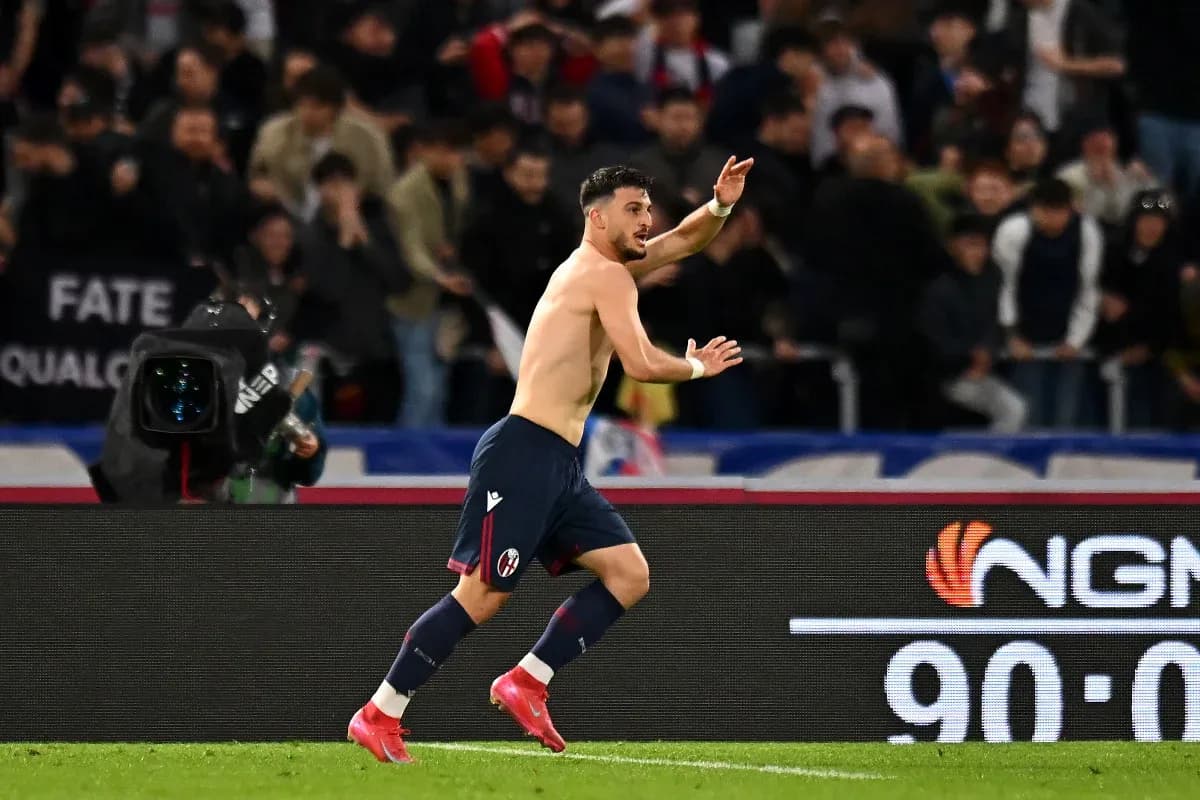
Bologna vs Inter: A Thrilling 3-3 Draw at Stadio Renato Dall’Ara
On the final afternoon at Stadio Renato Dall’Ara, Bologna and Inter produced a 3-3 thriller that distilled an entire Serie A season into 90 frantic minutes. Following this result, the table tells its own story: Inter crowned champions on 87 points, Bologna ending in eighth with 56, but the match narrative showed just how thin the line can be between hierarchy and upheaval.
I. The Big Picture – Structures and Seasonal DNA
Vincenzo Italiano rolled the dice with a bold 4-3-3. L. Skorupski anchored a back four of L. De Silvestri, E. Fauske Helland, J. Lucumi and J. Miranda. In front, a compact midfield trio of L. Ferguson, R. Freuler and T. Pobega was tasked with both screening and springing the front line of F. Bernardeschi, S. Castro and J. Rowe.
Across from them, Cristian Chivu stayed faithful to Inter’s seasonal blueprint: a 3-5-2 that has underpinned 27 wins in 38 league games. J. Martinez started in goal behind a trio of Y. Bisseck, S. de Vrij and Carlos Augusto. The five-man midfield – A. Diouf, N. Barella, P. Sucic, P. Zielinski and F. Dimarco – wrapped around the pitch’s width, feeding a forward pair of F. Esposito and Lautaro Martínez.
The standings data underlines the clash of identities. Overall this campaign, Bologna have been an away-driven side: 10 wins on their travels compared to 6 at home, with only 19 goals scored at Dall’Ara at an average of 1.0 per home game. Inter, by contrast, have been ruthless everywhere: 89 goals overall, averaging 2.6 at home and 2.1 away, while conceding only 35 in total (0.9 per game). A 3-3 draw, then, was Bologna punching above their usual home weight and Inter conceding far more than their typical defensive standard.
II. Tactical Voids – Absences and Hidden Costs
The team sheets were shaped as much by who was missing as by who played. Bologna were stripped of key structural and creative pieces: K. Bonifazi (inactive) and M. Vitik (ankle injury) thinned the central defensive options, while N. Casale’s calf injury further limited rotation at the back. Higher up, the absence of N. Cambiaghi and, most crucially, R. Orsolini (muscle injuries) robbed Italiano of his most prolific wide threat. Orsolini’s season – 10 league goals and 4 penalties scored despite 2 misses – usually provides a direct route to goal and a set-piece edge that Bologna had to reconstruct through Bernardeschi and Ferguson.
Inter’s absentees were of a different profile: strategic rest and fine-tuning ahead of bigger horizons. M. Akanji, D. Dumfries and M. Thuram were all listed as missing due to rest, while H. Çalhanoğlu was out lacking match fitness. Thuram’s 13 goals and 6 assists, plus Çalhanoğlu’s 9 goals and 4 assists (including 4 penalties scored but 1 missed), normally give Inter a second wave of scoring and control from deep. Without them, Chivu leaned heavier on Lautaro Martínez’s all-round game and the creative weight of Dimarco and Barella.
Disciplinary trends framed the emotional temperature. Across the season, Bologna’s yellow cards spike between 61-75 minutes (26.87%) and 76-90 (25.37%), a clear pattern of late-game aggression as they chase or protect results. Inter mirror that late tension: 31.25% of their yellows arrive between 76-90 minutes. This match, with its late goals and stretched transitions, fell perfectly into that shared zone of risk.
III. Key Matchups – Hunter vs Shield, Engine Room vs Enforcer
The headline duel was always going to be Lautaro Martínez against Bologna’s defensive block. Lautaro’s 17 goals and 6 assists this season, built on 69 shots (39 on target), make him Serie A’s leading reference point in the box. He thrives on sharp, diagonal service and quick combinations – exactly what a line of Dimarco, Barella, Zielinski and Sucic is built to supply.
Against that, Bologna’s defensive record at home – 23 goals conceded in 19 matches, an average of 1.2 – is solid but not elite. J. Lucumi and E. Fauske Helland were forced into a constant calibration: step out to engage Lautaro between the lines, or hold the line and trust Freuler to screen? When Bologna were brave, pushing their back four high to compress space, they opened corridors for Esposito and Lautaro to spin in behind. When they dropped, Inter’s wing-backs, particularly Dimarco, had time to angle crosses and cut-backs.
Dimarco versus Bologna’s right flank was another decisive front. As Serie A’s top assist provider with 16, plus 7 goals, Dimarco is less a wing-back and more a left-sided playmaker. L. De Silvestri’s task was twofold: deny Dimarco time to whip in early deliveries, and still offer enough overlap to support Bernardeschi. Every time Bologna’s right-back joined the attack, Inter’s transition threat flared – but when he stayed home, Bologna’s 4-3-3 risked becoming too narrow, starving Castro and Rowe of wide support.
In the engine room, the contest between R. Freuler and N. Barella was a study in contrasting energies. Freuler, the metronome, looked to shield the back four and recycle possession quickly into Ferguson and Pobega. Barella, who has 8 assists and 3 goals this campaign, is Inter’s accelerant: 72 key passes and a constant willingness to break lines with both runs and passes. When Barella escaped Freuler’s cover shadow, Inter tilted the field; when Freuler and Ferguson boxed him in, Inter’s build-up slowed and Bologna could press in numbers.
IV. Statistical Prognosis – xG Logic in a Chaotic Game
Even without explicit xG values, the season-long numbers sketch the underlying probabilities. Inter’s away profile – 39 goals scored and 19 conceded in 19 games, averaging 2.1 for and 1.0 against – points to a typical expected scoreline in the region of 2-1 in their favour on their travels. Bologna at home, with 1.0 scored and 1.2 conceded on average, broadly support that same expectation.
A 3-3 draw therefore sits above the statistical norm for both sides. It suggests that Bologna finished their chances at a rate higher than their usual home average, while Inter’s usually compact defence – 18 clean sheets overall, 10 of them away – allowed more high-quality looks than typical. Given Inter’s season-long attacking efficiency, it is reasonable to infer that their xG would still have leaned in their favour, but Bologna’s clinical edge on the day dragged the actual outcome away from the model and into the realm of narrative.
Following this result, the tactical verdict is nuanced. Inter’s 3-5-2 remains structurally superior over a season, but this match exposed what happens when key controllers like Çalhanoğlu and Thuram are absent and the press loses a half-step of cohesion. Bologna, meanwhile, showed that even with Orsolini sidelined, Italiano’s 4-3-3 can manufacture volume and chaos, especially when Ferguson and Bernardeschi are aggressive between the lines.
On paper, the champions should have managed the game state more ruthlessly once they hauled themselves back into contention. In practice, Bologna’s late-season resilience – 16 wins overall, a goal difference of +3 from 49 scored and 46 conceded – surfaced in one last act of defiance. The numbers say Inter; the 90 minutes at Dall’Ara insisted on parity.