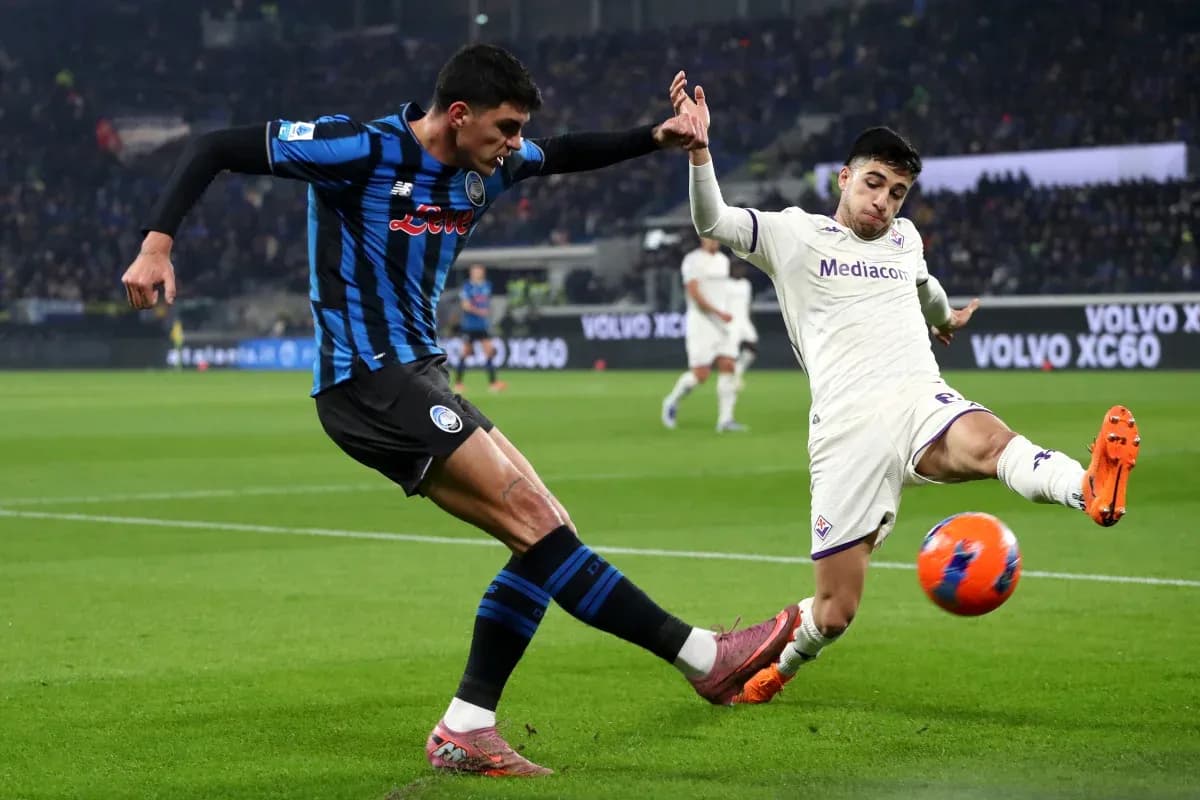
Fiorentina vs Atalanta: A Season-Ending Draw
Under the evening lights of Stadio Artemio Franchi, Fiorentina closed a turbulent Serie A season with a 1-1 draw against Atalanta, a result that neatly encapsulated the campaign’s identities of both sides. Following this result, Fiorentina settled in 15th place on 42 points, while Atalanta’s point in Florence confirmed a 7th-place finish and a route into Conference League qualification.
I. The Big Picture – Styles Colliding in Florence
Fiorentina’s season-long profile was that of a fragile but stubborn mid-table survivor. Overall they played 38 matches, winning 9, drawing 15 and losing 14. Their goal difference of -9 came from 41 goals for and 50 against, a team that rarely collapsed but rarely imposed itself either. At home they were cautious: in 19 matches at the Franchi they scored 21 and conceded 21, averaging 1.1 goals for and 1.1 against at home, leaning heavily on structure and game management rather than chaos.
Atalanta arrived with the more assertive DNA. Overall they collected 59 points from 15 wins, 14 draws and 9 defeats, with a positive goal difference of 15 built on 51 goals scored and 36 conceded. On their travels they were quietly efficient: 6 away wins, 8 draws, 5 defeats, with 26 goals scored and 21 conceded, an away average of 1.4 goals for and 1.1 against. The numbers underlined a side comfortable dictating the tempo in a 3-4-2-1 shape, even outside Bergamo.
Those identities were visible from the first whistle. Paolo Vanoli went with Fiorentina’s most-used structure, the 4-3-3 that had been deployed 15 times this season, trusting a back four of Dodo, P. Comuzzo, D. Rugani and R. Gosens in front of O. Christensen. Raffaele Palladino, in turn, doubled down on Atalanta’s season-long blueprint: a 3-4-2-1 that had started 34 league matches, with G. Scalvini, I. Hien and H. Ahanor as the back three ahead of M. Sportiello.
II. Tactical Voids – Absences and Discipline
Both managers had to navigate significant absences that subtly reshaped the tactical landscape. Fiorentina were without M. Kean (calf injury), F. Parisi (knee injury) and, crucially, L. Ranieri, suspended after a red card. Kean’s absence removed a vertical, penalty-box reference that could have stretched Atalanta’s high defensive line, while Parisi’s injury limited Vanoli’s options at left-back and wing-back. Ranieri’s suspension was more than a missing name: he had made 34 appearances, contributing 34 tackles, 13 successful blocks and 24 interceptions, and his one red card this season underlined his combative edge. Without him, Fiorentina leaned on Comuzzo and Rugani to marshal the central zones, sacrificing some aggression for positional discipline.
Atalanta, for their part, travelled without L. Bernasconi (knee injury) and O. Kossounou (thigh injury). Kossounou’s absence in particular removed a powerful, recovery-pace defender from Palladino’s rotation, nudging the coach toward trusting the young Ahanor on the left of the back three. It was a selection that carried risk against a Fiorentina front line built on mobility and half-space drifting.
Discipline had been a season-long storyline for Fiorentina. Their card profile showed a team that often lived on the edge in the closing stages: 25.30% of their yellow cards arrived between 76-90 minutes, and 66.67% of their red cards also came in that late window. The suspension of Ranieri for this match was a direct echo of that tendency. Atalanta, too, were no strangers to late drama; 23.33% of their yellow cards and half of their reds arrived from 76-90 minutes, reinforcing the idea that this fixture would be decided in the margins of fatigue and concentration rather than in the opening exchanges.
III. Key Matchups – Hunter vs Shield, Engine Room Battles
The “Hunter vs Shield” narrative was inevitably framed by Atalanta’s attacking depth. Nikola Krstović, listed among the league’s top scorers with 10 goals and 5 assists, and G. Scamacca, also on 10 league goals, formed a devastating one-two punch from the bench. Even starting from the sidelines, their presence shaped Fiorentina’s defensive line: Rugani and Comuzzo knew that any drop in focus could be punished by fresh, high-calibre forwards entering after the hour.
Fiorentina’s shield, statistically, had been average rather than elite. Overall they conceded 1.3 goals per game, and on their travels they were more porous, but at home they held opponents to 1.1 goals on average. Their 10 clean sheets overall (6 at home) spoke of a unit that could lock in when required, particularly when the midfield screen was well-organised.
In the “Engine Room” duel, the contrast was stark. Atalanta’s central core of M. De Roon and M. Pasalic, flanked by Y. Musah and R. Bellanova, formed a dynamic, pressing unit. De Roon’s positional discipline allowed Pasalic to arrive late in the box, while Musah’s ball-carrying from deeper zones helped Atalanta bypass Fiorentina’s first pressing line.
Fiorentina responded with R. Mandragora, M. Brescianini and G. Fabbian. Mandragora acted as the metronome, dropping between centre-backs to help progression, while Brescianini and Fabbian were tasked with shuttling to close Atalanta’s half-spaces. Ahead of them, A. Gudmundsson floated as the creative fulcrum, supported by J. Harrison and R. Piccoli. Gudmundsson’s season numbers – 5 goals and 4 assists, plus 32 key passes – underlined his dual role as scorer and creator, and his red card earlier in the season was a reminder of his emotional edge in tight contests.
On the flanks, Gosens against Bellanova was a fascinating mirror. Gosens, a former Atalanta wing-back, stepped into a more conservative full-back role but still offered underlapping runs and aerial threat. Bellanova, higher and more aggressive as a wide midfielder, constantly tested the channel between Gosens and Rugani, looking to feed G. Raspadori’s movements off the front.
IV. Statistical Prognosis – A Draw Written in the Numbers
Following this result, the 1-1 scoreline felt almost preordained by the season-long metrics. Fiorentina, who had drawn 15 of 38 league games overall, once again found themselves in that familiar middle ground: competitive, organised, but lacking the extra edge to turn control into victory. Their home averages of 1.1 goals scored and 1.1 conceded at home aligned almost perfectly with a tight, low-scoring contest.
Atalanta’s away profile – 1.4 goals scored and 1.1 conceded on their travels – suggested they would create enough to breach Fiorentina at least once but were unlikely to run away with the game against a side that kept 6 home clean sheets and failed to score at home only 4 times. With both clubs perfect from the spot this season (Fiorentina scoring all 6 penalties overall, Atalanta all 3 overall, and neither missing), there was always a sense that any penalty awarded would tilt the xG balance sharply, but none was squandered across the campaign to undermine that trust.
In pure Expected Goals terms, this fixture projected as narrow: Fiorentina’s modest attacking volume versus Atalanta’s more efficient, structured offence and resilient back three. The final 1-1 felt like the statistical midpoint between Fiorentina’s caution and Atalanta’s ambition – a closing chapter at the Franchi that stayed faithful to the story both teams had been writing all season.