Orlando Pride W's 3-1 Win Over Bay FC W: A Statement of Intent
Under the Orlando lights at Inter&Co Stadium, this felt less like a routine group-stage date and more like a statement of intent. Orlando Pride W, sitting 7th in the NWSL Women table with 17 points and a slender overall goal difference of 1 (18 scored, 17 conceded), used this 3–1 win over Bay FC W to underline their emerging identity: front-foot, vertical, and increasingly ruthless at home. Bay FC W arrived as the league’s 13th-placed side on 11 points, carrying a heavy overall goal difference of -8 (9 for, 17 against) and a form line that read like a warning label: LLLDD heading into this game.
I. The Big Picture – Two 4-2-3-1s, Two Very Different Stories
Both coaches doubled down on a 4-2-3-1, but the shapes told very different stories once the whistle went.
Seb Hines’ Orlando were familiar and settled. The back four of Oihane Hernández, Coriana Dyke, Hailie Mace and Rafaelle Souza sat in front of Anna Moorhouse, with Haley Hanson and Ally Lemos as the double pivot. Ahead of them, a fluid band of three – Kerry Abello, Nicole Payne and Luana Bertolucci – constantly rotated around the central reference point of Barbra Banda.
The numbers already hinted at this identity. Heading into this game, Orlando had used 4-2-3-1 in all 12 league fixtures, scoring 18 overall at an average of 1.5 goals per game, with 1.7 at home. They had not failed to score at home once this season, and the 3–1 full-time scoreline here matched their biggest home win margin to date.
Emma Coates mirrored the structure but not the aggression. Emmie Allen started in goal behind a back four of Sydney Collins, Joelle Anderson, Brooklyn Jean Courtnall and Madeline Moreau. In front, Claire Hutton and Hanna Bebar anchored midfield, with Taylor Huff, Caroline Conti and Racheal Kundananji supporting Cristiana Girelli as the nominal striker.
Bay FC’s season numbers framed the challenge. Overall they averaged just 0.8 goals for per game and 1.5 against, with their away attack at 1.0 and away defence shipping 1.8. The 3–1 defeat in Orlando landed almost exactly on that away defensive trend, exposing again how brittle they become when forced to defend in space.
II. Tactical Voids – Discipline, Fatigue and Invisible Absences
There were no formal absentees listed, but the real voids were structural and psychological. Orlando’s disciplinary profile this season shows a distinct late-game edge: 28.57% of their yellow cards come between 61–75 minutes and 21.43% between 76–90. They play on the edge as games stretch, and yet here they managed that aggression with control, avoiding the kind of red that has haunted them once already this campaign.
Bay FC’s card map is far more alarming. A late-game surge of 23.81% of their yellows arrives in the 76–90 window, and their reds are scattered across early (0–15), mid (61–75) and stoppage (91–105) phases. That pattern speaks to a side that loses emotional control at key junctures. Even when the cards did not spill over into dismissals on this particular night, Orlando were able to sense that fragility, driving at tired legs and frayed decision-making as the game tilted.
The absence that really hurt Bay FC was conceptual: without Aldana Cometti and Jordan Silkowitz in this specific lineup, the spine that usually absorbs pressure and organizes the block was missing. In their place, a young back line and a new goalkeeper were asked to live with Banda and a high-tempo, rotating support cast. It was a mismatch.
III. Key Matchups – Hunter vs Shield, Engine Room vs Enforcer
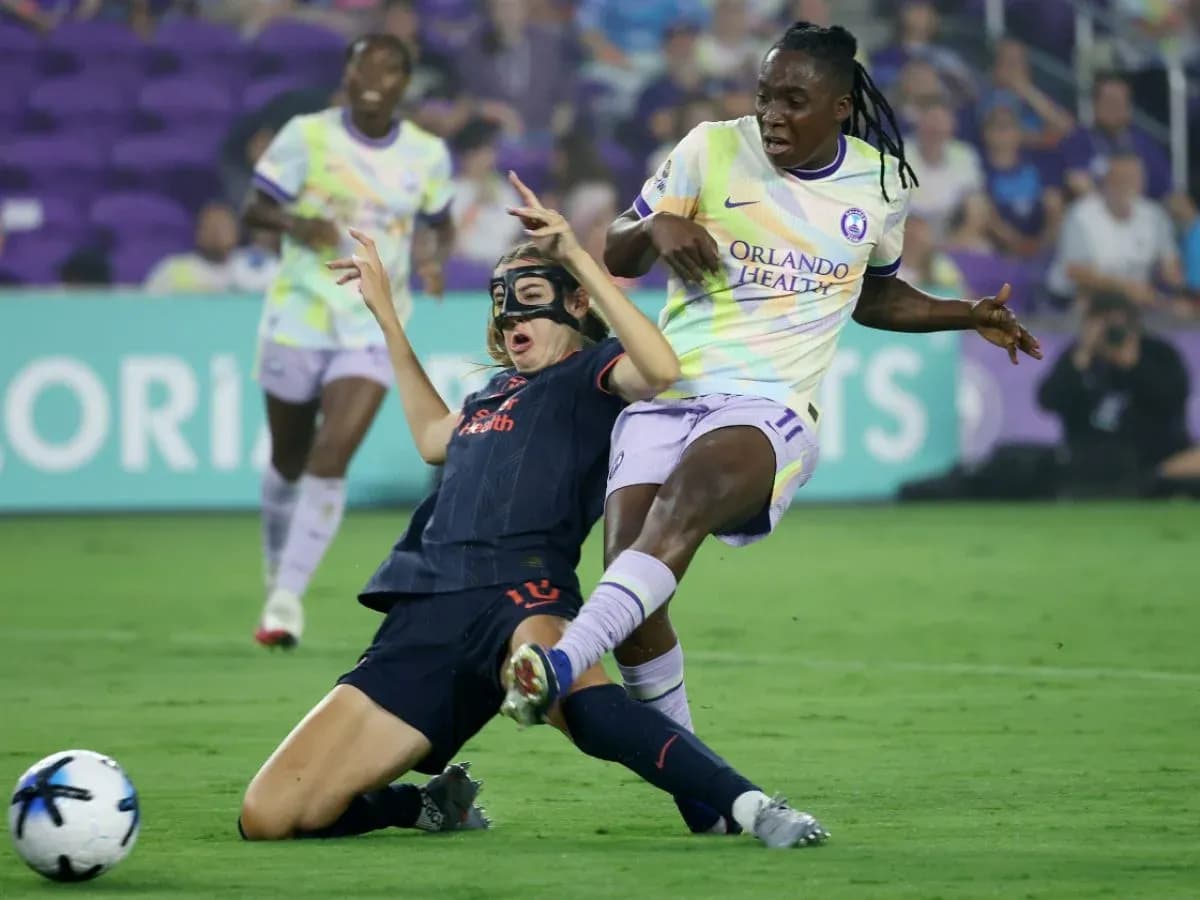
Hunter vs Shield was always going to be Banda against Bay FC’s leaky defence. Banda entered as the league’s leading scorer for Orlando with 8 goals from 12 appearances, off 41 shots and 23 on target. She is not just prolific; she is relentless, having drawn 25 fouls and attempted 25 dribbles. Her presence alone bends defensive lines.
Bay FC’s “shield” has been porous all season: 17 goals conceded overall in 11 games, with 9 of those shipped on their travels. Their biggest away defeat, 3–0, already hinted at what happens when the first line of pressure is broken. In Orlando, Banda’s constant vertical runs and physical duels (102 overall, 44 won) forced Collins and Courtnall to defend facing their own goal, exactly where Bay FC have looked most uncomfortable.
The engine-room duel pitted Orlando’s double pivot of Hanson and Lemos against Bay’s ball-winning axis of Hutton and Bebar. Hutton, one of the league’s most industrious midfielders, came in with 29 tackles, 2 blocked shots and 23 interceptions, plus 418 completed passes at 77% accuracy. She is Bay FC’s metronome and enforcer rolled into one, but she was asked to do too much.
Orlando cleverly overloaded her zone. Luana drifted inside from the left, Payne tucked into the right half-space, and Abello popped up between the lines. This created a rotating triangle around Hutton, forcing her to choose between stepping to the ball or screening Banda. Every choice opened another passing lane. When Orlando accelerated in transition, Hutton’s duels (112 overall, 64 won) became firefighting actions rather than proactive control.
On the flanks, Mace’s influence was quietly decisive. With 26 tackles, 4 blocked shots and 24 interceptions this season, she is Orlando’s defensive barometer. Her timing in stepping out of the line allowed Orlando to keep Kundananji and Huff from turning in dangerous areas, pinning Bay’s wingers deeper than Coates would have liked.
IV. Statistical Prognosis – xG Shape Without the Numbers
Even without explicit xG values, the statistical scaffolding points to a game Orlando were more likely to tilt in their favour. At home they average 1.7 goals for and 1.5 against; Bay FC on their travels average 1.0 for and 1.8 against. Layer Orlando’s unbeaten home scoring record onto Bay’s habit of conceding multiple away, and a home win with a multi-goal margin aligns with the underlying trends.
Defensively, Orlando’s overall concession rate of 1.4 per game is not elite, but it is balanced by their four clean sheets and just one overall failure to score. They can afford to trade chances because Banda’s finishing and the volume of shots she generates tilt the probability curve their way.
For Bay FC, the prognosis is harsher. Five overall games without scoring, only 9 goals in 11 matches, and a back line that bends under sustained pressure make them heavily reliant on tight, low-event contests. Once Orlando turned this into a running match, Bay’s discipline patterns and defensive averages suggested the dam would eventually break.
Following this result, Orlando’s 3–1 victory feels less like an outlier and more like the logical extension of their season-long metrics: a side that always backs its attack at home, anchored by the league’s most ruthless hunter in Banda, against a visiting defence that has yet to find a reliable shield on its travels.