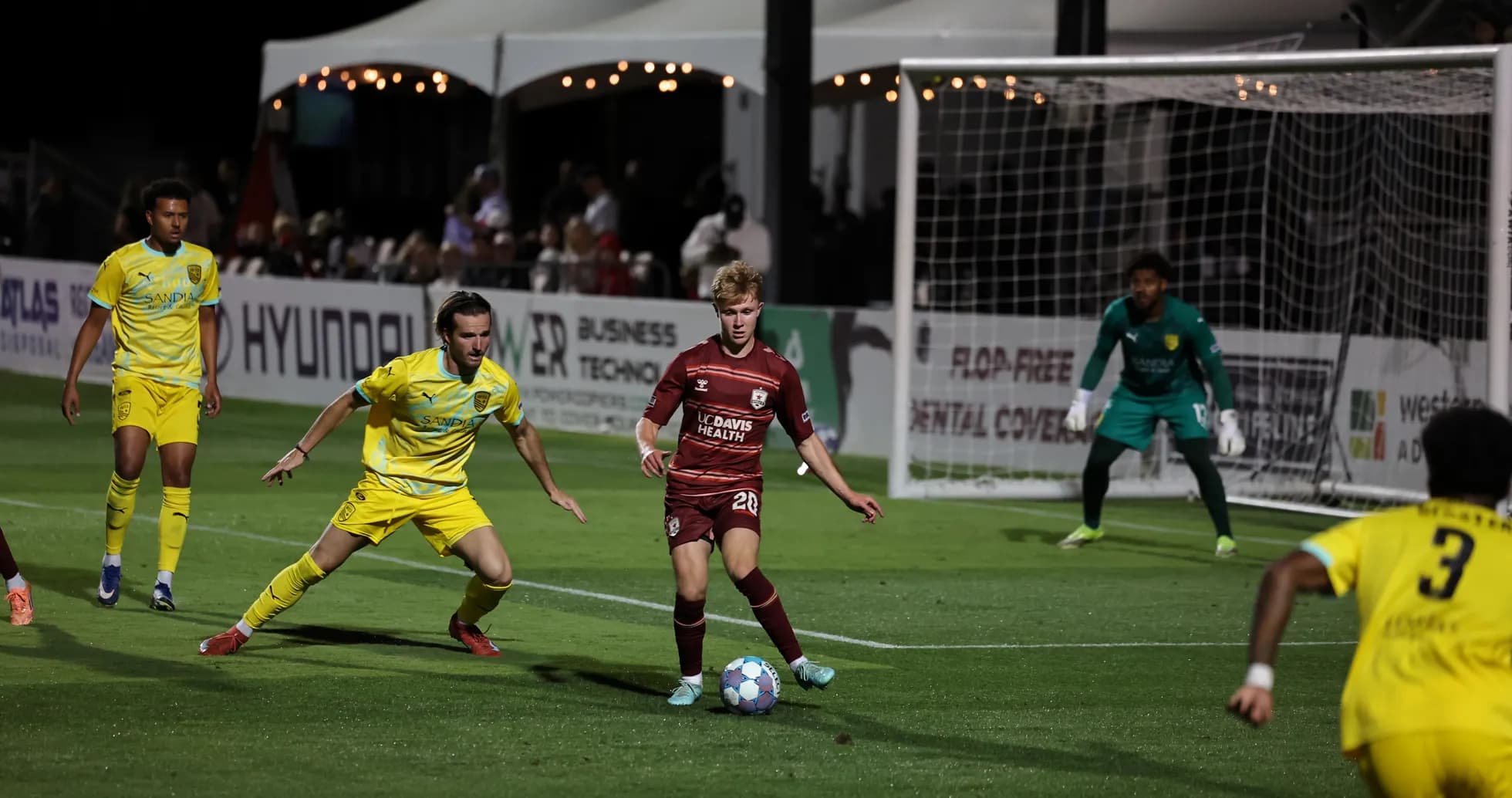
Monterey Bay Grinds Out 1–0 Victory Over El Paso Locomotive
Cardinale Stadium under the lights, a tight 1–0 scoreline, and two teams whose seasons are pulling in opposite directions: this was Monterey Bay against El Paso Locomotive in microcosm. In the USL Championship Group Stage, the hosts arrived as a paradoxical 12th-place side: fragile overall, yet quietly formidable at home. El Paso, 9th in the same group, carried the profile of a dangerous traveler but a brittle collective. Over 90 minutes, Monterey Bay leaned into their home identity and recent form to grind out a win that felt more like a statement of who they have become than a one-off upset.
Monterey Bay's Season Overview
Heading into this game, Monterey Bay’s season had been split along a clear fault line. Overall they had taken 14 points from 14 matches, with a goal difference of -8 (14 scored, 22 conceded). But at Cardinale Stadium, the numbers told a different story: 4 wins from 8, 10 goals scored and only 8 conceded. An average of 1.3 goals for and 1.0 against at home framed them as a compact, opportunistic side who could live with suffering long spells without the ball. Their form line – “WLWWW” in the standings – suggested a team finally learning how to close games.
El Paso's Profile
El Paso’s profile was almost inverted. Overall they were level in goals, 23 for and 23 against, with 16 points from 13 matches and a neutral goal difference of 0. But away from home they were efficient and ruthless: 3 wins, 2 draws, 2 defeats, 13 goals scored and only 7 conceded, an away average of 1.9 goals for and 1.0 against. Locomotive were built to punch on their travels, often more composed outside El Paso than within it.
Lineups and Tactics
Against that backdrop, the lineups offered a first glimpse of how each coach wanted to tilt the balance. Alex Covelo’s Monterey Bay XI was heavy on industry and balance. J. Jackson anchored the side, with N. Gordon and Z. Farnsworth forming part of a defensive core that has quietly underpinned those home clean sheets. O. Glasgow and J. Garcia brought legs and aggression, while R. Nakamura and N. Ross added structural discipline. Further forward, W. Leggett and I. Paul offered width and direct running, and S. Lletget, wearing 88, gave Covelo a technical fulcrum between the lines.
On the bench, the options hinted at a second-half plan: A. Rebollar and J. Belmar as injection points for pace and pressing, G. Lomtadze and E. Blancas as technical reinforcements, and defenders like S. Ritchie and K. Egwu to lock things down if Monterey Bay were nursing a narrow lead. It was a squad built to adapt within a game rather than dominate it from the outset.
Junior Gonzalez’s El Paso XI was more expansive on paper. S. Mora-Mora in goal, shielded by a back line including A. Quezada, N. Cardona, K. Twumasi and Tony Alfaro, suggested a unit comfortable defending higher and wider. In front of them, Gabriel Torres, A. Mendez and R. Coronado provided progression from deep, with E. Calvillo and R. Avila linking midfield to attack. At the tip, R. Rubin was the reference point – a classic “Hunter” tasked with converting the away side’s superior attacking averages into goals.
El Paso’s bench carried different weapons: A. Romero as an alternative presence up front, D. Abitia as a direct attacking threat, G. Diaz for creativity, and D. Gomez plus N. Dollenmayer and O. Mora to reshuffle the back line. With 4 penalties taken and 4 scored in total this season, Locomotive also arrived with the confidence of a side that punishes mistakes in the box.
Defensive Strategies
Tactically, the clash was defined by how Monterey Bay’s defensive DNA at home would stand up to El Paso’s away firepower. Heading into this game, Monterey Bay had kept 3 clean sheets, all at Cardinale Stadium. They conceded an average of 1.0 goal at home, and their disciplinary map painted them as a team that grew more combative as matches wore on: 28.21% of their yellow cards between 61–75 minutes, and 23.08% between 76–90. They are a side that lives on the edge late in games, pressing and tackling with rising intensity.
El Paso’s card profile, by contrast, showed a different volatility. A significant chunk of their yellow cards clustered between 31–75 minutes, with 21.21% between 31–45, 27.27% between 46–60, and another 27.27% from 61–75. Their red cards were scattered early and mid-game, including dismissals in the 0–15 and 16–30 ranges. This is a team that can lose control of the emotional tempo, especially as they try to assert themselves in the middle third of matches.
Key Matchups
In narrative terms, the “Hunter vs Shield” duel was Rubin against a Monterey Bay back line that, at home, concedes just 1.0 goal on average and has already shown it can completely shut down opponents. Without detailed xG data, the contours were still clear: El Paso’s total scoring average of 1.8 goals per match versus Monterey Bay’s total concession rate of 1.6, but crucially, that drops to 1.0 at Cardinale Stadium. The Shield was reinforced by context.
The “Engine Room” confrontation revolved around S. Lletget and E. Calvillo. Lletget, as Monterey Bay’s most natural organizer, was tasked with linking Nakamura, Ross and the wide runners into coherent attacks, especially in transition. Calvillo, for El Paso, had to dictate tempo and break Monterey Bay’s rhythm, feeding Rubin and the wide forwards before the home block could settle. With El Paso’s away defensive average a stingy 1.0 goal conceded per match, the battle for second balls and set-piece territory was always going to be decisive.
Post-Match Analysis
Following this result, the story is that Monterey Bay’s home identity held firm. They took their chance, protected a 1–0 lead, and leaned on a defensive structure that has become their competitive edge. El Paso, for all their away threat, were shut out – a rare event for a side averaging 1.9 goals on their travels.
From a statistical prognosis perspective, this match fits the emerging pattern more than it breaks it. Monterey Bay remain a low-scoring but resilient home side, still averaging 1.3 goals for and 1.0 against at Cardinale Stadium, while El Paso’s overall balance of 23 scored and 23 conceded underscores a team whose margins are thin. Without explicit xG numbers, the defensive solidity and home-away splits suggest this kind of narrow Monterey Bay win was not an anomaly, but the logical outcome when a disciplined Shield meets a sometimes-erratic Hunter on the Shield’s own ground.