Liverpool vs Brentford Tactical Analysis: Control and Resilience
Liverpool’s 1-1 draw with Brentford at Anfield was tactically defined by control versus resilience: Arne Slot’s side imposed their 4-2-3-1 structure and territorial dominance, while Keith Andrews’ identically shaped 4-2-3-1 leaned on compactness, counter-threat and a disciplined, sometimes fractious, defensive block.
Liverpool’s shape was clear from the outset. In possession, the nominal back four of C. Jones, I. Konaté, V. van Dijk and A. Robertson behaved more like a three-plus-one platform. Jones, starting as a right-sided defender, regularly stepped into the right half-space to support D. Szoboszlai and M. Salah, while Robertson provided classic width on the left. The double pivot of R. Gravenberch and Alexis Mac Allister underpinned this structure, with Mac Allister the deeper distributor and Gravenberch more willing to drive vertically and support the press.
Ahead of them, the trio of R. Ngumoha (left), Szoboszlai (central) and Salah (right) operated between Brentford’s lines, trying to overload the pockets around J. Henderson and Vitaly Janelt. C. Gakpo, as the lone forward, often dropped short to create a 4-2-4-0 look in buildup, dragging centre-backs out and opening lanes for third-man runs from the attacking midfielders.
The statistical profile underlines Liverpool’s territorial control. They posted 60% ball possession, 503 passes with 434 accurate (86%), and generated 24 total shots, including 17 from inside the box. The 2.9 xG reflects not just volume but the quality of chances created through repeated incursions into the penalty area. Eight shots on goal and eight blocked shots show a side that consistently reached the final third but faced a Brentford block willing to throw bodies in front of efforts.
The breakthrough on 58' captured Liverpool’s positional ideas. C. Jones, stepping high from his nominal defensive berth, finished a move assisted by M. Salah. The right flank overload – Jones, Szoboszlai, Salah combining – finally broke Brentford’s resistance, illustrating how Slot’s use of an inverted full-back was designed to add an extra man between lines rather than merely overlap on the outside.
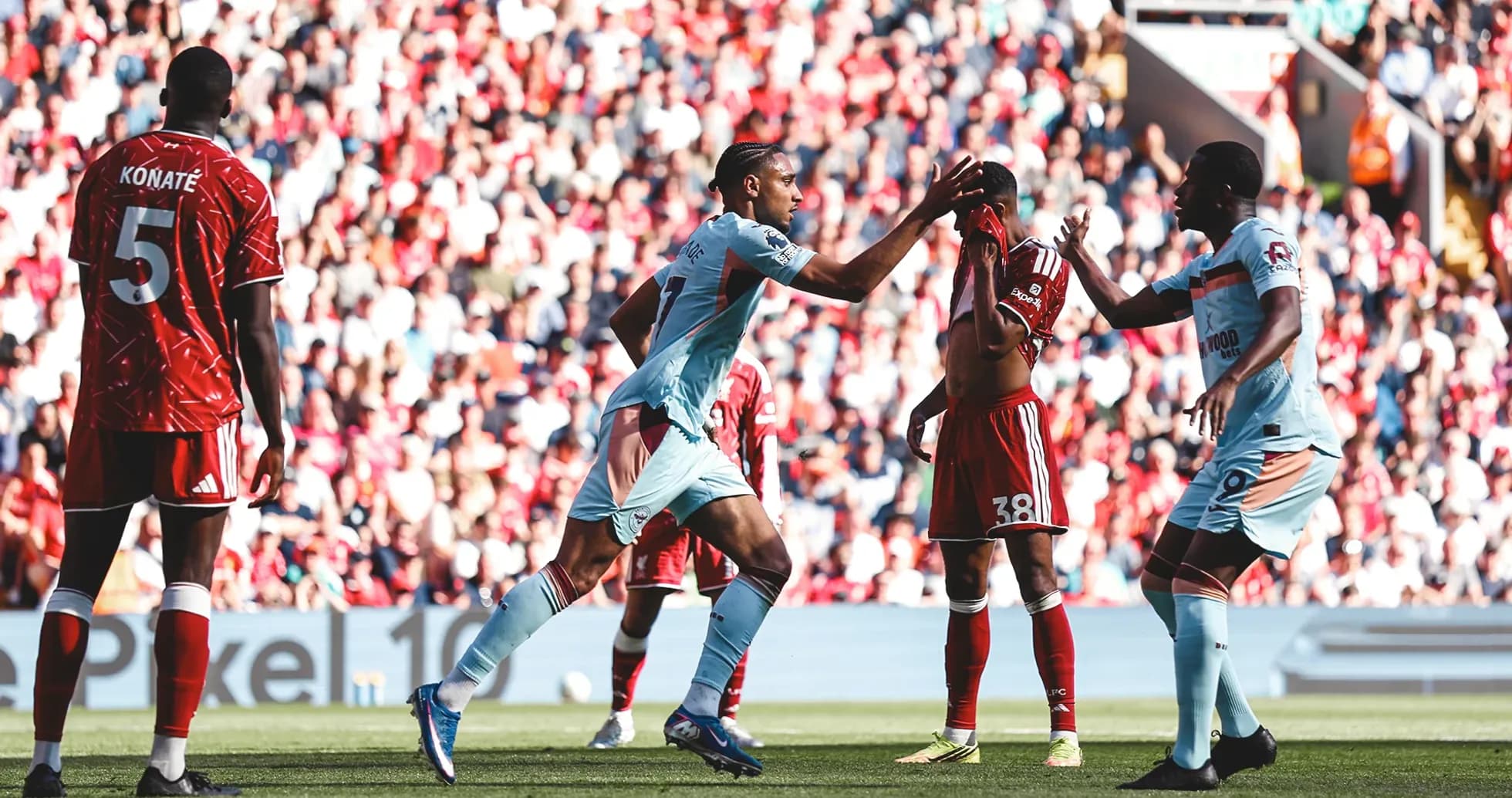
Brentford’s equaliser on 64' through K. Schade, however, exposed the risk in Liverpool’s structure. With both full-backs aggressive and the double pivot pushed up to sustain pressure, Brentford looked to exploit transitional moments. Their 4-2-3-1 out of possession was narrow and compact, but in transition they released Schade and the wide midfielders quickly into the spaces vacated by Liverpool’s advanced back line. The visitors produced only 11 total shots and 2 on goal, but their 1.22 xG suggests that when they did arrive in the box (9 shots inside), the situations were relatively clear.
Out of possession, Liverpool pressed assertively. The front four oriented themselves on Brentford’s back line and double pivot, with Gakpo and Szoboszlai triggering pressure on centre-backs and Mac Allister stepping up selectively on Henderson or Janelt. This front-foot approach limited Brentford to 331 passes (262 accurate, 79%), reflecting a game in which the visitors rarely strung together long phases of controlled buildup. However, Brentford’s willingness to go more direct, especially from C. Kelleher’s restarts and early balls into I. Thiago and the wide runners, allowed them to bypass the press at times.
The substitutions in the second half subtly reshaped Liverpool’s attacking pattern. At 73', F. Wirtz (IN) came on for R. Ngumoha (OUT), adding a more intricate, combination-focused presence on the left. A minute later, at 74', J. Frimpong (IN) replaced M. Salah (OUT), providing fresh legs and more direct running from the right side. Later, M. Kerkez (IN) for A. Robertson (OUT) at 83' and T. Nyoni (IN) for R. Gravenberch (OUT) in the same minute injected energy and maintained the aggressive full-back and midfield lines. Finally, J. Gomez (IN) for I. Konaté (OUT) on 89' offered a like-for-like defensive change, potentially aimed at managing physical load and shoring up against late counters.
Brentford’s changes were more about consolidating and refreshing the block. A. Hickey (IN) for J. Henderson (OUT) on 60' rebalanced the side, with Hickey offering defensive solidity and allowing adjustments in the back line or wide areas. At 83', M. Damsgaard (IN) replaced M. Jensen (OUT), giving Brentford a more technically creative outlet for counters, and at 89', R. Nelson (IN) came on for K. Lewis-Potter (OUT), keeping pace and pressing intensity on the flank as Liverpool pushed for a winner.
Discipline also framed the tactical tone. A pre-kickoff flashpoint saw Jordan Henderson (Brentford) booked for “Argument” at -5'. As Liverpool chased a late winner, Ibrahima Konaté (Liverpool) received a yellow card for “Foul” on 79', reflecting the risks taken to halt transitions. Deep in added time, Alexis Mac Allister (Liverpool) was cautioned for “Foul” at 90+2', while Brentford’s compact, combative stance culminated in bookings for Nathan Collins (“Argument”, 90+5') and Vitaly Janelt (“Argument”, 90+4') as tensions rose.
In goal, Alisson (Liverpool) had a relatively quiet but high-stakes afternoon, officially making 1 save. The goals prevented figure of 1.4 indicates that when Brentford did carve out chances, they were of sufficient quality to demand decisive interventions and strong positioning. At the other end, C. Kelleher (Brentford) made 7 saves and, crucially, matched Alisson’s 1.4 goals prevented. That alignment between Liverpool’s 2.9 xG and the final 1-1 scoreline is largely explained by Kelleher’s performance and Brentford’s commitment to blocking – 3 blocked shots on top of his saves – under constant pressure.
Statistically, Liverpool’s 14 corner kicks to Brentford’s 2, and equal foul count (9-9), underscore a game played mostly in Brentford’s half but with the visitors defending aggressively and occasionally on the edge. The draw will feel underwhelming for Liverpool given the xG and shot dominance, but from a tactical lens it highlights both the effectiveness of Slot’s possession framework and the lingering vulnerability to quick counters when full-backs and pivots are simultaneously advanced. For Brentford, the point validates a game plan built on structural discipline, direct transitions, and a standout display from Kelleher in goal.