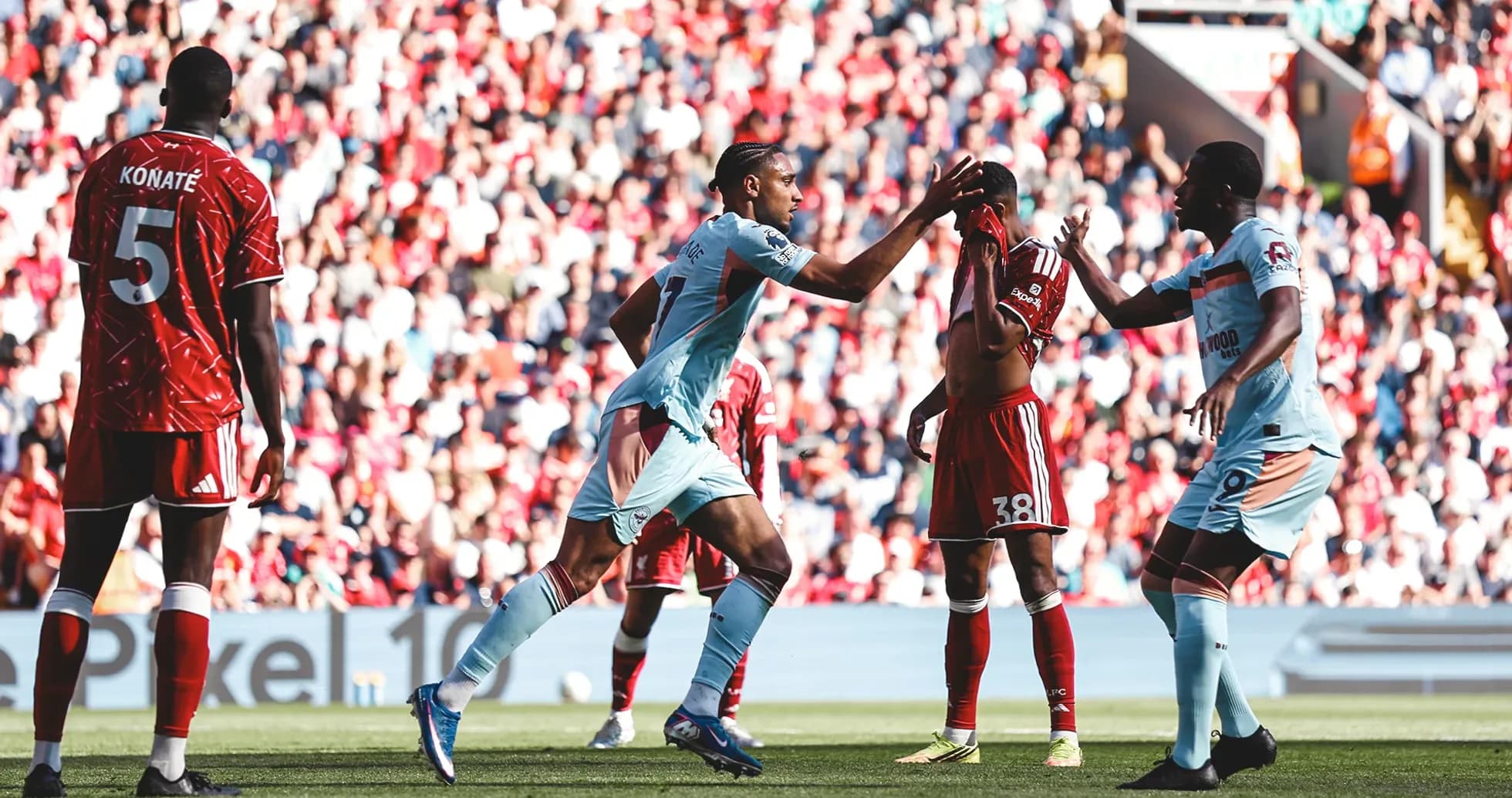
Liverpool and Brentford End Premier League Season in Stalemate
Anfield’s final act of the 2025–26 Premier League season ended not with a flourish, but with a stalemate that told a deeper story about both sides. Liverpool 1–1 Brentford, under the eye of Darren England, closed out Round 38 with a result that crystallised their seasonal identities: Liverpool finishing 5th on 60 points, Brentford 9th on 53.
Following this result, the numbers are stark. Overall, Liverpool’s campaign reads 17 wins, 9 draws, 12 defeats from 38 matches, with 63 goals scored and 53 conceded – a goal difference of +10. At Anfield they remained a strong, if not ruthless, force: 10 home wins, 6 draws, 3 losses, scoring 34 and conceding 20. Brentford, meanwhile, completed a quietly impressive season: 14 wins, 11 draws, 13 defeats, with 55 goals for and 52 against, a goal difference of +3. On their travels they were more fragile – 6 away wins, 3 draws, 10 defeats, 22 scored and 31 conceded – but resilient enough to finish in the top half.
Both sides lined up in a 4-2-3-1, mirroring shapes but not intentions. Arne Slot doubled down on Liverpool’s season-long blueprint – this was their 35th league outing in that system – while Keith Andrews leaned into Brentford’s own 4-2-3-1 identity, used 29 times. The 1–1 draw felt less like two teams cancelling each other out and more like two different versions of control colliding: Liverpool’s territorial dominance versus Brentford’s vertical punch.
Tactical Voids and the Cost of Absence
The team sheets carried absences that shaped the contest in subtle ways. For Liverpool, S. Bajcetic (hamstring), C. Bradley (knee), H. Ekitike (Achilles) and G. Leoni (knee) were all ruled out. The loss of Ekitike, Liverpool’s 11-goal forward in the league, removed a direct, penalty-box threat from Slot’s bench options. With Cody Gakpo starting as the nominal striker and Mohamed Salah and Dominik Szoboszlai operating behind, Liverpool retained creativity but lacked a pure finisher to change the rhythm late on.
Brentford travelled without F. Carvalho (knee), R. Henry (hamstring) and A. Milambo (knee). Henry’s absence in particular nudged Andrews into a slightly improvised back four, with K. Lewis-Potter deployed as a defender. It underlined Brentford’s willingness to adapt, but also hinted at vulnerability down that flank against Salah and the overlapping A. Robertson.
Disciplinary trends from the season also cast a long shadow over how both coaches managed the tempo. Liverpool’s yellow-card profile shows a pronounced late-game surge: 31.58% of their league yellows arrived between 76–90 minutes, with another 17.54% between 91–105. Brentford mirrored that late volatility: 26.09% of their yellows came from 76–90, and 21.74% between 61–75. This history of late bookings forced both midfields to walk a tightrope as the match opened up, particularly for high-intensity pressers like Szoboszlai and Brentford’s K. Schade, who has accumulated 6 yellows and 1 red this season.
Importantly, Liverpool’s only league red card came from Szoboszlai, while Brentford’s sole dismissal was Schade’s. That shared edge meant the final quarter of an already tense game was played with an undercurrent of caution, each coach aware that one mistimed challenge could tilt the balance.
Key Matchups – Hunter vs Shield, Engine Room vs Enforcer
The headline duel was always going to revolve around Igor Thiago. Brentford’s No. 9 has been one of the league’s most ruthless finishers: 22 goals and 1 assist from 38 appearances, with 67 shots and 43 on target. He also converted 8 penalties but missed 1, a reminder that even his clinical edge has a crack in it. His presence at Anfield was the purest expression of Brentford’s threat: a focal point capable of punishing any lapse from Liverpool’s back line.
Opposite him stood a Liverpool defence that, at home, has been significantly tighter than on their travels. At Anfield they conceded 20 goals in 19 matches, an average of 1.1 per game, anchored by V. van Dijk and I. Konate in front of Alisson. Over the season, Liverpool kept 10 clean sheets in total, split evenly between home and away. The 1–1 scoreline underlined a familiar pattern: Liverpool generally control territory, but a single moment can still breach them.
Further up the pitch, the “Engine Room” battle was defined by creative gravity versus disruptive energy. For Liverpool, Szoboszlai and Salah form a dual axis. Szoboszlai’s league numbers – 6 goals, 7 assists, 78 key passes and 55 tackles, with 8 blocked shots – paint the picture of a complete midfielder, just as capable of threading passes as breaking up play. Salah, with 7 goals and 7 assists plus 49 key passes, remains the conduit through which Liverpool’s best attacking sequences flow.
Brentford countered with the double pivot of J. Henderson and V. Janelt screening in front of the back four, and the creative trio of D. Ouattara, M. Jensen and Schade behind Thiago. Schade’s season – 8 goals, 3 assists, 45 shots (24 on target), 29 key passes and 40 tackles – makes him both a pressing trigger and a transition spear. His 2 penalties won but 1 missed also underline his high-risk, high-impact profile.
In this match, that meant Liverpool’s advanced midfielders had to constantly track runners from deep while still providing service to Gakpo. Szoboszlai’s tendency to step high into the half-spaces pulled Henderson and Janelt into awkward zones, but Brentford’s structure, with Jensen knitting play and Schade attacking the channels, ensured Thiago was never entirely isolated.
Statistical Prognosis and What the Draw Reveals
Following this result, the underlying season metrics still frame Liverpool as the more expansive, if volatile, side. Overall they averaged 1.7 goals scored and 1.4 conceded per game, with 4 total failures to score and 10 clean sheets. At home, their attacking output was stronger: 1.8 goals scored on average and 1.1 conceded. Brentford’s profile is more balanced but slightly less explosive: overall 1.4 goals scored and 1.4 conceded per match, with 12 total blanks and 10 clean sheets. Away from home, their attack dipped to 1.2 goals on their travels, while conceding 1.6.
Translating those numbers into an xG-style reading of the Anfield draw, Liverpool’s structure and home scoring rate suggest they likely generated the higher volume and quality of chances, especially with Salah, Gakpo and Szoboszlai all on the pitch. Brentford, by contrast, came with a narrower margin for error but a sharper spearhead in Thiago, whose shot efficiency and penalty record (8 scored, 1 missed) make him a persistent over-performer relative to typical chance volumes.
The 1–1 therefore fits a logical statistical narrative: Liverpool’s systemic control producing enough to score once but not break a disciplined block, Brentford’s compactness and set-piece or transition threat – funneled through Thiago and Schade – yielding a goal of their own. Defensive solidity, rather than attacking chaos, ultimately dictated the equilibrium.
In total this campaign, Liverpool’s 60-point haul and Brentford’s 53 underline that both clubs have coherent identities: Liverpool as a high-usage, high-creation side occasionally undermined by defensive lapses; Brentford as a compact, punchy outfit whose efficiency in both boxes keeps them competitive. This final-day draw at Anfield did not just share the points; it mirrored, almost perfectly, who these teams have been all season.