USA's Tactical Efficiency in 2-0 Victory over Bosnia & Herzegovina
USA’s 2-0 win over Bosnia & Herzegovina at Levi's Stadium in this World Cup Round of 32 tie was defined by structural clarity and superior penalty-box efficiency rather than territorial dominance. Despite trailing 48–52 in possession and facing 10 men for the final 26 minutes, Bosnia & Herzegovina never converted their territorial edge into real threat, finishing with just 3 shots on goal from 10 attempts and a modest 0.25 xG. USA, set up in a 4-3-3 by Mauricio Pochettino, used verticality and front-three movement to manufacture higher-quality chances (0.92 xG) and struck at key moments through Folarin Balogun and Malik Tillman.
Bosnia & Herzegovina, in Sergej Barbarez’s 5-3-2, aimed to control rhythm through their back five and three-man midfield, but their possession was largely sterile. USA’s compact mid-block and aggressive first line forced play wide, where Bosnia & Herzegovina’s wing-backs struggled to deliver decisive actions. Even after Balogun’s red card, USA’s defensive structure held, protecting the central lane and forcing Bosnia & Herzegovina into low-value efforts from outside or crowded positions.
USA’s Formation
USA’s 4-3-3 was built on a clear spine. Matthew Freese (USA) in goal sat behind a back four of Alexander Freeman, Chris Richards, Tim Ream and Antonee Robinson. In front, Tyler Adams anchored as the single pivot, flanked by Weston McKennie and Malik Tillman as the advanced interiors. The front three of Sergiño Dest, Balogun and Christian Pulišić provided width and depth, with Dest high on the right and Pulišić attacking from the left half-space.
Out of possession, USA defended in a 4-1-4-1/4-5-1 hybrid. Adams screened central passes into Bosnia & Herzegovina’s forwards Edin Džeko and Ermedin Demirović, while McKennie and Tillman jumped to press the opposition midfield three. This structure limited Bosnia & Herzegovina to 5 shots inside the box from 10 total, with 3 blocked. The USA back line held a relatively high starting position but was protected by coordinated pressure on the ball; Bosnia & Herzegovina’s 446 passes (364 accurate, 82%) rarely broke the second line cleanly.
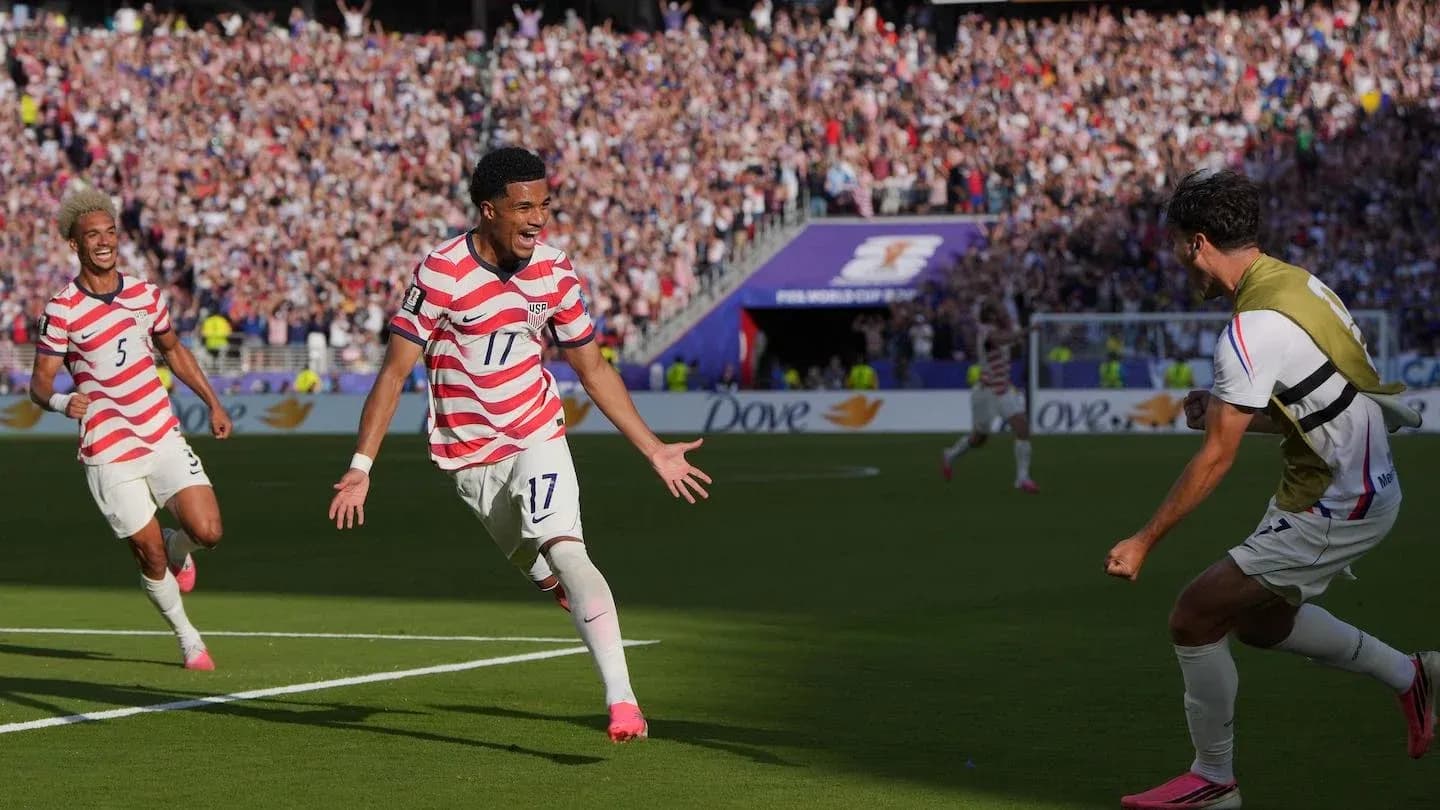
With the ball, USA’s approach was direct and purposeful. Their 415 passes with 346 accurate (83%) underline a slightly lower volume but comparable precision. The key difference was where those passes were played: USA sought to connect quickly from Adams into the advanced eights and wide forwards, generating 6 of their 8 total shots from inside the box. Balogun’s 45' goal reflected this emphasis on timing and central occupation—USA’s attacking patterns consistently tried to isolate him between centre-backs or on the blind side of the back five.
Bosnia & Herzegovina’s Formation
Bosnia & Herzegovina’s 5-3-2, anchored by Nikola Vasilj in goal behind a line of Amar Dedić, Nikola Katić, Tarik Muharemović, Stjepan Radeljić and Sead Kolašinac, was initially conservative. The wing-backs were cautious in the first half, wary of USA’s wingers in transition. Their midfield of Armin Gigović, Ivan Šunjić and Kerim Alajbegović struggled to progress centrally against USA’s three, often forced to recycle across the back line. The forwards Džeko and Demirović were left to operate on limited service, frequently dropping deep to connect play but thereby vacating the penalty area.
Barbarez’s triple substitution at 51' — Esmir Bajraktarević (IN) came on for Armin Gigović (OUT), Benjamin Tahirović (IN) came on for Ivan Šunjić (OUT), and Ermin Mahmić (IN) came on for Edin Džeko (OUT) — was a clear attempt to add energy and vertical running between the lines. Later, Haris Tabaković (IN) came on for Sead Kolašinac (OUT) and Amar Memić (IN) came on for Nikola Katić (OUT) at 75', shifting emphasis further towards attacking presence and loosening the back-five rigidity. However, these changes coincided with USA tightening their block and, after the red card, dropping into a deeper, narrower 4-4-1, which nullified the extra forwards.
Turning Points
The turning disciplinary moment came at 64', when Folarin Balogun (USA) received a straight red card for “Serious foul”. Reduced to ten men, USA reconfigured: Dest and Pulišić were later withdrawn, with Sebastian Berhalter (IN) coming on for Sergiño Dest (OUT) at 87', Ricardo Pepi (IN) coming on for Christian Pulišić (OUT) at 88', and Giovanni Reyna (IN) coming on for Weston McKennie (OUT) at 90+5'. These substitutions reinforced central stability and ball retention, with Berhalter and Reyna helping USA to manage the closing stages by offering secure outlets and positional discipline.
Bosnia & Herzegovina’s frustration surfaced in discipline. At 80', the bench was cautioned when S. Barbarez (Bosnia & Herzegovina) received a yellow card, followed moments later by Stjepan Radeljić (Bosnia & Herzegovina) booked for “Holding”. These incidents mirrored a tactical picture in which Bosnia & Herzegovina, despite their 52% possession and 13 fouls committed, were chasing the game and increasingly resorting to physical interventions to halt USA counters.
Goalkeeping Performance
In goal, Matthew Freese (USA) made 3 saves, aligning closely with Bosnia & Herzegovina’s 3 shots on target. His interventions, combined with USA’s 2 blocked shots, ensured that Bosnia & Herzegovina’s limited xG never translated into a realistic route back. At the other end, Nikola Vasilj (Bosnia & Herzegovina) recorded 0 saves, a direct reflection of USA’s ruthless finishing: both of their shots on goal found the net. The goals prevented metric at -1.73 for both teams underscores that the finishing in this match exceeded the underlying shot quality, particularly on USA’s side.
Statistical Overview
Statistically, USA’s 2-0 victory was built on efficiency and structure rather than volume. They produced fewer total shots (8 to 10) and slightly less possession, but concentrated their attacks in high-value zones (6 shots inside the box) and converted both efforts on target. Their xG of 0.92 versus Bosnia & Herzegovina’s 0.25 confirms that, while the game was not chance-heavy, USA consistently generated the better opportunities.
Defensively, USA’s lower foul count (7 to 13) and single red card speak to a generally controlled approach, with the dismissal an isolated incident rather than a systemic lack of discipline. Bosnia & Herzegovina’s higher foul volume and two yellow cards, including the “Holding” infringement by Radeljić, reflected their struggle to contain USA’s transitions and late-game counters.
Conclusion
From a broader tactical lens, this Round of 32 tie illustrated a classic knockout pattern: the side with clearer attacking mechanisms and better penalty-box occupation prevailed over a team that had more of the ball but less clarity in the final third. USA’s 4-3-3, anchored by Adams and empowered by the movements of Balogun, Pulišić and Tillman, proved more coherent and decisive than Bosnia & Herzegovina’s evolving 5-3-2, sending Pochettino’s team into the next round with both a clean sheet and a template for pragmatic, knockout football.