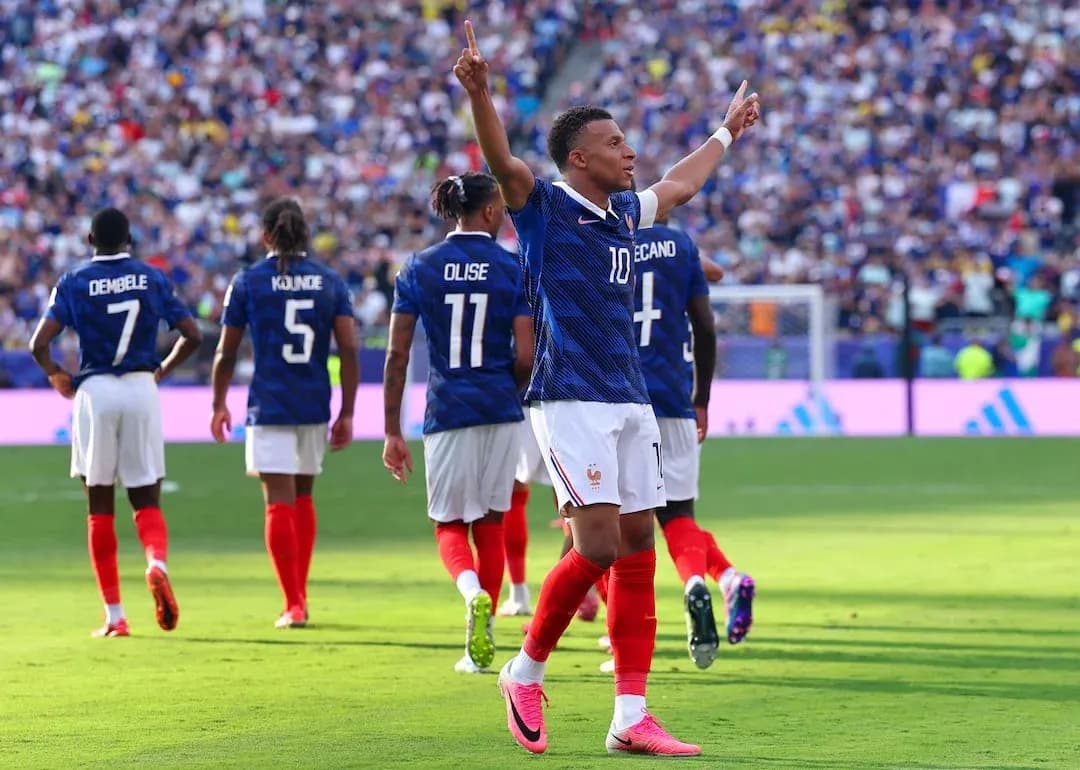
France Dominates Sweden in World Cup Round of 32 Clash
MetLife Stadium in New-York staged a Round of 32 meeting that always felt like a clash of identities as much as a knockout tie: France, rolling in with a perfect group campaign, against a Sweden side still trying to reconcile its attacking potential with a fragile defensive record. The 3–0 full-time scoreline in favour of France underlined the gulf, but the squads and their tactical profiles tell a deeper story of why this matchup tilted so decisively blue.
I. The Big Picture – Seasonal DNA and Structural Certainties
Heading into this game, France arrived as the form side of the World Cup. They topped Group I with 9 points from 3 matches, a goal difference of 8 built from 10 goals scored and 2 conceded overall. Their broader tournament profile only reinforced that dominance: across all venues they had played 4 fixtures, winning all 4, with 13 goals for and just 2 against in total. At home they averaged 3.0 goals scored and 0.3 conceded, while on their travels they were even more ruthless in attack with 4.0 goals scored and 1.0 conceded on average.
Sweden, by contrast, came into the Round of 32 with a more volatile identity. Their group campaign produced 4 points from 3 games, with 7 goals scored and 7 conceded overall for a neutral goal difference of 0. Across the tournament they had played 4 fixtures in total, winning 1, drawing 1 and losing 2. At home they were explosive but untested defensively over a small sample, scoring 5.0 goals and conceding 1.0 on average. Away, however, they were far more constrained: only 0.7 goals scored and a worrying 3.0 conceded on average, with 9 goals shipped on their travels in total. That away fragility set the stage for what France would repeatedly exploit.
Didier Deschamps stayed faithful to France’s established 4-2-3-1, a structure they had used in all 4 matches of this World Cup. Graham Potter’s Sweden, by contrast, arrived in a 4-4-2 after experimenting with three-at-the-back systems earlier in the tournament. That shift was a clear attempt to stabilise a defence that had already absorbed heavy blows away from home.
II. Tactical Voids – Lineups, Balance and Discipline
France’s starting XI had the air of inevitability. Mike Maignan anchored the side in goal, with a back four of Jules Kounde, Dayot Upamecano, William Saliba and Lucas Digne. In front of them, the double pivot of Aurelien Tchouameni and Adrien Rabiot provided the platform, freeing a devastating line of three – Ousmane Dembele, Michael Olise and Bradley Barcola – behind Kylian Mbappe as the lone forward.
This configuration crystallised France’s tournament profile: an aggressive, high-technical front four supported by a physically dominant and positionally disciplined spine. They had kept 2 clean sheets in total, failed to score in none of their 4 games, and had no penalties awarded or missed, meaning their output was built almost entirely from open play and structured attacking patterns.
Sweden’s 4-4-2 was more reactive. Johan Widell Zetterstrom started in goal behind a back line of Daniel Svensson, Gustaf Lagerbielke, Victor Lindelof and Gabriel Gudmundsson. The midfield four of Anthony Elanga, Lucas Bergvall, Yasin Ayari and Ethan Stroud was tasked with shuttling laterally to close French passing lanes, while Viktor Gyokeres and Alexander Isak led the line.
Yet the numbers hinted at cracks. Sweden had kept 0 clean sheets overall and had already failed to score once on their travels. Their disciplinary profile was also telling: 40.00% of their yellow cards in this World Cup came in the 76–90 minute window, a late-game surge that suggested a side often chasing, stretched and forced into recovery fouls. Bergvall, already on the tournament’s yellow-card radar with 1 caution in 4 appearances, embodied that edge, having committed 7 fouls in total.
France, by contrast, had drawn just a single yellow card in total, and that came between minutes 61–75 – a sign of control rather than chaos. No red cards for either side meant both managers had their full squads available and no suspensions altering the tactical blueprint.
III. Key Matchups – Hunter vs Shield, Engine Room Battles
The headline duel was always going to be Kylian Mbappe against Sweden’s back line. Mbappe arrived as the World Cup’s most devastating attacker: 6 goals and 2 assists in total, from 19 shots (13 on target), with an 8.65 average rating across 4 appearances. His movement off the left channel of France’s 4-2-3-1 forced Lagerbielke and Lindelof into constant decisions: step out and risk being spun, or sit deep and concede space for Olise and Dembele between the lines.
Supporting him, Dembele had 4 goals and 2 assists in total, while Olise led the entire tournament in assists with 5 overall. Together they formed a triple-threat that Sweden’s defence – which had already conceded 10 goals in total, 9 of them away – was ill-equipped to contain. France’s biggest away win of 4–1 underlined how lethal this attack could be once transitions opened up.
On the Swedish side, the “Hunter vs Shield” dynamic inverted. Gyokeres and Isak both arrived as creative outlets as much as finishers. Isak had 1 goal and 3 assists in total, while Gyokeres added 1 goal and 2 assists. Yet their influence depended heavily on Sweden’s ability to withstand pressure and spring forward. Against a French unit that had conceded only 2 goals overall and kept 2 clean sheets, those margins were always narrow.
The “Engine Room” duel pitted Tchouameni and Rabiot against Bergvall and Ayari. Bergvall’s numbers – 84 passes at 88% accuracy and 2 interceptions in total – painted him as Sweden’s most reliable distributor between lines. But the French pivot’s task was to smother that outlet, turning Sweden’s first pass into a pressing trigger. With Olise and Barcola pinching in, France could form a box in midfield, trapping Sweden’s central two and forcing longer, lower-percentage balls towards Gyokeres and Isak.
IV. Statistical Prognosis – Why 3–0 Felt Baked In
From a statistical and tactical standpoint, this fixture always leaned heavily towards France. Their overall scoring rate of 3.3 goals per match, combined with Sweden’s overall concession rate of 2.5 per game and 3.0 on their travels, suggested that if the game opened up, it would do so in one direction.
France’s defensive solidity – only 0.5 goals conceded per match overall – meant Sweden needed either an outlier finishing performance or set-piece dominance. Yet with no penalties taken or missed by either side in the tournament, and no evidence of France conceding many high-leverage chances, Sweden’s path was narrow.
The late-game disciplinary profile was the final clue. Sweden’s tendency to collect 40.00% of their yellows in the last quarter of normal time hinted at fatigue and stretched distances between lines. Against Mbappe, Dembele and Olise, that is precisely when space becomes fatal. Once France established control, the probability of them adding to the score rather than merely protecting it always looked higher.
In the end, the 3–0 full-time score at MetLife Stadium did not just reflect a good French night; it crystallised the structural realities of this World Cup. France’s coherent 4-2-3-1, powered by elite attacking talent and a miserly defence, met a Sweden side still searching for balance between ambition and protection. The numbers, the shapes and the narratives all pointed in the same direction – and the pitch simply confirmed it.