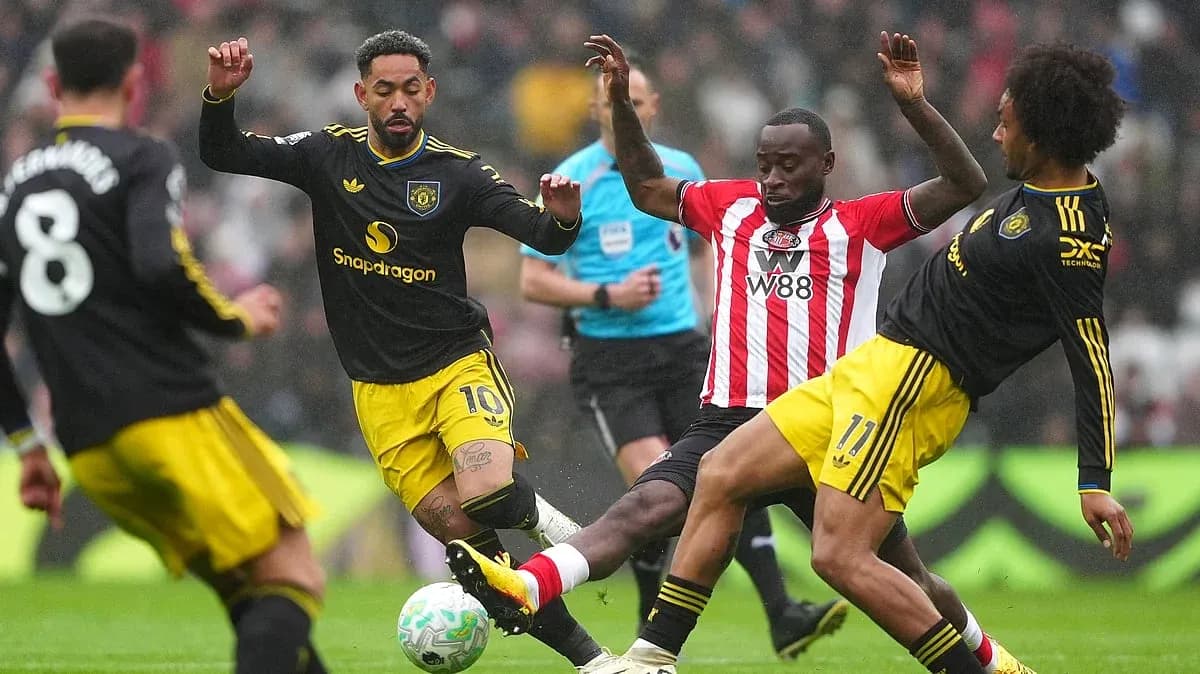
Sunderland vs Manchester United: Tactical Analysis of Goalless Draw
Sunderland and Manchester United played out a goalless draw at the Stadium of Light in Round 36 of the Premier League, but the 0–0 hides a clear tactical story. Regis Le Bris’ Sunderland controlled marginally more of the ball, generated the better chances, and forced Senne Lammens into four saves, while Michael Carrick’s United were restricted to a single shot on target and leaned heavily on their defensive structure. The draw reflects Sunderland’s territorial and chance-creation edge against a United side that struggled to progress centrally and increasingly resorted to managing space and transitions rather than actively chasing the win.
The disciplinary and event timeline underlines how the game’s intensity rose after the break. There were three yellow cards in total, all for Manchester United, and no reds: Sunderland: 0, Manchester United: 3, Total: 3.
Card Log
- 54' Mason Mount (Manchester United) — Foul
- 58' Joshua Zirkzee (Manchester United) — Foul
- 90+3' Matheus Cunha (Manchester United) — Simulation
Substitutions followed the same upward curve in tactical adjustment. At 65', Patrick Dorgu (IN) came on for Joshua Zirkzee (OUT), signaling a structural tweak from Carrick, likely adding defensive security on the flank and altering United’s first line of pressure. On 75', Bryan Mbeumo (IN) came on for Amad Diallo (OUT), a move to inject pace and more direct threat in transition. Le Bris waited until 79' to make his first change: Nilson Angulo (IN) came on for Chemsdine Talbi (OUT), refreshing Sunderland’s attacking midfield line and maintaining intensity between the lines. Finally, at 90', Eliezer Mayenda (IN) came on for Trai Hume (OUT), a late attacking substitution aimed at tilting the final minutes in Sunderland’s favour.
From a tactical standpoint, Sunderland’s approach was built on controlled possession and layered progression. With 51% of the ball, 493 total passes and an 84% pass completion rate, they showed a clear intent to construct from deeper zones. The back line of Lutsharel Geertruida, Nordi Mukiele, Omar Alderete and Reinildo Mandava provided a stable platform, with Granit Xhaka and Noah Sadiki anchoring midfield. Sunderland’s 15 total shots, including 9 inside the box, reflect a methodical plan: circulate through Enzo Le Fée and Talbi, then look to connect into Brian Brobbey’s feet or into the half-spaces for late midfield runs.
The shot profile (4 on goal, 6 off, 5 blocked) and xG of 1.25 show that Sunderland consistently reached good zones but met a compact United block around the edge of the area. Corners (6) and the ability to pin United back suggest repeated occupation of the final third, even if the final action lacked precision. The presence of Hume and Talbi as midfielders with wide tendencies likely gave Sunderland the width to stretch United’s back four, while Xhaka’s positioning helped recycle possession and prevent counters.
Manchester United, by contrast, played a more reactive game. Their 49% possession and 478 passes at 82% accuracy indicate they were not overwhelmed, but they struggled to convert possession into threat: only 11 shots total, with just 1 on target. That, combined with an xG of 0.62, paints the picture of a side largely limited to lower-quality looks, often from outside the box (5 shots from range) or under pressure. The equal number of fouls (12 each) shows United did compete physically, but their bookings — two for “Foul” and one for “Simulation” — point to moments where they were either late in duels or forced into riskier individual actions when chasing transitions.
Structurally, the starting midfield of Mason Mount, Kobbie Mainoo, Amad Diallo, Bruno Fernandes and Matheus Cunha behind Joshua Zirkzee should, in theory, offer fluid rotations and multiple ball-carrying options. In practice, the numbers suggest Sunderland’s central block, led by Xhaka and Sadiki, effectively compressed space between the lines. United’s 7 corners show they did reach the final third, but the lack of clear shots on target indicates Sunderland’s defenders were consistently able to contest deliveries and block attempts (Sunderland and United each recorded 5 blocked shots).
In goal, the contrast is telling. Robin Roefs made just 1 save, while Lammens was called upon 4 times. This aligns directly with the xG figures: both keepers are credited with 1.81 goals prevented, implying that when chances did arise, both were sharp, but the volume of work fell more heavily on Lammens. Sunderland’s defensive index in this match — inferred from allowing only 1 shot on target and an xG of 0.62 — is strong, reinforcing the idea that their structure without the ball was as effective as their possession game.
Statistically, Sunderland’s overall form in this fixture was that of a mid-table side executing a clear home plan: moderate possession edge, higher xG (1.25 vs 0.62), more shots (15 vs 11), and better shot locations (9 inside the box vs United’s 6, but with more control). Their defensive index is highlighted by limiting United to a single effort on target and matching them in fouls without incurring any cards.
For Manchester United, the statistical verdict is more concerning. Despite nearly equal possession and a similar pass volume, their attacking output was thin, and three yellow cards — including a late one for “Simulation” — underline a side increasingly chasing half-chances rather than constructing stable attacks. The 0–0 final score therefore masks an underlying imbalance: Sunderland dictated more of the game’s key zones and chance quality, while United’s point owed much to defensive resilience and goalkeeping rather than sustained offensive structure.