Saudi Arabia vs Uruguay: Tactical Breakdown of a 1-1 Draw
Saudi Arabia’s 1-1 draw with Uruguay at Hard Rock Stadium was a classic clash of strategic compactness against high-volume, high-press football. Over 90 minutes, Georgios Donis’ 4-4-2 absorbed sustained pressure from Marcelo Bielsa’s 4-2-3-1, with the shot and possession profiles underlining how extreme the territorial imbalance was: 27-7 in total shots and 67%-33% in possession for Uruguay, yet only a point to show for it.
Structurally, Saudi Arabia set up in a low-to-mid block 4-4-2, with Firas Al-Buraikan and Musab Al Juwayr leading the line and Salem Al-Dawsari as the key outlet from the left. The priority was clear: compress the central lane in front of Abdulelah Al-Amri and Hassan Altambakti, protect the box, and concede wide areas. Uruguay’s 4-2-3-1, with Darwin Núñez as the nominal striker and Maximiliano Araújo and Federico Viñas supporting from the line of three, was built to dominate the ball and pin Saudi Arabia back with width and volume of crosses and shots.
First Half
The first half followed that script. Uruguay’s double pivot of Manuel Ugarte and Rodrigo Bentancur controlled circulation, feeding Federico Valverde between the lines and pushing full-backs Guillermo Varela and Matías Viña high. Yet, despite 16 shots inside the box over the match and 14 corners overall, Uruguay repeatedly ran into a disciplined Saudi block. The Saudis’ horizontal compactness forced Bielsa’s side into crowded central zones where second balls were fiercely contested by Mohamed Kanno and Abdullah Al-Khaibari.
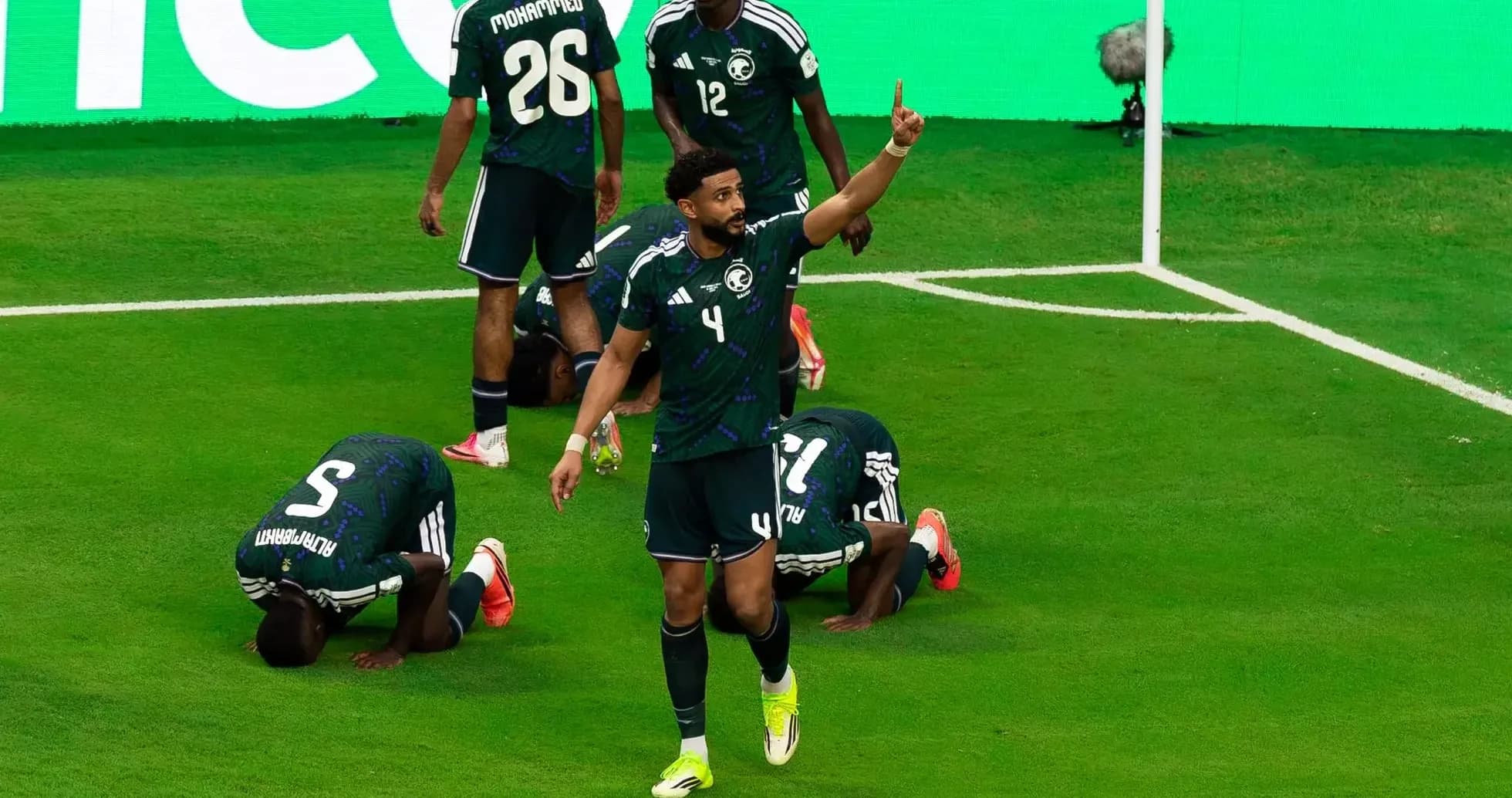
Saudi Arabia’s attacking plan was minimalist but coherent. With only 322 total passes against Uruguay’s 612, they focused on direct vertical releases into the front two and early switches to Salem Al-Dawsari. The breakthrough at 41’ reflected their set-piece and aerial threat: Abdulelah Al-Amri rose to score for Saudi Arabia, capitalising on one of the few moments they could commit numbers forward. That goal flipped the game state into one perfectly suited to Donis’ approach: a lead to protect, a block to sit in, and counter-attacks as a bonus rather than a necessity.
Defensively, Saudi Arabia’s back four were asked to defend their box relentlessly. The statistics capture the siege: Uruguay produced 10 shots on goal and 27 in total, with seven blocked. Saudi Arabia’s single blocked shot at the other end highlights how little time they spent in advanced zones. Fouls (11 for Saudi Arabia, 6 for Uruguay) show the extent of Saudi disruption, with tactical infringements used to break rhythm and slow Uruguay’s combinations.
In goal, Mohammed Al-Owais (Saudi Arabia) was central to the result. He faced 10 shots on goal and made 9 saves, an output that, combined with Uruguay’s xG of 1.72, underlines how often the Saudi last line was exposed. The goals prevented metric for Saudi Arabia sits at -0.35, indicating that, relative to the quality of chances conceded, the team marginally underperformed the xG model defensively, but Al-Owais’ raw save count was still decisive in preserving the draw under heavy fire. At the other end, Fernando Muslera (Uruguay) made 2 saves from 3 shots on goal; Saudi Arabia’s xG of 0.66 suggests their attacks were sporadic but not entirely speculative.
Second Half
The second half was defined by Bielsa’s adjustments. At 46’, Darwin Núñez (OUT) was replaced as Agustín Canobbio (IN) came on, and Juan Sanabria (IN) came on for Matías Viña (OUT). These changes sharpened Uruguay’s right side and injected more direct running and crossing. Later, at 72’, Nicolás de la Cruz (IN) replaced Manuel Ugarte (OUT), adding creativity and forward passing from deeper midfield. The cumulative effect was an even more aggressive attacking posture, with Uruguay pushing numbers into the final third and sustaining pressure through repeated entries and 14 corners.
The equaliser at 80’ came from Maximiliano Araújo, emblematic of Uruguay’s wide overloads finally paying off. His goal for Uruguay levelled the match and rewarded their territorial dominance. Immediately after, Bielsa refreshed the left flank: at 81’, Brian Rodríguez (IN) came on for Araújo (OUT), maintaining the intensity on the wings as Uruguay chased a winner. Uruguay’s shot profile—16 efforts inside the box—shows how frequently they managed to penetrate Saudi Arabia’s last line, but imprecision and Saudi last-ditch defending kept the score at 1-1.
Donis’ in-game management was focused on defensive reinforcement and energy conservation. At 63’, Nasser Al-Dawsari (IN) came on for Musab Al Juwayr (OUT), adding fresh legs and work rate in midfield. Later, a triple wave of substitutions at 90’ further solidified the structure and burned time: Ali Lajami (IN) for Saud Abdulhamid (OUT), Ala'a Al-Hejji (IN) for Firas Al-Buraikan (OUT), and Abdullah Al-Hamdan (IN) for Moteb Al-Harbi (OUT). Each move nudged Saudi Arabia towards a more conservative, physically fresher block to survive the final minutes.
Discipline played a minor but telling role. Saudi Arabia collected 1 yellow card (Uruguay 0), underlining how often they had to foul to halt Uruguay’s rhythm. The booking went to Abdulelah Al-Amri at 44’ for “Foul”, a moment that encapsulated the defensive strain placed on the Saudi centre-backs as they dealt with repeated incursions and duels around the box.
Statistical Overview
Statistically, the verdict is stark. Uruguay’s 1.72 xG against Saudi Arabia’s 0.66, combined with a 27-7 shot count and 67%-33% possession split, indicates that Bielsa’s side created more and better chances and controlled the game territorially. Uruguay’s 540 accurate passes from 612 total (88%) contrast sharply with Saudi Arabia’s 236 accurate from 322 (73%), reflecting a patient, high-precision build-up against a more direct, lower-volume approach.
Yet, context matters. Saudi Arabia’s game plan was never to compete on volume but on efficiency and defensive resilience. They turned 3 shots on goal into 1 goal, defended 14 corners, and survived 10 shots on target from Uruguay. From a tactical standpoint, this 1-1 draw is a textbook example of a compact 4-4-2 executing a low-block strategy effectively against a dominant 4-2-3-1, with goalkeeping, set-piece execution, and disciplined shape compensating for a significant disparity in overall form and attacking metrics.