Philadelphia Union II Stages Comeback Against Atlanta United II
Under the evening lights at Subaru Park, Philadelphia Union II turned what looked like a statement road win for Atlanta United II into a 2–1 home comeback, a result that subtly reshapes the Eastern Conference narrative in MLS Next Pro’s group stage.
Heading into this game, the table framed it as a clash of contrasting identities. Philadelphia sat 8th in the Eastern Conference playoff picture with 18 points and a goal difference of 3, built on a volatile 6–0–5 record overall. At home they were the definition of feast-or-famine: 4 wins and 4 losses in 8, scoring 11 and conceding 8. Atlanta, by contrast, arrived as the more expansive, high-variance side. Fifth in the Eastern Conference with 19 points and a goal difference of 6, they had scored 21 and conceded 15 overall across 11 matches, with their attack travelling particularly well: 15 away goals in 8 outings, averaging 1.9 on their travels.
First Half
The first half followed the season’s script. Atlanta’s offensive DNA is clear in the timing of their goals: a late-game surge, with 23.81% of their strikes coming between 76–90 minutes, but also a steady threat across every phase. Their willingness to commit numbers forward, especially in the 46–75 window where 38.10% of their goals are clustered, is underpinned by a front line that presses high and attacks quickly once possession is turned over. In Subaru Park, that ambition paid off early, with the visitors taking a 1–0 lead into half-time.
Second Half
Union II’s response after the break spoke to a different kind of identity. This is a side built on narrow margins and emotional swings: 6 wins, 5 losses, no draws; home averages of 1.4 goals for and 1.1 against. They are used to living on the edge, and the second half became an illustration of that edge hardening rather than fraying. With no defined formation listed, the tactical picture has to be read through roles and tendencies.
G. Marks, wearing 31, again anchored the side from the back. Union II’s defensive record at home — 9 conceded in 8 — suggests a unit that bends but doesn’t quite break, and in the second half they managed to limit Atlanta’s typically dangerous transitional surges. The back line built around figures like R. Uzcategui and K. Moore tightened their distances, staying compact enough to deny the vertical lanes Atlanta usually exploit between full-back and centre-back.
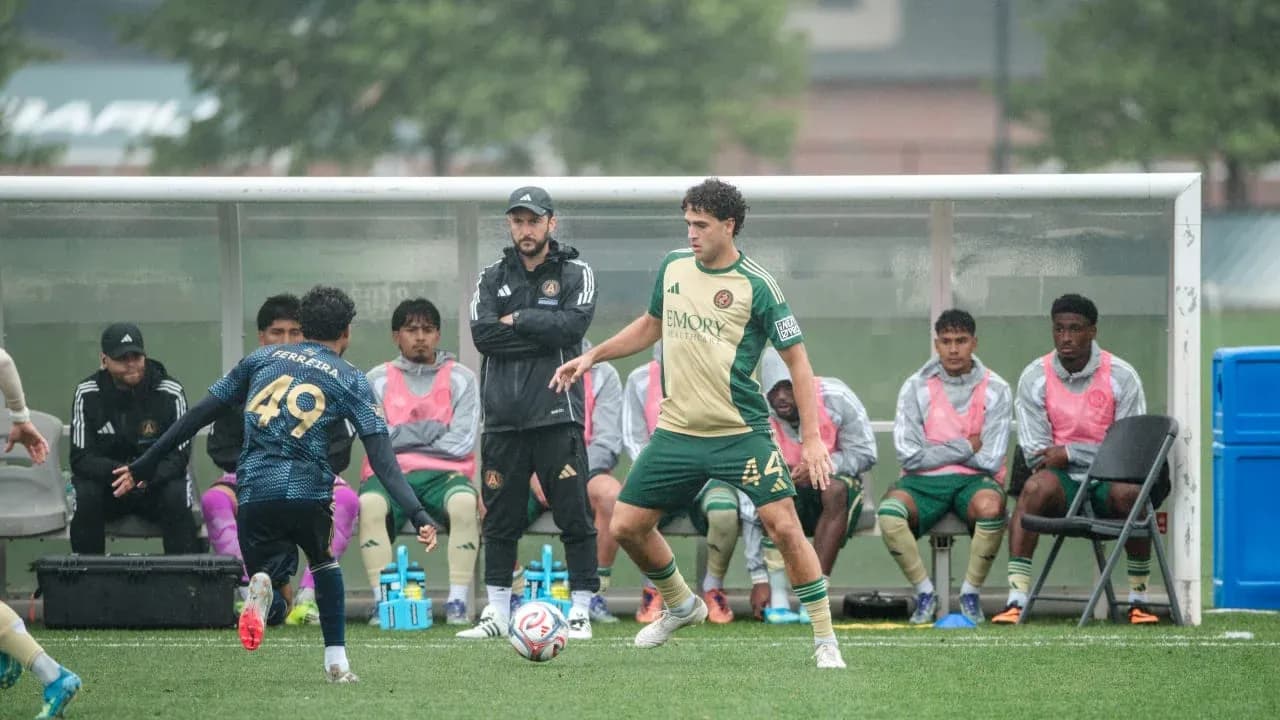
In front of them, the spine of O. Benitez, J. Griffin and N. Hasan provided the platform for the turnaround. Griffin’s role as a connective midfielder was crucial: he repeatedly offered a short option to help Union II play through Atlanta’s first line, then looked early for the more advanced movement of T. Reed and E. Davis III. Reed, wearing 45, often drifted into half-spaces, pulling markers out of shape and opening corridors for W. Ferreira and M. De Paula to attack the box.
The comeback goals reflected Philadelphia’s broader season profile. At home, they average 1.4 goals, but their “biggest wins” data — a 4–1 at home and a 1–2 away — shows that when they tilt momentum, they can score in bunches. The 2–1 full-time scoreline fits that pattern of surging once they sense vulnerability, rather than grinding out cagey stalemates.
For Atlanta, the defeat is a reminder of the risk baked into their style. Their away numbers are impressive going forward — 15 goals on their travels — but they also concede 1.5 per match overall, with defensive fragility spread almost evenly across the game. Their goals-against minute distribution is damningly symmetrical: 20.00% conceded in each of the 0–15, 46–60, 61–75 and 76–90 ranges. There is no safe period. Even as they chased a second goal late on, their back line remained exposed to counters, and Union II capitalised.
The disciplinary profile of both sides added another layer to the tactical picture. Philadelphia’s yellow cards are scattered, but there is a notable late-game spike: 17.65% of their bookings fall in the 61–75 range and another 17.65% between 91–105. That speaks to a team willing to foul to break rhythm once the game becomes stretched. Atlanta, meanwhile, lean into physicality after the interval: 20.83% of their yellows come in each of the 46–60, 61–75 and 76–90 windows. Their red-card profile is even more telling, with dismissals spread across 46–60, 61–75 and 76–90 (each at 33.33%). This is a side that walks a disciplinary tightrope precisely when they are trying to press hardest.
In this match, that aggression under pressure played into Union II’s hands. As Atlanta pushed, Philadelphia’s front unit — particularly the direct running of E. Davis III and the link play of Ferreira — found more space to attack the channels. Without any penalties taken by either side this season (both teams show 0 total penalties, 0 scored, 0 missed), the margins were always going to be decided in open play and set pieces rather than from the spot.
The benches underscored the stylistic contrast. Ryan Richter had a leaner set of options — five substitutes — but players like P. Holbrook and C. Lorent offered fresh legs and defensive stability to lock down the result. Atlanta’s deeper bench, featuring the likes of M. Tablante, P. Weah and M. Pineda, gave them multiple ways to chase the game, yet the structural issues at the back remained unsolved.
From a statistical prognosis standpoint, the expected goals narrative would likely mirror what the raw numbers hint at: Atlanta’s season-long attacking volume usually generates a healthy xG, but their defensive xG conceded is inflated by how frequently they allow shots in transition. Union II, with more modest attacking averages (1.4 total goals per match, 1.3 on their travels, 1.4 at home) but a tighter defensive record (1.1 conceded overall, 1.1 at home, 1.0 away), are built to exploit exactly that imbalance.
Following this result, the broader arc of the Eastern Conference tightens. Philadelphia have reinforced their identity as a volatile but dangerous playoff contender, capable of flipping games at home when their emotional intensity aligns with tactical discipline. Atlanta remain a high-ceiling, high-risk side: devastating when they ride the wave of their late-game surge, but vulnerable to precisely the kind of controlled, vertical response Union II produced in the second half at Subaru Park.