Liverpool and Chelsea Share Points in Tactical Stalemate
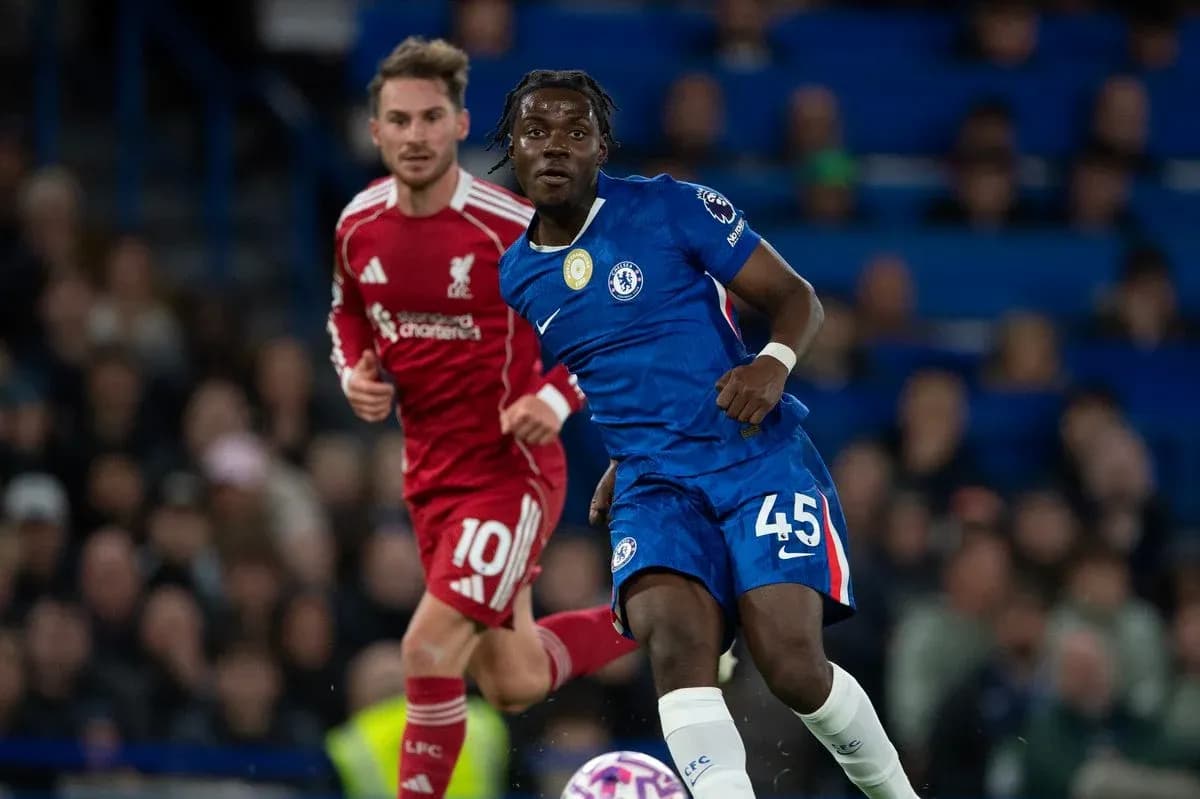
Liverpool and Chelsea played out a 1–1 draw at Anfield in Premier League Round 36, a result that accurately reflected a game of marginal advantages and mutual tactical restraint. Under Arne Slot, Liverpool sought verticality and high pressing, while Calum McFarlane’s Chelsea leaned on controlled possession and a compact mid-block. The early Liverpool breakthrough through Ryan Gravenberch was cancelled out before half-time by Enzo Fernández, and despite a disallowed goal for Cole Palmer and a flurry of late cards, neither side managed to tilt the balance. The match settled into a finely poised tactical stalemate rather than an end-to-end shootout.
Goals
The scoring opened at 6' when Ryan Gravenberch (Liverpool) converted a “Normal Goal” assisted by Rio Ngumoha, rewarding Liverpool’s aggressive start and early press. Chelsea’s response grew steadily, culminating at 35' when Enzo Fernández (Chelsea) struck a “Normal Goal” with no assist recorded, levelling the match at 1–1, which remained the half-time score.
Early in the second half, at 50', Cole Palmer (Chelsea) briefly thought he had completed the turnaround, but his effort was ruled out after a VAR intervention recorded as “Var — Goal cancelled.” That cancellation preserved parity and became the game’s key inflection point.
Substitutions
Substitutions then reshaped the tactical picture. At 63', Reece James (IN) came on for Andrey Santos (OUT) for Chelsea, adding width and crossing threat from right-back. Liverpool’s first change came at 67', with Alexander Isak (IN) replacing Rio Ngumoha (OUT), a clear shift towards a more traditional central striking reference.
Discipline
Discipline escalated in the final quarter. The full card log, in chronological order:
- 67' Jorrel Hato (Chelsea) — Foul
- 73' Enzo Fernández (Chelsea) — Foul
- 83' Marc Cucurella (Chelsea) — Foul
- 88' Joe Gomez (Liverpool) — Argument
- 89' Moisés Caicedo (Chelsea) — Handball
- 90+4' Alexis Mac Allister (Liverpool) — Persistent fouling
This produces exact totals of Liverpool: 2, Chelsea: 4, Total: 6 yellow cards.
Tactical Analysis
Liverpool’s tactical identity under Slot was visible from the first whistle: a high-intensity, press-oriented side seeking quick vertical progressions once possession was regained. Despite the official formation not being listed, the personnel suggest a flexible shape with Giorgi Mamardashvili in goal behind a back line of Curtis Jones, Ibrahima Konaté, Virgil van Dijk and Miloš Kerkez. Jeremie Frimpong’s listing as a midfielder hints at an advanced wing-back or wide runner role, while Alexis Mac Allister, Ryan Gravenberch and Dominik Szoboszlai formed a technically secure central unit, with Rio Ngumoha supporting Cody Gakpo in attack.
The statistical profile backs this: Liverpool had 48% possession (473 passes, 84% accuracy) but generated 8 total shots to Chelsea’s 6, including 5 from inside the box. Their xG of 0.56 indicates that, despite some promising positions, they did not carve out a series of high-quality chances. Mamardashvili was called upon for 2 saves, matching Filip Jørgensen’s 2 at the other end, underlining that neither keeper was under sustained siege. Notably, Liverpool’s “goals prevented” figure of -0.49 suggests their keeper conceded slightly more than the underlying shot quality might predict, though with only one goal conceded this is marginal in a single-game context.
Chelsea’s approach was more possession-centric. With 52% of the ball, 515 passes and a higher pass completion (87%), McFarlane’s side looked to build through Moisés Caicedo and Enzo Fernández, with Cole Palmer as the creative hub between the lines. The back four of Malo Gusto, Wesley Fofana, Levi Colwill and Jorrel Hato provided a stable platform, while Marc Cucurella’s designation as a midfielder indicates he was likely tasked with hybrid wide-midfield/full-back responsibilities on the left, helping to manage Frimpong’s forward surges.
Chelsea’s xG of 0.5, marginally lower than Liverpool’s 0.56, again underscores how fine the margins were. Their 4 yellow cards — three for “Foul” (Hato, Fernández, Cucurella) and one for “Handball” (Caicedo) — reflect a side frequently forced into halting transitions and dealing with Liverpool’s direct running. The handball on Caicedo at 89' hints at a late, slightly desperate intervention to break up a dangerous situation.
Final Tactics
The introduction of Reece James for Andrey Santos at 63' subtly altered Chelsea’s structure. James’ natural width and delivery from deep provided an overlapping outlet and allowed Palmer to drift more centrally, but Liverpool’s defensive unit, especially van Dijk and Konaté before his substitution, managed the box well, restricting Chelsea’s shot volume (6 total, 4 inside the box). For Liverpool, bringing on Alexander Isak at 67' for Ngumoha shifted their attacking reference point. Isak’s presence between the lines and in the channels aimed to pin Chelsea’s centre-backs and create space for late runners like Szoboszlai, but the improved Chelsea defensive discipline and compactness limited his influence.
At 77', Liverpool made a double adjustment: Federico Chiesa (IN) came on for Cody Gakpo (OUT), and Joe Gomez (IN) replaced Ibrahima Konaté (OUT). Chiesa’s introduction signalled a desire for more direct 1v1 threat and diagonal runs from wide areas, while Gomez’s entry, followed by his 88' yellow card for “Argument,” suggests a tense, high-stakes closing phase where defensive duels and disputes intensified. Mac Allister’s booking at 90+4' for “Persistent fouling” encapsulated Liverpool’s commitment to counter-pressing even in stoppage time, but also the cumulative toll of repeated tactical fouls.
Statistical Summary
Statistically, the game’s verdict is of near-parity. Possession was 52–48 in Chelsea’s favour; shots 8–6 to Liverpool; both sides recorded 3 shots on goal and 1 blocked shot. Corners (5–2 to Liverpool) indicate slightly more sustained territorial pressure from the hosts, but the near-identical xG (0.56 vs 0.5) and equal goalkeeper saves (2–2) underline that neither side truly dominated the danger zones. Both teams committed 17 fouls, but Chelsea’s 4 yellows to Liverpool’s 2 highlight that their infringements were more often deemed card-worthy, perhaps reflecting the nature and zones of their defensive interventions.
Conclusion
In synthesis, Liverpool’s Overall Form in this match showed a coherent high-pressing, vertical side that lacked a final incisive edge, while their Defensive Index was solid, limiting Chelsea’s shot quality but conceding once from a rare clear chance. Chelsea’s Overall Form was that of a controlled, possession-based team capable of constructing attacks but slightly blunted in the penalty area. Their Defensive Index was respectable in open play but reliant on repeated fouls and last-ditch actions, as evidenced by their disciplinary record. The 1–1 draw and the underlying metrics together paint a picture of two evolving sides cancelling each other out more through structure and discipline than through attacking brilliance.