Liverpool and Chelsea Share Points in 1–1 Draw
Liverpool 1–1 Chelsea at Anfield, a result that keeps Liverpool inside the Champions League places but stalls their late push to cement a top-four finish, while Chelsea’s point on the road steadies them in mid-table without significantly improving their outside hopes of European qualification.
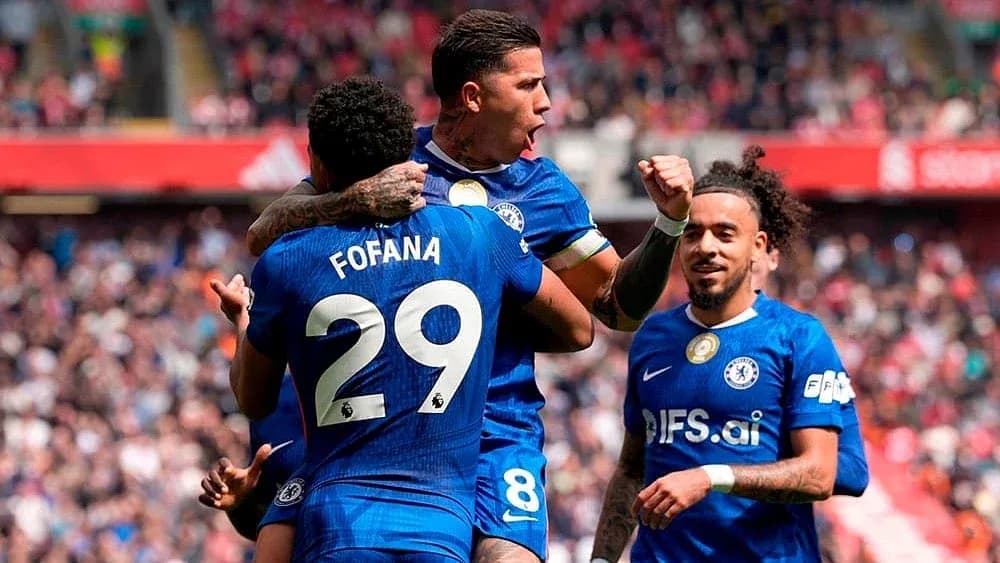
Liverpool struck first inside six minutes. Ryan Gravenberch arrived from midfield to finish after Rio Ngumoha created the chance with a sharp piece of play on the flank, the teenager’s assist sliding Gravenberch into space to make it 1–0. Chelsea responded gradually, and on 35 minutes Enzo Fernández levelled with an unassisted effort, seizing on second-phase possession and beating Giorgi Mamardashvili to bring the visitors back to 1–1.
Early in the second half, Chelsea thought they had turned the game around when Cole Palmer found the net on 49 minutes, but VAR intervened and the goal was disallowed for offside, a key momentum swing that preserved parity. The first change came from Chelsea on 63 minutes as Reece James replaced Andrey Santos, adding more attacking thrust and crossing quality from the right.
Liverpool answered with their own changes on 67 minutes, Alexander Isak replacing Rio Ngumoha to provide a more traditional focal point up front. In the same minute, Jorrel Hato went into the book for holding, the first of a flurry of Chelsea cautions as the visitors increasingly relied on tactical fouls to break up Liverpool’s play.
On 71 minutes, Chelsea coach Calum McFarlane was shown a yellow card from the touchline, underlining the tension on the away bench. Two minutes later, Enzo Fernández collected a yellow card for tripping, reflecting Chelsea’s struggle to contain Liverpool’s midfield rotations.
Liverpool reshaped their back line on 77 minutes with a double substitution: Joe Gomez replaced Ibrahima Konaté, and moments later Federico Chiesa came on for Cody Gakpo, Slot looking for fresh legs and more direct running in the final third. Chelsea’s defensive discipline remained stretched, and on 83 minutes Marc Cucurella was booked for holding as he tried to stop another Liverpool break.
The closing stages were increasingly scrappy. Joe Gomez received a yellow card on 88 minutes for delay of game as Liverpool tried to manage their defensive structure. One minute later, Moisés Caicedo was booked for handling, adding to Chelsea’s disciplinary tally. Deep into stoppage time, at 90+4 minutes, Alexis Mac Allister was cautioned for tripping, the final notable act of a tight contest that neither side could force beyond 1–1.
Fixture Statistics & Tactical Audit
- xG (Expected Goals): Liverpool 0.51 vs Chelsea 0.47
- Possession: Liverpool 49% vs Chelsea 51%
- Shots on Target: Liverpool 3 vs Chelsea 3
- Goalkeeper Saves: Liverpool 2 vs Chelsea 2
- Blocked Shots: Liverpool 1 vs Chelsea 1
The numbers underline how finely balanced the match was. The xG was almost level (Liverpool 0.51 vs Chelsea 0.47), suggesting the 1–1 scoreline slightly exceeded the quality of chances for both sides but was broadly fair in relative terms. Possession was essentially shared (49% vs 51%), and both teams produced the same number of shots on target (3 vs 3), reflected in identical save counts for the two goalkeepers (2 vs 2). Liverpool’s slightly higher total shot volume (8 vs 6) pointed to marginally more sustained pressure, but Chelsea’s compact shape limited clear openings, with both sides recording only one blocked shot apiece. Overall, this was a tactical stalemate where neither attack consistently broke down well-organised defensive structures.
Standings Update & Seasonal Impact
Pre-match, Liverpool sat fourth on 59 points with a goal difference of +12, having scored 60 and conceded 48. The 1–1 draw adds one point and one goal for and against, moving them to 60 points with 61 goals scored and 49 conceded, for a new goal difference of +12. They remain in fourth place, still in control of a Champions League berth but with limited margin for error in the final weeks as they try to fend off challengers immediately below them.
Chelsea began the day ninth on 49 points with a goal difference of +6, having scored 55 and conceded 49. This draw lifts them to 50 points, with their totals now 56 goals for and 50 against, maintaining a goal difference of +6. They stay ninth, still looking up at the European places and needing a strong finish plus dropped points from the teams above to re-enter the race for continental qualification.
Lineups & Personnel
Liverpool Actual XI
- GK: Giorgi Mamardashvili
- DF: Curtis Jones, Ibrahima Konaté, Virgil van Dijk, Miloš Kerkez
- MF: Ryan Gravenberch, Alexis Mac Allister, Jeremie Frimpong, Dominik Szoboszlai, Rio Ngumoha
- FW: Cody Gakpo
Chelsea Actual XI
- GK: Filip Jørgensen
- DF: Malo Gusto, Wesley Fofana, Levi Colwill, Jorrel Hato
- MF: Andrey Santos, Moisés Caicedo, Cole Palmer, Enzo Fernández, Marc Cucurella
- FW: João Pedro
Expert's Post-Match Verdict
This was a controlled but ultimately cautious performance from both managers, with neither side able to turn small territorial edges into a decisive advantage. Arne Slot’s Liverpool pressed selectively and created slightly more volume in attack (8 total shots vs 6) but lacked truly incisive final-third play, which is reflected in a modest xG of 0.51. Their early goal came from good structure between the lines, with Ngumoha’s positioning and Gravenberch’s late run, but after that Liverpool’s attacking patterns rarely disorganised Chelsea’s back four.
Calum McFarlane’s Chelsea were disciplined out of possession and compact between the lines, limiting Liverpool to just three shots on target (3 shots on target, xG 0.51). Offensively, however, they were similarly constrained, generating only six shots and an xG of 0.47, with the disallowed Palmer goal via VAR underlining how fine the margins were. The cluster of yellow cards (four for Chelsea, two for Liverpool) showed Chelsea leaning on tactical fouls to break rhythm, while Liverpool’s late bookings reflected game management more than structural frailty.
In tactical terms, this was neither a clinical attacking display nor a defensive collapse from either side; it was a tight, risk-managed contest where both teams’ defensive organisation largely cancelled out the other’s attacking intent (near-identical xG 0.51 vs 0.47, shots on target 3 vs 3, possession 49% vs 51%). The draw feels an accurate reflection of a match defined more by structure and control than by sustained attacking threat.