Australia's Tactical Masterclass in 2-0 Win Over Türkiye
Australia’s 2-0 win over Türkiye at BC Place was a classic example of defensive control without the ball, built on structure, compactness and ruthless efficiency in transition. In a World Cup group opener where Türkiye had 72% possession and fired 30 shots, Australia’s 5-4-1 under Tony Popovic absorbed pressure, protected the box and struck decisively at key moments.
The game’s tactical story hinged on the contrast between Australia’s low-possession, direct approach and Türkiye’s high-volume positional play in a 4-2-3-1. With just 28% of the ball and 270 passes (202 accurate, 75%), Australia accepted long spells without possession, prioritising verticality and field position over circulation. Türkiye, by contrast, attempted 707 passes (638 accurate, 90%), constantly recycling through Hakan Çalhanoğlu and Orkun Kökçü, but struggled to convert territory into clear, high-quality chances in proportion to their dominance.
Australia’s back five of Jacob Italiano, Alessandro Circati, Harry Souttar, Cameron Burgess and Jordan Bos gave them a stable, horizontally compact base. The wing-backs, Italiano and Bos, were crucial in closing down Ferdi Kadıoğlu and Zeki Çelik, preventing Türkiye from consistently creating 2v1s in wide zones. The three central defenders stayed narrow to protect the space in front of Patrick Beach, prioritising the central lane against Kerem Aktürkoğlu’s movements and the half-space entries of Arda Güler and Kökçü.
In midfield, the double axis of Connor Metcalfe and Aiden O’Neill, supported by Paul Okon-Engstler and Nestory Irankunda tucking inside from the line of four, created a dense central block. Their main task was to screen passing lanes into Türkiye’s No. 10 and striker, forcing play wide and ensuring that when crosses came in, they were mostly contested under pressure and from less dangerous angles. Australia committed 12 fouls to break rhythm, compared to Türkiye’s 4, a deliberate trade-off to disrupt combinations and slow Turkish tempo.
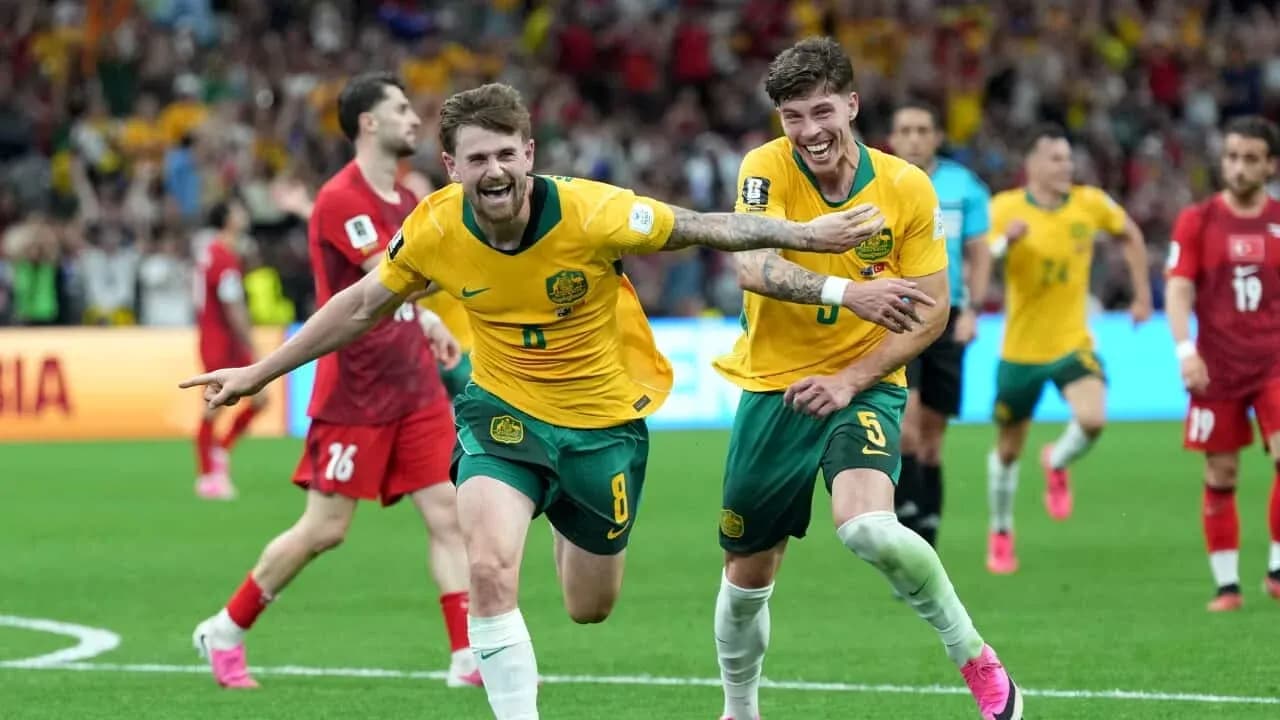
The attacking plan was clear: use Irankunda’s ball-carrying threat and Mohamed Touré’s running to attack quickly once possession was regained. The opening goal on 27 minutes encapsulated this. Nestory Irankunda scored for Australia, assisted by Paul Okon-Engstler, a move that came from Australia exploiting space once Türkiye’s structure was stretched. It was a textbook transition strike: few passes, maximum verticality, and a clinical finish that gave Australia the scoreboard leverage to sit even deeper.
From there, Türkiye increased the pressure. Their 8 shots on goal and 14 efforts inside the box underline how often they managed to pin Australia back. Yet the final ball and shot selection were frequently rushed, a product of Australia’s compactness and aggressive last-ditch defending, including 12 Turkish shots being blocked. Australia were content to concede volume from distance and crowded central areas, trusting their structure and goalkeeper.
Patrick Beach (Australia) was central to this plan working. He made 8 saves, a high workload that reflects Türkiye’s attacking volume and underlines his importance as the final layer of resistance. His shot-stopping, particularly against efforts from inside the box, allowed Australia to maintain belief in their low block. On the other side, Uğurcan Çakır (Türkiye) faced only 4 shots on goal and made 2 saves; the goals conceded owed more to structural exposure in transition and one moment of open-play penetration than to goalkeeping errors.
The second half brought an expected tactical escalation from Vincenzo Montella. At 46', Barış Alper Yılmaz (OUT) was replaced as Kenan Yıldız (IN) came on, signalling a push for more direct threat and creativity in the final third. Later, at 62', Orkun Kökçü (OUT) made way as Yunus Akgün (IN) came on, adding another wide, aggressive profile to attack Australia’s flanks. Further changes followed: İsmail Yüksek (OUT) was replaced as Salih Özcan (IN) came on at 81', and Zeki Çelik (OUT) as Mert Müldür (IN) came on at the same minute, with Kerem Aktürkoğlu (OUT) withdrawn for Deniz Gül (IN) at 85'. These moves pushed Türkiye into an even more attacking posture, with full-backs higher and more numbers committed ahead of the ball.
However, this aggression left transition spaces that Australia exploited. At 61', Irankunda (OUT) was replaced as Nishan Velupillay (IN) came on, adding fresh legs for counter-attacks. On 74', Mohamed Touré (OUT) was replaced as Tete Yengi (IN) came on, and Jacob Italiano (OUT) was replaced as Jason Geria (IN) came on, rebalancing the side with defensive security on the right and a physical outlet up front. The key moment followed immediately: at 75', Connor Metcalfe scored Australia’s second, with no assist recorded. That goal, arriving just after the double substitution, effectively punished Türkiye’s stretched shape and killed their momentum.
Tony Popovic then moved into pure game-management mode. At 84', Jordan Bos (OUT) was replaced as Aziz Behich (IN) came on, and Paul Okon-Engstler (OUT) was replaced as Jackson Irvine (IN) came on, reinforcing defensive experience and ball retention for the closing phase.
Discipline also played a minor tactical role. Türkiye finished with 1 card to Australia’s 0. The only booking came at 86': Yunus Akgün (Türkiye) — Roughing. It reflected Turkish frustration as Australia continued to break up play and run down the clock.
Statistically, Türkiye’s 1.33 xG versus Australia’s 0.77 underlines that the shot quality gap was much narrower than the raw shot count (30-9) suggests. Both goalkeepers are credited with -0.95 goals prevented, indicating that, relative to xG on target, neither significantly outperformed expectation in pure shot-stopping terms; instead, the match was decided by structure and efficiency. Australia converted their limited chances with ruthless precision and defended their box with collective clarity. Türkiye, despite control of possession, passing superiority and territorial dominance, lacked the incision to break a well-drilled 5-4-1 that never lost its shape after taking an early lead.