South Africa's World Cup Journey: Hope and New Beginnings
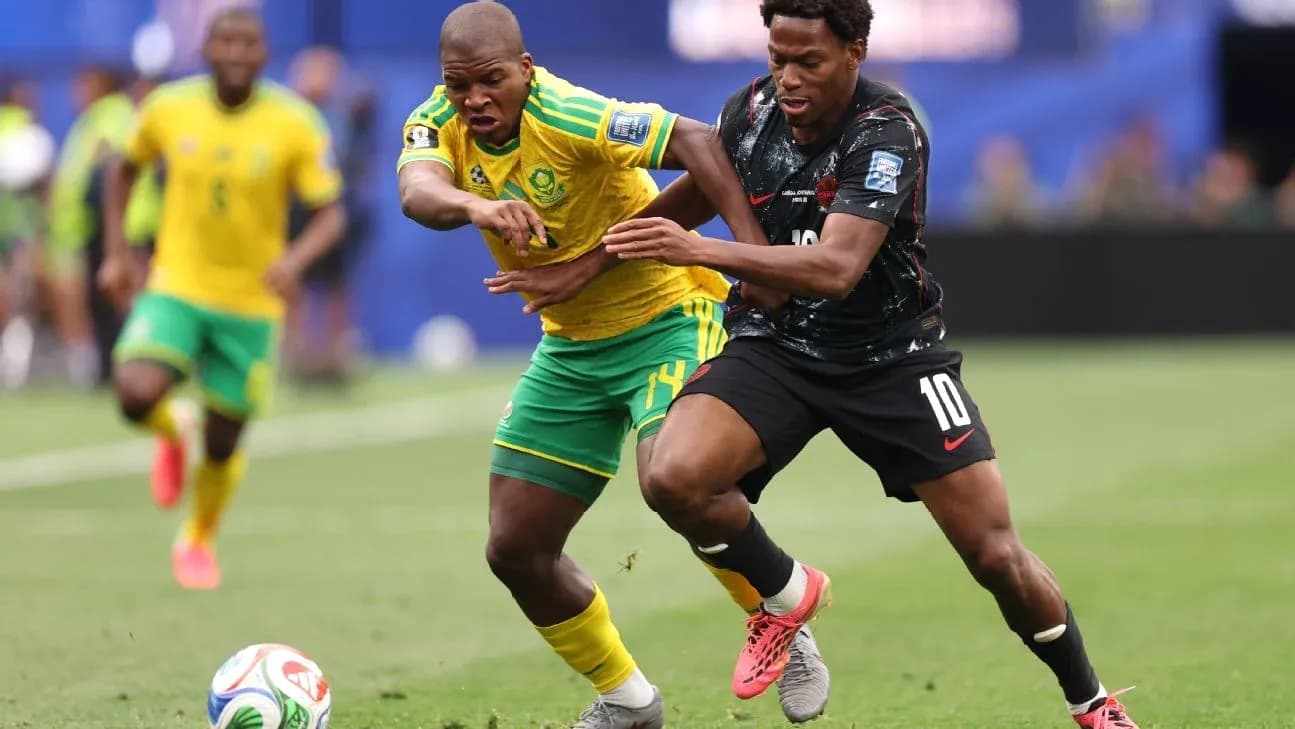
South Africa’s World Cup exit hurt. It had to. A 1-0 defeat to Canada in the round of 32, a dream cut short just as it was beginning to feel real.
But for the first time in 16 years, Bafana Bafana were back on the biggest stage. And this time they did more than make up the numbers. They left behind something tangible: a structure, a spine, and a sense that this might be the start of a new era rather than a one-off return.
A defence built to last
If there is one department South Africa will not be losing sleep over any time soon, it is centre-back.
At this World Cup, Mbokazi and Okon did more than fill shirts. They owned their roles. They started together, handled the pressure, and looked entirely at home among the game’s elite. Mbokazi, in particular, played like a defender who had been waiting his whole life for this stage. Across the tournament, he stood out as one of the most assured centre-backs on show.
Behind them, there is depth – real depth, not just names on a long list. Olwethu Makhanya, Khulumani Ndamane, Tylon Smith, Malibongwe Khoza, Aden McCarthy and others are already pushing from beneath the surface. They are young, hungry and close enough in quality that any future Bafana coach, whether Hugo Broos or his successor, will have options rather than headaches.
The message is clear: the heart of South Africa’s defence is no longer a problem to be solved. It is a platform to build on.
Mofokeng: the wildcard waiting to explode
Relebohile Mofokeng’s World Cup story never quite took off in the way many South Africans had hoped.
Broos did not lean on the Orlando Pirates playmaker as heavily as fans wanted. For some, that felt like a missed opportunity. Yet the bigger picture is impossible to ignore: Mofokeng is only 21. His window is not closing; it is opening.
His performance in the 1-0 win over South Korea told its own story. On that night, he looked like he belonged among global stars, gliding into pockets, demanding the ball, shifting the rhythm of the game. It was the kind of display that hinted at a ceiling far higher than the one he is currently operating under.
A move to Belgium’s Royale Union Saint-Gilloise is widely reported to be close. If that transfer goes through, it offers him exactly what a player of his profile needs: a serious European platform, high-level coaching, and exposure to different tactical demands. By 2030, if his development tracks even close to his potential, South Africa could arrive at the next World Cup with a fully formed attacking weapon, not just a promising prospect.
For now, he remains the ace still tucked in the deck.
Homegrown, world-class
One of the quiet triumphs of this World Cup for South Africa lay in who carried the team.
Not the big-name exports. The homebodies.
Teboho Mokoena, the metronome and enforcer from Mamelodi Sundowns, dictated games with a maturity that underlined why he is so central to club and country. Thalente Mbatha, representing Orlando Pirates, brought balance and bite in midfield. On the flanks, Sundowns fullbacks Khuliso Mudau and Aubrey Modiba pushed high, defended aggressively and showed they could live with the pace and intensity of the tournament.
Behind them all, Ronwen Williams reminded everyone why his reputation has spread far beyond the borders of the South African Premiership. The captain’s interventions in key moments were decisive, his presence authoritative. He has built his entire club career at SuperSport United and Mamelodi Sundowns, yet here he was, performing on a stage many assume you can only reach via Europe.
That is the crux of it. Of course, South African football will benefit if more young stars test themselves abroad. But this World Cup proved something vital: you do not have to leave home to become a serious footballer. The domestic league is producing players who can stand shoulder to shoulder with the world’s best and not flinch.
For a new generation watching from townships, suburbs and villages, that matters.
Maseko: from the brink to a nation’s lifeline
No story cut as deeply across both football and life as that of Thapelo Maseko.
At 20, he had already announced himself on the continental stage, scoring his first goal for Bafana at the delayed 2023 Africa Cup of Nations in early 2024. Hugo Broos liked him. The country liked him. The trajectory looked upward.
Then it stalled.
After moving from SuperSport United to Mamelodi Sundowns, Maseko slipped out of favour. Under new head coach Miguel Cardoso, he was often on the fringes, sometimes in the reserves, rarely in the spotlight. By August 2025, the winger was using social media to talk about losing his love for the game. For a player that young, that talented, it was a sobering moment.
January 2026 changed everything. A loan move to AEL Limassol in Cyprus looked, on paper, like a step into obscurity. Instead, it became his lifeline. He played, he ran, he believed again.
By March, he was back in a Bafana shirt.
This month, he did more than just return. He wrote himself into South African football history. His goal against South Korea did not only win a match; it opened a door the country had been knocking on for decades, sending Bafana into the World Cup knockout rounds for the first time ever.
In that moment, Maseko became a symbol of something bigger: that careers can be rescued, that belief can be rebuilt, that a player once sent to the reserves can end up carrying a nation.
Money, survival and the chance to dream again
Away from the pitch, the stakes were just as high.
SAFA arrived at this World Cup under a financial cloud. Players had been paid late after the previous African Nations Championship, and the association had been operating with expenses that consistently outstripped revenue. The concern was not abstract. It was existential.
The World Cup changed the maths.
Simply by reaching the group stage, SAFA were guaranteed at least $9 million in performance-based payouts, excluding preparation fees. By reaching the round of 32, Bafana added another $2 million. An $11 million lifeline landed in the association’s coffers.
That money will not magically erase years of mismanagement or poor decisions. It will not instantly fix structures, development pathways or administration. But it does buy time. It offers breathing space. It provides a buffer that South African football at all levels desperately needed.
Just as important, the team’s performances have shifted perception. Sponsors who might have hesitated before now have a different proposition in front of them: a national team that not only qualified, but competed, advanced and carried a compelling narrative.
Securing new deals should be easier now. The challenge for SAFA is to ensure that this World Cup is not treated as a one-off cash grab, but as a springboard.
The association’s task is stark and simple: move from survival mode to strategy. Turn emergency funds into long-term planning. Use this moment to build something that can outshine even the brightest chapters of South Africa’s past.
Bafana leave this World Cup with tears in their eyes, but also with something they have not had in years: a clear spine, emerging stars and a federation with the means, at least for now, to back them.
What they do with that combination will define the next decade of South African football.