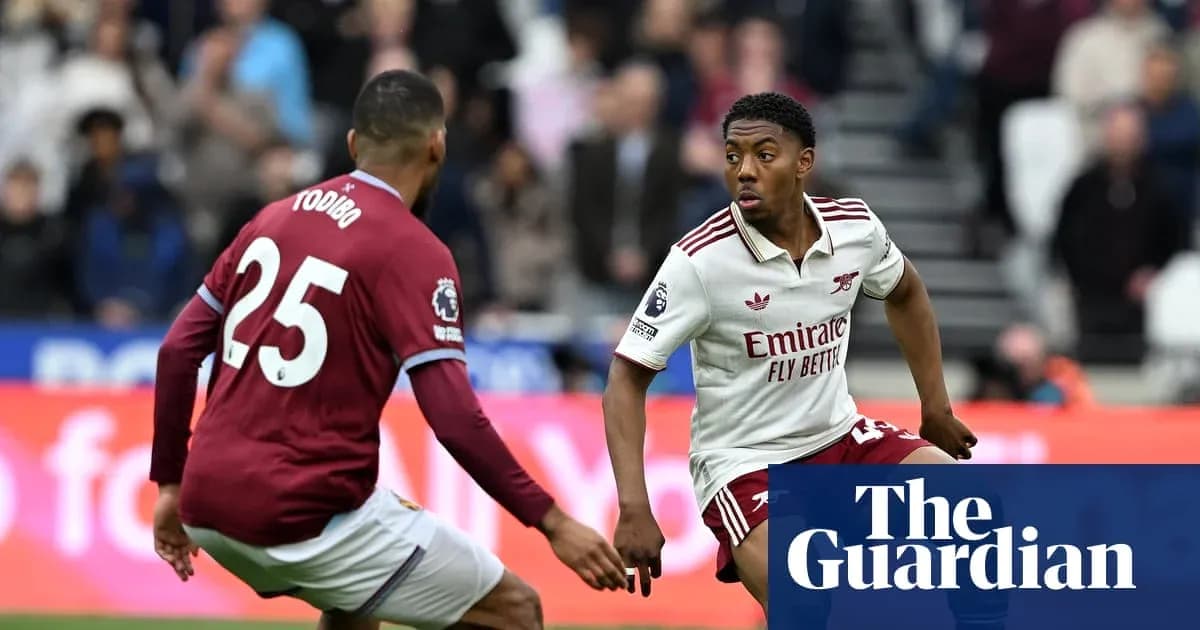
Arsenal's Title Chase: Lewis-Skelly's Journey from Doubt to Triumph
The words crackled through the London Stadium like a verdict from the heavens.
“Final decision, direct free-kick.”
Chris Kavanagh’s announcement did more than chalk off Callum Wilson’s 95th‑minute equaliser. It ripped West Ham’s lifeline from the scoreboard and pushed Arsenal one step closer to a title they have chased with a kind of obsession. On the touchline and in living rooms, the reaction was visceral. In the Sky Sports studio, Ian Wright reached for history.
The sweetest words he’d heard? “The sweetest words since Martin Luther King’s ‘I have a dream’,” he said, half-joking, fully emotional. Classic Wright. Big feelings, big lines.
Inside the away dressing room, Myles Lewis-Skelly didn’t bother dressing it up. For him, it felt like divine intervention.
“It was just God on our side,” he said. “We are so grateful.”
Arsenal’s 1-0 win at West Ham did more than squeeze three points out of a fraught afternoon. It gave shape to a title run-in that now looks brutally simple on paper and anything but in reality. Arsenal sit five points clear of Manchester City with two to play – Burnley at home, Crystal Palace away. City still have a game in hand and three fixtures left: Palace at home, Bournemouth away, Aston Villa at home.
Every decision, every ricochet, every VAR line now feels like it carries the weight of a season.
From the brink to the centre
For Lewis-Skelly, that feeling is nothing new. His entire year has played out like one long spell of stoppage-time jeopardy.
Nineteen years old, once the fearless kid who seemed to glide straight from academy prospect to first-team revelation, he began this campaign staring at the bench and, often, the stands. The minutes dried up. The England call-ups stopped. The buzz around his name slipped into background noise.
Last season, he looked untouchable. Fifteen Premier League starts. A first Arsenal goal in a 5-1 demolition of Manchester City, capped by that cheeky imitation of Erling Haaland’s “Zen” celebration. A teenager who did not so much knock on the door as kick it clean off its hinges.
He carried that swagger onto the international stage, scoring 20 minutes into his England debut against Albania. At the Bernabéu, in a Champions League quarter-final against Real Madrid, he played with such authority that club legends in the VIP seats were left asking the same thing: “Who is this kid?”
Then, almost without warning, the ascent stalled.
This season brought only frustration. When Mikel Arteta finally handed him a league start against Bournemouth on 11 April – just his second of the campaign – Arsenal imploded. A damaging defeat, a manager under scrutiny, and a young player left to absorb the fallout. The perfect storm for doubt.
Arteta later admitted he had been hard on Lewis-Skelly. Demanding. Uncompromising. The kind of approach that can either sharpen a young talent or shatter him.
Nine days ago, everything flipped.
The Fulham gamble
Arteta went with his instinct. A “gut feeling”, as he called it, led him to write Lewis-Skelly’s name into the starting XI against Fulham, this time in midfield rather than at left-back.
That detail matters. Midfield is where Lewis-Skelly grew up, the position in which he first learned to dictate games in Arsenal’s academy. His promotion to the senior side had come at left-back, out of necessity and opportunity. Now, for the first time, he was trusted in the heart of things.
“It feels so natural for me to be there,” he said. “I have been training there a lot so [against Fulham] I felt comfortable. The boss told me: ‘You are going to play midfield, so go for it.’ That is what I did. I had to be bold and play with courage because that is what this league demands.”
He did more than go for it. In a 3-0 win, he drove Arsenal forward with the kind of energy and clarity that had once made him the story of last season. Passing lanes opened. Presses snapped into place. That old sense of inevitability returned.
Arteta kept him in for the Champions League semi-final second leg against Atlético Madrid. Another high-stakes night, another test passed. Arsenal edged it 1-0 to set up a final against Paris Saint-Germain, and Lewis-Skelly stayed in the side again for West Ham.
Suddenly, the kid who couldn’t get a game had leapfrogged Martín Zubimendi in the midfield hierarchy. Suddenly, the conversation around him had changed.
Mental strength in the noise
The shift did not happen by accident.
“It was tough for me initially,” Lewis-Skelly said of the season. “But I pride myself on having mental strength. Sport is not one pathway because there are ups and downs. It’s how you bounce back from that, how you are in those moments when you face adversity. That is what defines you.”
He shut out the commentary. Literally.
“I spoke with my family and friends. I just told them: ‘I don’t want to hear all the noise that is coming from social media. Let me stay in this moment, let me continue to face this adversity and let me come out the other side of it.’”
No grand gestures. No cryptic posts. Just quiet work and a simple rule: always prepare like a starter.
“It is always being prepared, always feeling like I prepare as a starter because you never know when your time will come. Luckily enough, it came against Fulham. I took my opportunity and helped the team out as much as I can.”
That mindset is why, when the game at West Ham began to tilt and Arteta turned to Martin Ødegaard on 67 minutes, Lewis-Skelly did not vanish. He adapted. Ødegaard came on and immediately lifted Arsenal’s attacking rhythm; Lewis-Skelly slid back to left-back, the role that first put him in the spotlight.
Different position, same intensity. No sulking, no sense of demotion. Just another job to do.
Future questions can wait
Around him, the market talk has swirled. When a homegrown player of his age struggles for minutes at a club as financially astute as Arsenal, two words inevitably surface: “pure” and “profit”. The idea that he could become a clean line in a balance sheet rather than a long-term pillar in midfield has been floated more than once.
Lewis-Skelly is aware of the noise. He just refuses to live in it.
Lewis-Skelly’s answer is straightforward: there is too much at stake right now to think about anything else.
“I am focused on the games we have got coming up,” he said. “And bringing this club back to glory.”
That is the lens through which he has chosen to see everything – the VAR chaos, the rotation, the sudden resurgence. An extraordinarily worrying situation followed by everything coming good in the end, powered by faith and belief. It describes the West Ham finale. It describes his season.
Arsenal still have work to do. Two more league games, a title race with City that will not blink, and a Champions League final looming against PSG. Every match feels like a final. Lewis-Skelly calls them exactly that.
“We have got two more finals left,” he said. “We are buzzing, but we know that the job is not done.”
For a 19-year-old who has already lived a year’s worth of doubt, pressure and redemption, that job description sounds just about right. The next few weeks will decide whether this is the season he simply survived – or the one in which he helped drag Arsenal back to the summit they have been chasing for so long.