Argentina's World Cup Squad: A Balancing Act of Experience and Youth
Argentina’s champions arrive in Kansas City with a familiar look. Too familiar, perhaps.
Seventeen of the 26 players who conquered the world in Qatar are back together again, the core of a group that has turned Lionel Scaloni’s reign into an era. Ten of the 11 starters from the 2022 World Cup final remain on the scene; only Ángel Di María, now retired from international duty after bowing out as Player of the Match in the 2024 Copa America final, is missing.
Continuity has been Scaloni’s greatest weapon. It might now be his biggest gamble.
The band stays together – but it’s older
Sixteen players in this squad were there when Argentina lifted the 2021 Copa America, Scaloni’s first trophy. That level of stability is unmatched among their rivals. Brazil have carried just 11 players over from their squad of five years ago to this World Cup in North America, three of them goalkeepers. England, runners-up at Euro 2020, have retained only nine from that campaign.
Argentina, by contrast, have built a brotherhood. A group that has lived together, suffered together, and collected trophies together over half a decade.
The question now is whether that bond can outrun time.
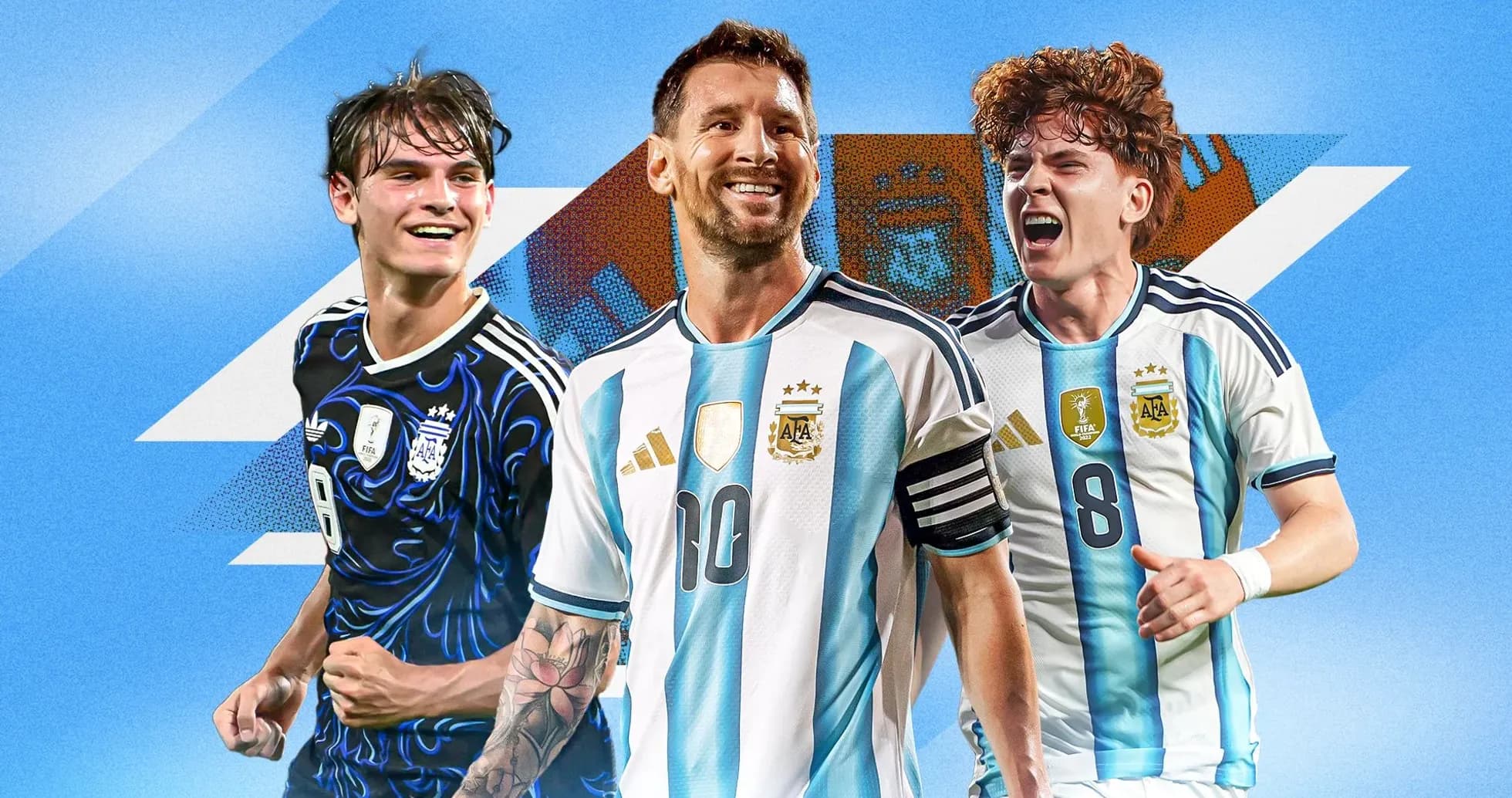
Nine members of the current squad are on the “wrong” side of 30. That list includes pillars like Emiliano Martínez, Rodrigo De Paul and, of course, Lionel Messi, who will turn 39 during what will be a record sixth World Cup.
At the other end, the youth is thin. Only three players – Giuliano Simeone, Valentín Barco and Nico Paz – are under 25. Talents such as Franco Mastantuono and Alejandro Garnacho have been left at home. The average age nudges past 29. For a team that has played deep into tournaments, year after year, the odometer is starting to matter.
Legs heavy, schedule relentless
The concern is not just age. It’s mileage.
On top of the 2024 Copa America, 11 of Scaloni’s players also went to last summer’s Club World Cup. For some, that means three straight seasons without a real break.
Since the start of the 2024-25 campaign, Enzo Fernández and Julián Álvarez have each played 121 matches for club and country. One hundred and twenty-one. It is no coincidence Álvarez limped through the final weeks of Atlético Madrid’s season nursing an ankle problem. It would be a surprise if the sheer volume of work Enzo has put in does not bite at some point, even with the midfielder still only 25 and in superb physical condition.
Alexis Mac Allister is the warning sign. His form has dipped sharply. He did not go to the Club World Cup, yet the Liverpool midfielder has still amassed 119 appearances over the past two seasons. He is expected to start Argentina’s opener against Algeria at Arrowhead Stadium on Tuesday, but his Premier League performances over the last nine months have raised alarms.
During Liverpool’s defeat to Manchester City in February, former winger Jermaine Pennant went public with his frustration on social media. Speaking later to TalkSport, he explained: “I was watching the game and I was frustrated and I tweeted… I was angry. It was constructive angry… I touched on that, ‘after your injury in pre-season, you’ve come back a shadow of what you are; it seems like your legs have gone’. In that [City] game, he was literally a bystander, he didn’t really get into it at all and that’s what I touched on, it was an observation.”
The criticism cut close to the wider fear around this Argentina side: too many tired legs, not enough fresh ones.
Scaloni’s loyalty vs the need for risk
Scaloni, though, remains loyal. Unfettered by outside noise, he is set to trust the core that has never failed him on a major stage.
Seven of the starters from the 2022 World Cup final are expected to line up again against Algeria. The number would likely have been as high as 10 had Álvarez, Nicolás Tagliafico and Nahuel Molina not arrived with minor injuries.
Cristian Romero, Nicolás Otamendi, Enzo Fernández, De Paul, Mac Allister and Messi are all set to reprise their roles. Lautaro Martínez, Golden Boot winner at the 2024 Copa America, will lead the line in Álvarez’s place.
This is a team that knows how to win. It has proven that in finals, in penalty shootouts, in hostile stadiums. But to go deep again, Scaloni may have to betray his own instincts and trust youth at key moments.
That tension is already visible at left-back.
With Tagliafico out, the obvious move would be to unleash Barco. The left-sided Strasbourg player, strongly tipped to join Chelsea this summer, has scored in two of Argentina’s last three games, playing slightly higher up the pitch. By trade he is a left-back, and at 21 he offers the kind of running power and attacking thrust this ageing side increasingly lacks down the flanks.
Scaloni is set to go another way. Lisandro Martínez, Manchester United’s rugged centre-back, will likely slide over to mark Algeria’s veteran talisman Riyad Mahrez. Defensively, it makes sense. Lisandro is a fierce one-on-one defender. But his instincts are those of a centre-back; the overlaps and surges Barco promises will not be part of the package.
On the opposite side, youth is being used out of necessity rather than design. Simeone is set to start at right-back, an unfamiliar role for him, while Molina and Gonzalo Montiel continue their recoveries from recent injuries. For now, Simeone deputises until at least one of the recognised full-backs can handle more than a cameo.
Nico Paz, the live wire on the bench
The real flashpoint in Argentina’s generational debate is Nico Paz.
At 21, the midfielder has lit up Serie A with Como across the past two seasons. Under the guidance of Cesc Fàbregas, Paz scored 13 goals and added seven assists this campaign, driving a newly promoted side to a fourth-place finish and Champions League qualification. The league named him Best Midfielder at its end-of-season awards. Real Madrid are widely expected to trigger the buy-back clause in his contract this summer.
His profile is exactly what this Argentina midfield sometimes lacks. Paz plays forward. He sees passes others do not. He is happy to risk possession to open a game up. His energy and imagination stand in sharp contrast to the conservative, heavy-legged displays Mac Allister has occasionally offered of late.
Yet Paz will likely start this World Cup on the bench. A minor knee issue has not helped his case, but the broader pattern is clear: Scaloni leans first on those who have served him before.
He has, though, shown a willingness to change when the tournament demands it. In Qatar, his decision to throw a then-21-year-old Enzo Fernández into the starting XI midway through the group stage transformed Argentina’s campaign. It turned a stumbling side into eventual champions.
He may need a similar jolt here.
A brutal route and one last dance
The draw offers little mercy. Win Group J ahead of Algeria, Austria and Jordan, and Argentina are likely to run into the runners-up from Group H – possibly Spain, more likely Uruguay – in the round of 32. Survive that and a favourable last-16 tie awaits against the runners-up from either Group D (currently Australia) or Group G (potentially Belgium, Egypt or Iran).
Then the temperature spikes.
If seedings hold, Portugal loom in the quarter-finals. That would set up the showdown football has been teasing for a decade and a half: Messi vs Cristiano Ronaldo, likely for the last time on this stage, with a place in the semi-finals of their final World Cup on the line.
By then, Scaloni must know his best team, not just his most trusted one. Sentiment has carried Argentina a long way, but the clock is ticking on this golden generation. Somewhere between the old guard and the new faces like Paz, Barco and Simeone lies the balance that could deliver Messi the send-off his career deserves.
The loyalty has been earned. The tough calls cannot be dodged forever.