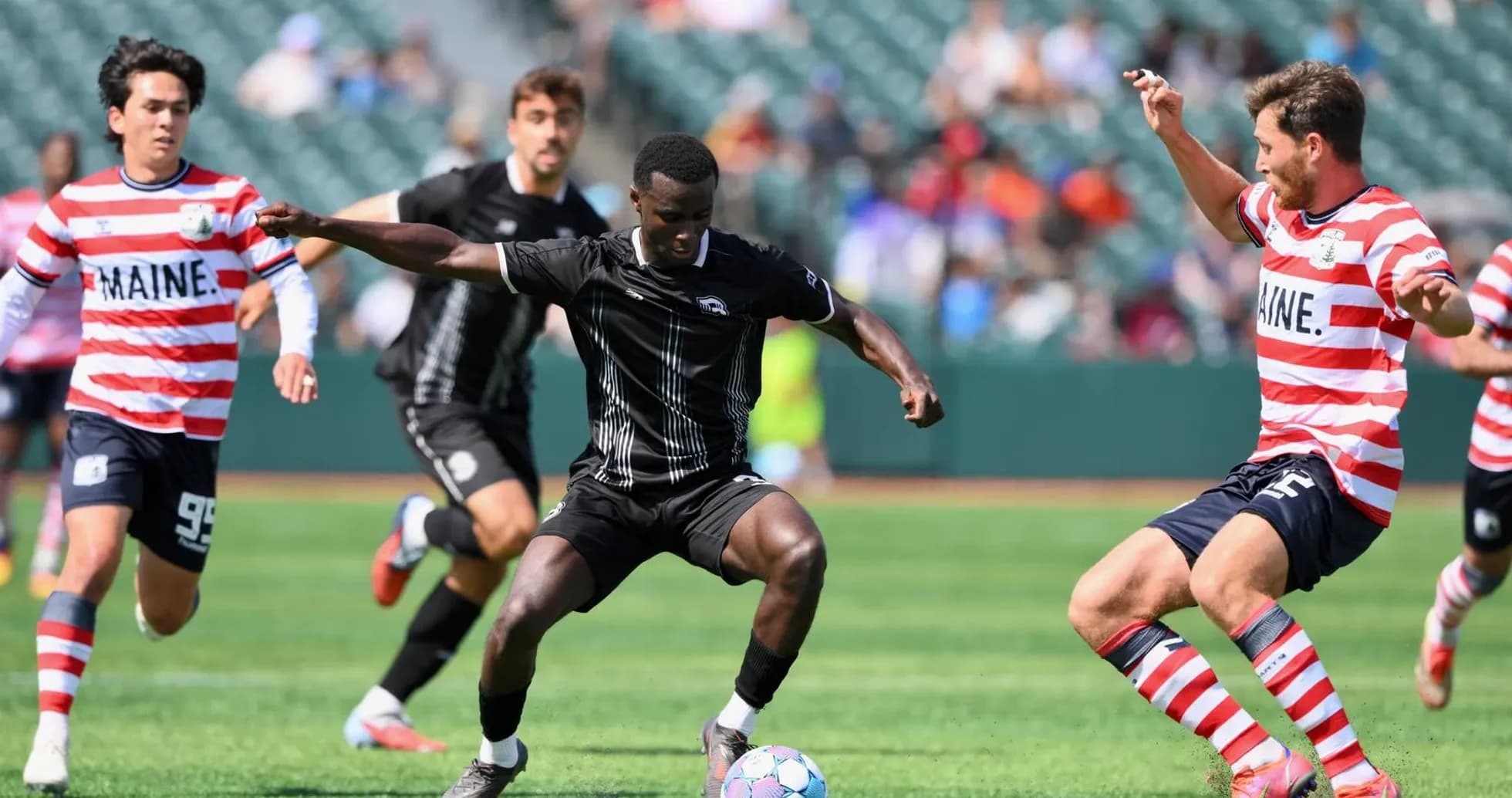
Alta's Resilience Shines in 2–1 Victory Over Orange County SC
Under the lights of Lancaster Municipal Stadium, Alta’s 2–1 victory over Orange County SC closed their USL League One Cup group campaign with a statement of resilience more than dominance. Following this result, Alta sit 4th in Group 2 with 3 points and a goal difference of -2, while Orange County SC languish in 6th with 0 points and a goal difference of -3. Both sides have scored 3 goals in total this campaign, but their defensive profiles and in‑game discipline sketch very different tactical identities.
I. The Big Picture – contrasting blueprints
Alta’s season to date has been defined by volatility. Overall they have played 3 matches, winning 1 and losing 2, with 3 goals for and 5 against. At home they are perfect in miniature: 1 win from 1, scoring 2 and conceding 1. On their travels they have lost both games, scoring 1 and conceding 4. The split is stark in the averages: at home Alta average 2.0 goals for and 1.0 against; away that drops to 0.5 for and jumps to 2.0 against, giving an overall scoring rate of 1.0 and conceding 1.7 per match.
Orange County SC’s pattern is simpler and more brutal: three matches, three defeats, 3 goals scored and 6 conceded. Whether at home or away, they average 1.0 goal for and 2.0 against, underlining a defensive structure that has not yet found stability and an attack that has not compensated for it.
This match, finishing 2–1 to Alta after a 1–1 half-time scoreline, encapsulated those broader arcs. Alta again found a way to be more efficient in front of their own supporters, while Orange County SC’s persistent fragility in managing transitions and game states resurfaced.
II. Tactical voids and discipline – where control slipped
Injuries and suspensions are not explicitly recorded for this fixture, but the season-long disciplinary data exposes the fault lines that shaped the contest.
Alta’s yellow card distribution shows a squad that increasingly lives on the edge as matches wear on. Across the campaign, 27.27% of their yellow cards have come in the 76–90' window, the single biggest slice of their caution profile. Earlier phases – 16–30', 31–45' and 46–60' – each account for 18.18%, with only 9.09% arriving in both the 0–15' and 61–75' ranges. That curve tells us Alta grow more combative and risk‑taking late, especially when protecting or chasing a result. The red card data is even more pointed: 100.00% of their dismissals have fallen in the 61–75' band. When Alta’s intensity spikes after the hour, it can tip from controlled aggression into numerical self‑sabotage.
Orange County SC’s disciplinary pattern is different but equally destabilising. They cluster 40.00% of their yellow cards between 31–45', another 20.00% in 46–60', and 20.00% again in the 76–90' band, with a final 20.00% in 91–105'. The red card story is brutal: 100.00% of their reds have arrived in the 46–60' window. That is precisely the phase when coaches attempt to reset structures at half-time; for Orange County SC, it has instead become a danger zone where tactical adjustments are undermined by rash decisions.
In this match, the 1–1 half-time scoreline set up a second half in which discipline and game management would decide the margins. Alta’s history of late yellows suggested a risk of inviting pressure; Orange County SC’s tendency to implode just after the interval hinted at the opposite. The final 2–1 score to Alta suggests that, on this night, the hosts managed that volatility better.
III. Key matchups – Hunter vs Shield, and the engine room
Without explicit individual scoring charts, the “Hunter vs Shield” duel is best read at unit level. Alta’s home attack, averaging 2.0 goals per game, went up against an Orange County SC defence that concedes 2.0 goals per match both home and away. The first half’s 1–1 score reflected Orange County SC’s capacity to trade chances, but the second half tilted toward Alta’s structural advantage: they are simply more efficient at home than Orange County SC are anywhere.
On the ball, Alta’s creative heartbeat came from the technical axis of M. Ibarra and J. Mariona behind the forward line. Ibarra, wearing 10, acted as the natural reference point between lines, while Mariona, with 17, offered vertical runs and half-space occupation. Around them, the double presence of O. Lay (6) and M. Alassane (5) provided a platform to compress the centre and spring counters.
Opposite them, Orange County SC’s “engine room” featured C. Hegardt (10) and O. Sylla (8), flanked by the wide threat of L. MacKinnon (11). On paper, that trio offers balance: Hegardt as connector, Sylla as carrier, MacKinnon stretching the back line. Yet the season numbers – 3 goals for, 6 against, no clean sheets – indicate that this midfield has not shielded the defence effectively, especially in transition.
Defensively, Alta’s back line of C. Ortiz, M. Pajaro, M. Winum and E. Ceja had to track the movement of T. Kadono and the supporting runs from deeper lines. Their previous away collapses (conceding 4 goals in 2 matches) suggested vulnerability when dragged wide or forced to defend repeated waves. At home, however, they have allowed only 1 goal in 1 match, and that pattern repeated here: an early concession, then a tightening of lines as the game matured.
IV. Statistical prognosis – what this result tells us going forward
From an Expected Goals perspective, the raw shot data is missing, but the scoring trends allow a cautious projection. Alta’s overall profile – 1.0 goals for and 1.7 against per match – points to a side whose underlying xG conceded is likely higher than ideal, especially away. Yet at home, their 2–1 win and 2.0 scoring average suggest their attacking xG at Lancaster Municipal Stadium should be comfortably above 1.0 per game, supported by a more compact defensive block.
Orange County SC’s flatline at 1.0 goals for and 2.0 against overall hints at an xG balance that is consistently negative. They are not failing to create entirely – 3 goals in 3 games – but their inability to suppress opposition chances, combined with red cards concentrated in the 46–60' window, suggests their defensive xG allowed spikes just when matches should be stabilising.
Following this result, Alta emerge as a volatile but dangerous home side: capable of scoring in bursts, yet always flirting with disciplinary trouble late on. Orange County SC, by contrast, look like a team trapped in a loop: structurally open, psychologically fragile after half-time, and still searching for a defensive identity that can support the technical promise of Hegardt, Sylla and MacKinnon.
If these trends hold into future knockout or league fixtures, Alta’s path forward will hinge on whether Brian Kleiban can harness the aggression of players like M. Alassane and O. Lay without tipping into the red-card zone after the hour. For Danny Stone and Orange County SC, the priority is more fundamental: re-engineer the midfield shield so that the back line of N. Ciotta, T. Brewitt, T. Espy and G. Doody is not perpetually exposed, and instil the composure to navigate that treacherous 46–60' corridor without self-destruction.