World Cup Third Gear: England Stalls, Scotland Prepares, Ronaldo Roars
The World Cup has reached that awkward third step of the group stage – where nerves fray, legs tire and clarity is in short supply. England felt all of that in Boston. Scotland are about to discover how it feels in Miami.
Bellingham’s “second game fever” and a night that slipped away
England’s 0-0 draw with Ghana was as flat as the scoreline suggests, a performance that stalled rather than sank their campaign. A point keeps them on top of Group L and all but into the last 32, yet it also denied them the early qualification they craved.
Jude Bellingham, man of the match and emotional barometer of this side, called it “second game fever” – a label backed by the numbers. This was England’s fourth straight draw in their second fixture at a major tournament, stretching back to Euro 2020. Different venues, different opponents, same stutter.
His message, though, was clear: roll with it. Learn from the grind, reset for Panama on Saturday and move on.
The frustration, naturally, clung to Harry Kane. The captain, who scored twice against Croatia in the opener, had the game on his right foot in the dying minutes and lashed over from seven yards. No theatrics from him afterwards, no self‑pity. Kane spoke like a striker who knows the rhythm of tournaments: chances missed, chances returned, and the odds eventually bending his way.
He rejected the idea that England lean on him too heavily. Eberechi Eze echoed that, pointing to the depth of attacking talent behind the No 9. Kane may be the reference point, but he is not the only route to goal – at least, that is the conviction inside the camp.
Rice walking the disciplinary tightrope
Declan Rice left Boston Stadium with his leg strapped, a visual jolt for England fans who have already watched him become Thomas Tuchel’s on‑field anchor. Early indications suggest no long‑term damage, yet his involvement against Panama is in doubt, with a rest under serious consideration.
Even if he plays, Rice must tread carefully. His yellow card for a foul on Jerome Opoku was England’s first of the tournament. One more against Panama and he would miss the second‑round tie. Under FIFA rules, two bookings before the end of the group phase trigger a one‑match suspension; only after the groups are done are single yellows wiped.
Reece James, who completed the full 90 minutes against Ghana after a patchy, injury‑hit season with Chelsea, will also be checked over. Tuchel has decisions to make: chase rhythm with a strong XI or rotate and protect key pieces with the knockouts looming.
Bellingham at the eye of a World Cup storm
Off the pitch, Bellingham has become the centre of a very different debate. Images of him covering his mouth while talking to Jordan Ayew sparked uproar in Paraguay, where Miguel Almiron was sent off for the same gesture in a heated clash with Turkiye.
Under a new World Cup directive, players can be dismissed for shielding their mouths during confrontations. Almiron’s red, awarded after VAR intervention, has ruled him out of Paraguay’s crucial final group game against Australia.
Bellingham, by contrast, faced no sanction because his exchange with Ayew was deemed a friendly chat, not a flashpoint. The Paraguayan FA have filed a formal complaint with FIFA, accusing the governing body of applying the rule inconsistently. What began as a minor image has now become a question of fairness at the heart of the tournament.
England fans praised as off‑field row rumbles
While controversy swirls in the committee rooms, the stands have told a different story. Around 30,000 England supporters packed into Boston Stadium, and UK Football Policing chiefs reported no arrests or trouble involving British nationals.
Chief Constable Mark Roberts hailed their behaviour as “exemplary”, echoing similar praise from local police and bar owners. The mood around England’s games in the US has been boisterous but controlled, a far cry from some previous tournaments.
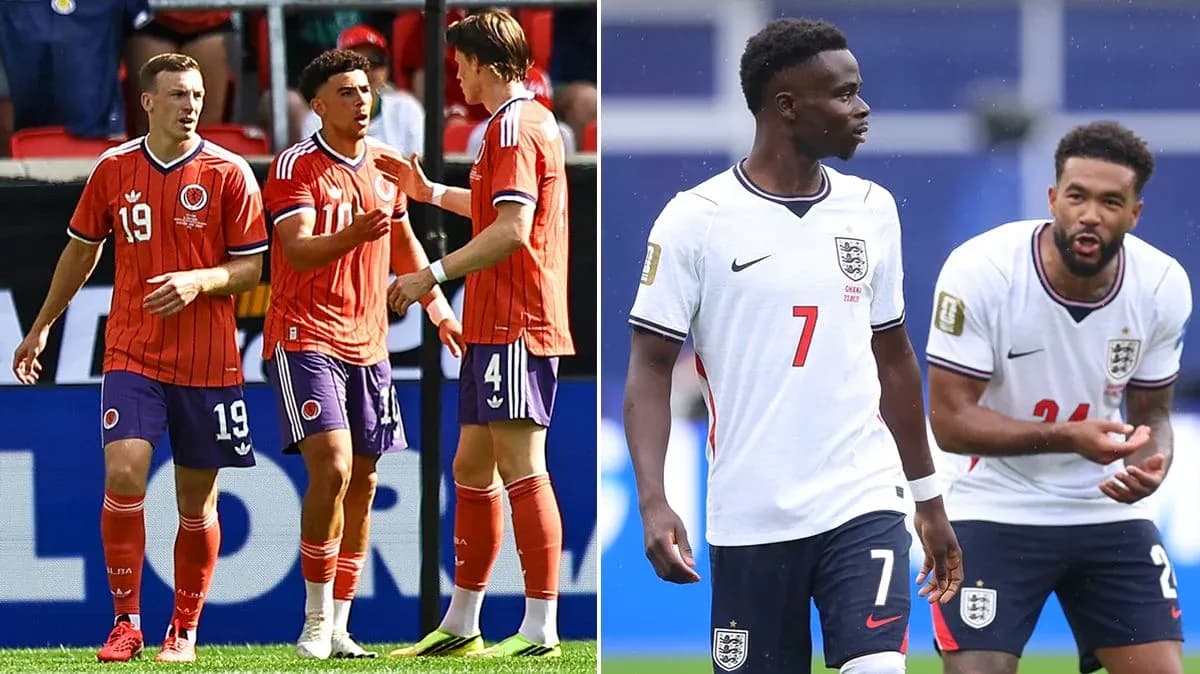
On the pitch, though, the margins remain thin. As it stands, England top Group L and Scotland sit third in Group C – a configuration that currently points towards a seismic last‑16 meeting in Mexico City on July 6. One slip for either side over the next few days, and that collision course could vanish.
Ronaldo’s response and Portugal’s statement win
Far from Boston and Miami, Cristiano Ronaldo chose his moment to reassert himself. Under scrutiny after a poor display against DR Congo, the 39‑year‑old responded with a brace in Portugal’s 5-0 demolition of Uzbekistan.
He declared he was “back”. His team‑mate Bruno Fernandes sounded more relieved than triumphant. The Manchester United captain admitted it was important for the squad – and for their captain – that Ronaldo found the net again. He called Ronaldo their “go‑to player in attack”, and when the captain scores twice in a five‑goal rout, that description feels less like flattery and more like fact.
Portugal now face Colombia in Miami on Saturday, a straight fight to top Group K. Ronaldo arrives in Florida with momentum and, crucially, with the debate about his place in the side temporarily silenced.
Scotland, Brazil and a night thick with jeopardy
If England are grumbling, Scotland are living on a knife-edge. Steve Clarke’s team head into a final‑day showdown with Brazil in Miami knowing exactly what is at stake and knowing, too, that history is not on their side.
Four previous World Cup meetings with Brazil – 1974, 1982, 1990, 1998 – have brought no Scottish victories. Yet this time, the equation is brutally simple.
Beat Brazil and Scotland are through, with a chance to top the group if Morocco slip against Haiti. A draw, almost certainly, does the job as well, taking them to four points – usually enough to secure a place among the eight best third‑placed sides advancing to the last 32.
Lose, and the calculators come out. A narrow defeat, mirroring the 1-0 reverse to Morocco, would leave Scotland on three points with a goal difference of -1. Past tournaments suggest that might still be enough to sneak through, but it would leave Clarke’s players sweating on results elsewhere and the Tartan Army glued to every kick in other groups.
The bookmakers still make Brazil heavy favourites, yet the mood among Scotland fans in Miami tells a different story. Kilts and bagpipes on the beaches, songs on the boardwalk, good‑natured taunts with Brazilian supporters – the Tartan Army have turned the city into a travelling carnival.
Local police have praised their behaviour and the “unforgettable atmosphere” they have created, just as officers did in Boston for Scotland’s earlier fixtures against Haiti and Morocco. Off the pitch, Scotland are winning hearts. On it, they need one more big performance.
Neymar back, Raphinha out, Ancelotti wary
Complicating Scotland’s task is the likely return of Neymar. The Brazil star has yet to feature at this World Cup because of a calf problem but trained fully this week and is, in Carlo Ancelotti’s words, “fit and able and ready to play”.
The Italy‑born coach talked up Neymar’s attitude and work ethic, hinting he could play anything from 45 minutes to the full match. Raphinha, however, will miss out after suffering a hamstring injury in Brazil’s 3-0 win over Haiti.
Ancelotti, who has seen enough tournaments to know danger when he sees it, sounded a clear warning to his own players. Scotland, he said, are “fighters”, well organised and packed with experience in the likes of Scott McTominay and John McGinn. “Easy games at the World Cup were finished a long time ago,” he added.
The scheduling underlines the stakes. Scotland’s clash with Brazil kicks off at the same time as Morocco vs Haiti – a direct consequence of FIFA’s move, post‑1982, to stage final group matches simultaneously and prevent any repeat of the infamous “Disgrace of Gijón”, when West Germany and Austria were accused of playing out a mutually convenient 1-0.
Yet even that safeguard is under threat. Severe storms have already delayed France’s game with Iraq, stretching it almost four hours beyond kick‑off. FIFA regulations allow for staggered kick‑offs in cases of force majeure, raising fears that weather could again open the door to manipulated results in the closing days of the group stage.
Ticket fury and a tournament feeling the heat
Away from the pitch, the World Cup has been hit by a different kind of anger. Former UK prime minister Gordon Brown has called for an inquiry into ticket prices, accusing FIFA of “pricing ordinary fans out of the game”.
Brown, who attended Scotland’s opener against Haiti, highlighted that seats for the final are reportedly 30 to 40 times more expensive than for the Euro final in Germany. He described the prices as “extortionate” and urged a full review once the tournament ends.
For now, though, fans are still travelling in huge numbers. An earthquake in California – a magnitude 5.6 tremor in Mendocino County – rattled nerves but did not disrupt preparations for the USA’s final group match against Turkey in Los Angeles. The National Tsunami Warning Center confirmed there was no tsunami threat.
Germany, Argentina and the hunt for momentum
Elsewhere among the contenders, Germany are refusing to ease off despite already qualifying. Midfielder Nadiem Amiri insists they will treat their clash with Ecuador “like a final”, determined to keep momentum and respect the integrity of the group.
Argentina, too, are in no mood to coast. Lionel Scaloni’s side have already wrapped up Group J and secured a last‑32 date in Miami, yet the coach plans to use Lionel Messi against Jordan in Dallas. Messi, on five goals from his first two matches and leading the Golden Boot race, is understood to want at least 45 minutes.
Scaloni will rotate around him – Cristian Romero is sidelined until the knockouts with a muscle issue – but Argentina’s intent is clear. They want rhythm, not rest, even with the Dallas heat forecast to hit 100F.
Spells, scapegoats and the human side of the World Cup
No World Cup is complete without its more surreal subplots, and Ghana have provided one of them. Self‑styled “witch doctor” Nana Kwaku Bonsam claimed to have cast a spell on Harry Kane before the England game, taking credit for the striker’s blank in Boston. Now, having hailed himself as the “most powerful spiritualist in the whole world”, he says he has “released” Kane so he can score against Panama.
In Sweden’s camp, the tone is very different. Graham Potter has been forced to defend captain Isak Hien after the defender’s error‑strewn display in a 5-1 defeat to the Netherlands. Hien, outstanding in Sweden’s opening 5-0 win over Tunisia, was blamed for three of the Dutch goals.
Potter’s response was emphatic. He said he “loves” Hien, insisted the centre‑back will continue to play while he is manager and called for criticism to be directed at him instead. For Sweden, like so many others, the World Cup has become a test not only of tactics but of resilience and unity.
What comes next?
England head towards Panama with questions about creativity, fitness concerns over Rice and James, and a disciplinary cloud hanging over their midfield anchor. Scotland walk into the glare of Brazil, with Neymar sharpening his studs and the Tartan Army turning Miami into a home from home.
Between them lies the tantalising prospect of a last‑16 showdown in Mexico City. To make it happen, England must turn frustration into fluency. Scotland must stand toe‑to‑toe with the five‑time champions and refuse to blink.
The third round of group games doesn’t just sort contenders from passengers. It reveals who can handle the weight of a moment that might define their summer – or their generation.