USA Dominates Paraguay 4-1 at SoFi Stadium
USA’s 4-1 win over Paraguay at SoFi Stadium was built on a clear structural superiority: a dominant 4-2-3-1 that controlled territory, tempo and central spaces against Paraguay’s 4-4-2. The scoreline aligned closely with the underlying dynamics: USA generated 16 total shots to 9, 13 of them inside the box, and held 65% possession, while Paraguay were forced into a reactive, foul-heavy game (17 fouls, 5 yellow cards) and rarely established stable attacking platforms.
USA’s shape was textbook Pochettino 4-2-3-1. Matthew Freese in goal sat behind a back four of Alexander Freeman, Chris Richards, Tim Ream and Antonee Robinson. In front, Tyler Adams and Malik Tillman formed the double pivot, with Sergiño Dest and Christian Pulišić as high, aggressive wide midfielders, Weston McKennie between the lines, and Folarin Balogun as the lone striker. The structure allowed USA to create a 2-4-4 in possession: full-backs advancing, pivots controlling circulation, and four attackers pinning Paraguay’s back line.
Paraguay’s 4-4-2 under Gustavo Alfaro, with Orlando Gill in goal, a back four of Juan Cáceres, Gustavo Gómez, Omar Alderete and Junior Alonso, a midfield line of Diego Gómez, Andrés Cubas, Damián Bobadilla and Miguel Almirón, plus Antonio Sanabria and Julio Enciso up front, never fully solved USA’s overloads between the lines. Their two forwards were often outnumbered by USA’s centre-backs and double pivot, which let USA build cleanly and force Paraguay’s midfield to collapse deep.
The opening own goal at 7' from Damián Bobadilla was a direct consequence of USA’s pressure and presence in the box: with USA already camped in the final third, Paraguay’s defensive line was facing its own goal, heightening the risk of miscues. That early lead tilted the tactical balance further. Paraguay’s first yellow at 10' to Juan Cáceres for “Tripping” underlined how quickly their back line was being stretched by USA’s wide rotations and underlapping runs.
USA’s attacking mechanisms were clear. With 596 total passes and 508 accurate (85%), they circulated the ball patiently, drawing Paraguay’s compact 4-4-2 from side to side until gaps appeared. Robinson and Freeman provided width, allowing Pulišić and Dest to drift inside and combine with McKennie and Balogun. The disallowed goal at 28' for Folarin Balogun, cancelled by VAR for offside, came from this pattern: vertical penetration after sustained circulation.
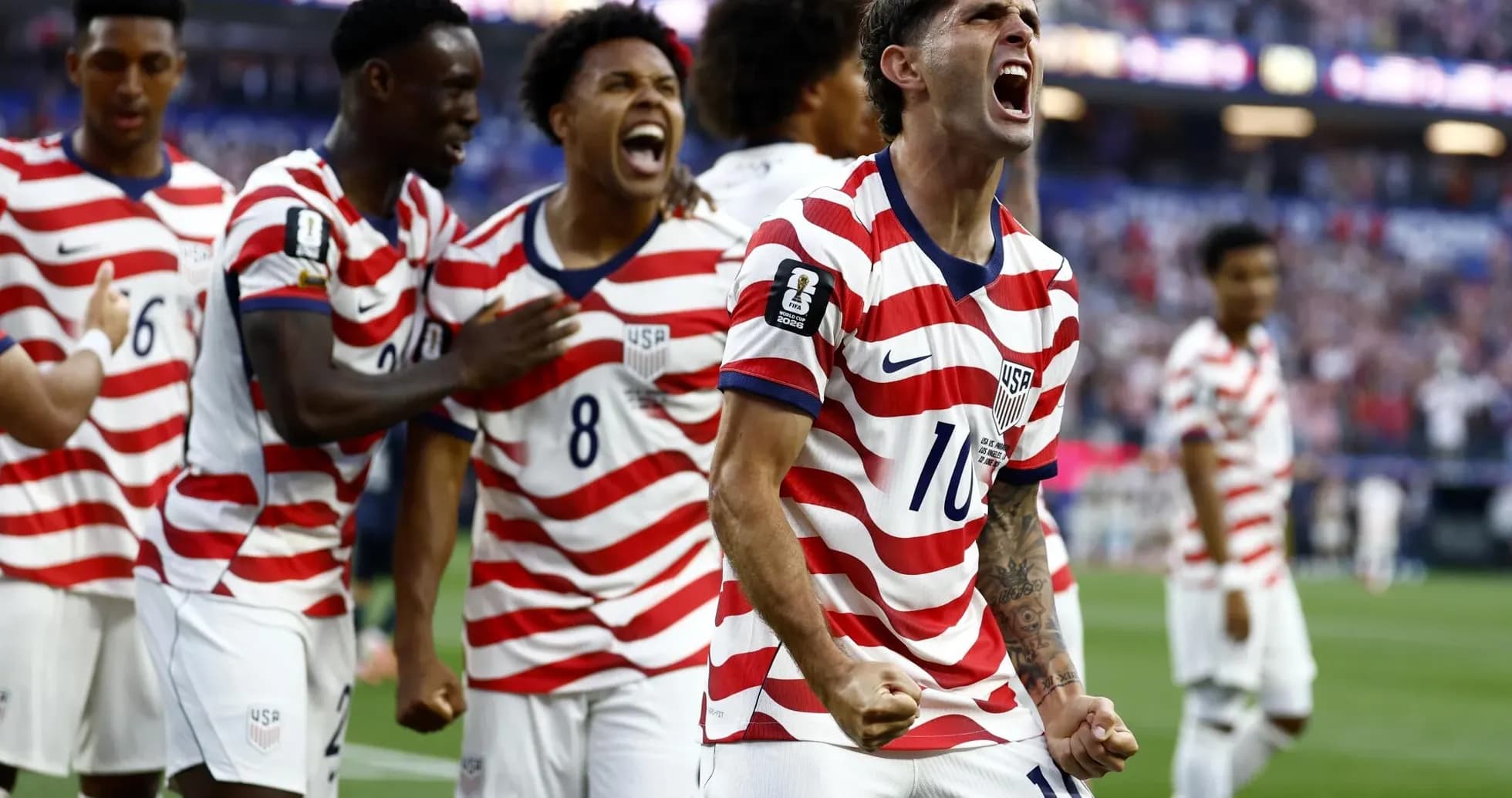
Balogun’s brace, at 31' (assisted by Christian Pulišić) and 45+5' (assisted by Malik Tillman), showcased the benefits of a clear reference point up front. In both actions, USA exploited the space between Paraguay’s centre-backs and full-backs. The first came from Pulišić’s ability to receive between the lines and release Balogun into the channel; the second from Tillman stepping higher from the pivot, recognizing that Paraguay’s midfield was pinned back and unable to track late runs. By half-time, at 3-0, the match state allowed USA to manage rather than chase the game.
Out of possession, USA’s pressing was structured rather than wild. The front four screened passes into Cubas and Diego Gómez, forcing Paraguay to play longer, lower-percentage balls toward Sanabria and Enciso. With Paraguay limited to 9 total shots and just 4 inside the box, the USA back line kept most of the danger at arm’s length. The foul count (13 for USA, 17 for Paraguay) suggests USA were occasionally forced into tactical fouls, but Paraguay’s card profile shows more strain: yellows for Miguel Almirón (“Diving” at 53'), Diego Gómez (“Holding” at 79'), Alex Arce (“Roughing” at 88') and Junior Alonso (“Holding” at 90+3') reflected a team repeatedly late to duels and transitions.
The second half began with key adjustments. Paraguay replaced Bobadilla with Mauricio at 46', a move that paid off with their lone goal at 73', assisted by Julio Enciso. The substitution was an attempt to inject more ball-carrying and creativity between the lines, and the goal came in a rare phase where Paraguay advanced their block and combined centrally. However, the overall attacking volume remained low: only 1 shot on goal and 0.51 xG, indicating that Paraguay’s improvement was more cosmetic than structural.
USA, for their part, managed minutes and roles intelligently. At 46', Sebastian Berhalter came in for Pulišić, slightly rebalancing the midfield toward control over pure incision. Later, Tim Weah for Sergiño Dest and Ricardo Pepi for Balogun at 72' refreshed the front line, while Giovanni Reyna for Malik Tillman at 82' added another technical profile between the lines. Reyna’s late goal at 90+8', assisted by Alexander Freeman, was emblematic of USA’s sustained attacking discipline: even in added time, the full-back overlapped and the advanced midfielder attacked the box.
From a statistical standpoint, the 4-1 scoreline tracks well with the underlying metrics. USA’s 1.27 xG suggests they finished slightly above expectation, helped by the own goal and clinical execution from high-quality central positions, while Paraguay’s 0.51 xG underlines how rarely they created clear chances. Both goalkeepers’ metrics point in the same direction: with USA recording 6 shots on goal and Paraguay 1, Orlando Gill (Paraguay) needed to make 3 saves, while Matthew Freese (USA) made 1 save. Paraguay’s negative goals prevented value (-1.16) indicates that their goalkeeping and last-line defending underperformed relative to shot quality faced.
Possession and passing further reveal the territorial story. USA’s 65% share and 596 passes to Paraguay’s 320, plus a higher accuracy (508 accurate, 85%, versus Paraguay’s 230 accurate, 72%), show a side comfortable dictating rhythm and compressing the pitch. USA also generated more set-piece platforms (3 corner kicks to 1) and far more box presence (13 shots inside the box versus 4), reflecting superior occupation of dangerous zones.
Tactically, this was a controlled, methodical group-stage performance from USA. The 4-2-3-1 gave them clear reference points in every phase, their rotations consistently disrupted Paraguay’s 4-4-2, and their substitutions maintained structural integrity while adding fresh legs. Paraguay’s 4-4-2, by contrast, struggled to adapt to USA’s central overloads and wide interchanges, relying heavily on individual moments and direct play. Over 90 minutes, the combination of territorial dominance, structured pressing and efficient finishing made the 4-1 outcome at SoFi Stadium a logical reflection of the tactical balance.