South Korea's Tactical Triumph Over Czechia in World Cup Opener
Under the floodlights of Estadio Akron, South Korea’s 2–1 victory over Czechia felt less like an opening skirmish and more like a statement of intent. In a World Cup group where margins will be thin, Myung-Bo Hong’s side walked away with three points, a sharpened identity, and a few tactical scars that will shape the rest of their Group A campaign.
I. The Big Picture – Structure and Stakes
Following this result, the table offers a clean snapshot of contrasting trajectories. South Korea sit 2nd in Group A with 3 points, a goal difference of +1 after scoring 2 and conceding 1 overall. Czechia, beaten but not broken, occupy 3rd with 0 points and a goal difference of -1, their total of 1 goal for and 2 against reflecting a narrow defeat rather than a collapse.
Both managers mirrored each other on the tactics board, rolling out a 3-4-2-1 that turned the midfield into a crowded chessboard. For South Korea, the shape revolved around the ball-playing authority of Kim Min-jae at the heart of the back three, the dual creativity of Hwang In-beom and Lee Kang-in, and the roaming menace of Son Heung-min at the tip of the structure. Czechia’s version leaned on Ladislav Krejčí as the aggressive left-sided stopper, Tomáš Souček as the anchor in front of the back line, and Patrik Schick as the reference point up front.
In total this campaign, South Korea’s attacking return is clear: 2 goals from 1 match, with an overall average of 2.0 goals scored and 1.0 conceded. Czechia’s numbers invert that picture – 1.0 goal scored and 2.0 conceded on their travels – a reminder that their back line is still calibrating to the demands of this tournament.
II. Tactical Voids – Discipline, Risk, and the Edge of Chaos
If there is a dark thread running through South Korea’s otherwise bright night, it is discipline. Their season card profile shows a single yellow in the 91–105’ band, accounting for 100.00% of their yellows so far, and it belongs to Gi-Hyuk Lee. His inclusion among both the top yellow and top red card lists underlines how fine the margins were in those closing stages. One rash step and the entire defensive structure could have been compromised.
Lee’s statistical line is revealing: 62 passes with 93% accuracy, 3 interceptions, and 10 duels contested, 6 of them won. He was proactive, sometimes aggressively so. The booking late in the game, arriving when legs are heavy and concentration wanes, is the kind of moment Hong will circle in red. In a knockout scenario, that same challenge might tilt the entire tournament narrative.
For Czechia, the disciplinary story is more about accumulation of small fouls than cards. Vladimír Coufal and Krejčí each committed 3 fouls without going into the book, a reflection of Miroslav Koubek’s willingness to use tactical fouling as a stabilizing tool. It disrupted Korean rhythm but also hinted at a side operating at the limits of control. In future group matches, a stricter referee than Amin Mohamed Omar could easily convert that pattern into suspensions.
III. Key Matchups – Hunter vs Shield, and the Engine Room
The “Hunter vs Shield” duel did not unfold in the traditional striker-versus-centre-back script. Instead, the tournament’s early scoring spotlight fell on Hwang In-beom and Oh Hyeon-gyu for South Korea, and Krejčí for Czechia.
Hwang has been the heartbeat of this Korean side. With 1 goal and 1 assist in total, 3 shots (2 on target), and 81 passes at 90% accuracy, he dictated tempo from deep. His rating of 8.9 and 2 interceptions underline a player who is not just a creator but a first defender when possession is lost. In the context of this match, he repeatedly found pockets behind Souček, pulling Czechia’s midfield pivot out of shape and forcing their back three to step into uncomfortable zones.
On the Czech side, Krejčí emerged as both shield and unexpected spear. Listed as a defender, he still produced 1 goal from his only shot on target, while winning 7 of 13 duels and making 3 tackles. His physical presence unsettled South Korea at set pieces, and his timing in stepping into midfield gave Czechia a brief foothold whenever they threatened to tilt the game.
The “Engine Room” battle, though, was defined by Hwang and Souček. Souček’s role was more understated, screening the back three and trying to connect with Lukáš Provod and Pavel Šulc between the lines. Yet the numbers and the flow of the match suggest Hwang won that duel. When he drifted to combine with Lee Kang-in, Czechia’s shape frayed.
Lee’s influence was surgical. With 37 passes at 100% accuracy, 3 key passes, 6 dribble attempts and 5 successful, he repeatedly isolated defenders like Chaloupek and Zelený in wide 1v1s. His understanding with Son Heung-min stretched Czechia horizontally, opening corridors for late runners like Seung Ho Paik and, eventually, the penalty-box instincts of Oh Hyeon-gyu.
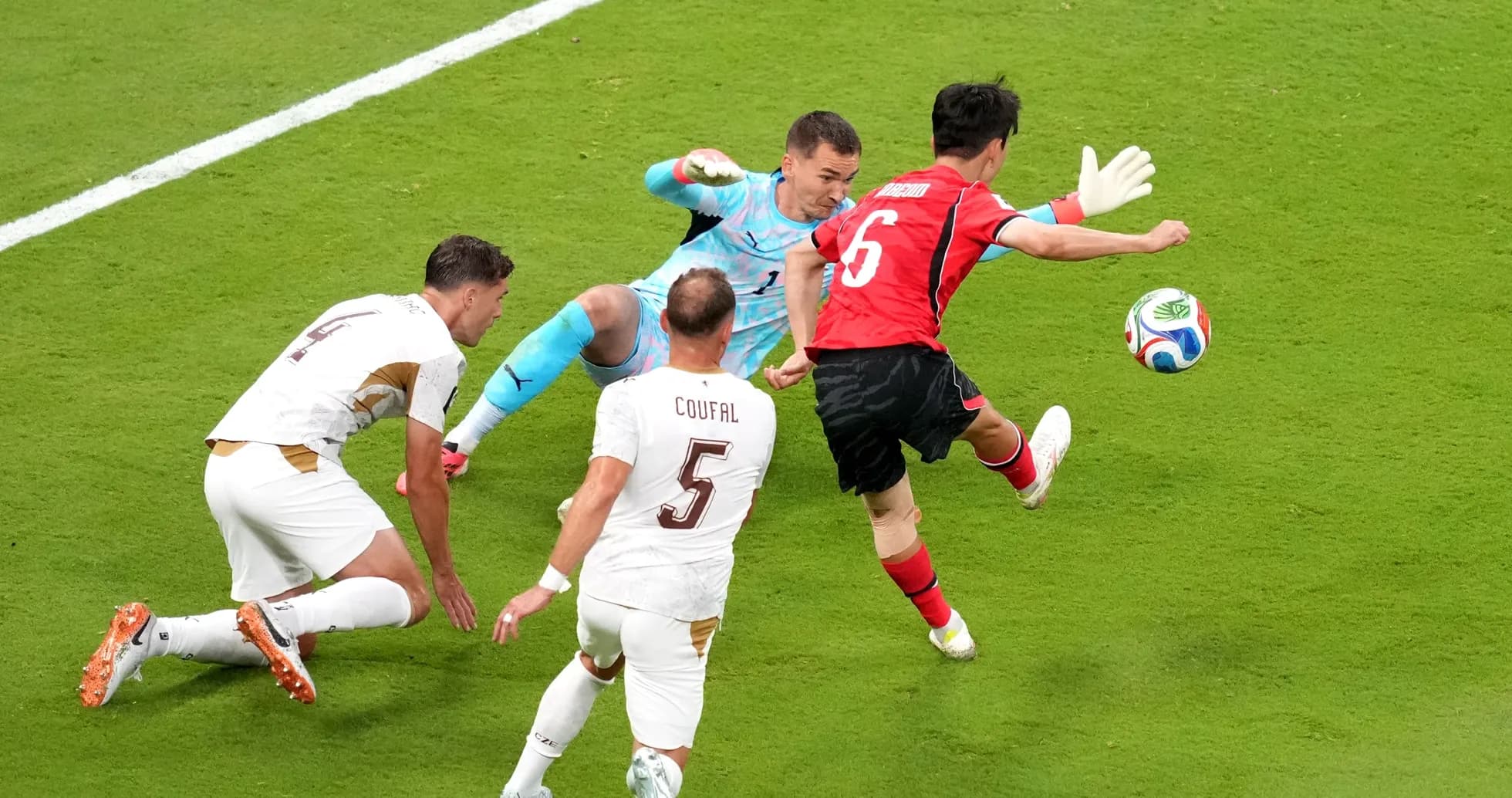
Oh’s cameo as a substitute – 1 goal from 1 shot on target, 4 duels contested and 3 won – added a different kind of hunter to the Korean front line: less about build-up, more about timing and penalty-area presence. His introduction effectively turned the 3-4-2-1 into a more direct, box-focused structure, and Czechia struggled to adjust.
On the flanks, Coufal versus Lee Tae-seok and Young-woo Seol was a bruising contest. Coufal’s 1 assist and 1 key pass show his enduring threat going forward, but his 2 duels won out of 9 and 3 fouls committed hint at how often he was forced onto the back foot by Korean rotations and Lee Kang-in’s drifts to that side.
IV. Statistical Prognosis – What This Match Tells Us About the Road Ahead
With no explicit xG values provided, we are left to infer from volume and quality of involvement. South Korea’s offensive spine – Hwang, Lee Kang-in, Son, and the impact of Oh – produced a coherent, layered threat. Their overall record of 2.0 goals scored and 1.0 conceded per match suggests an attack capable of sustaining pressure, but also a defense that can be punctured, especially by aerially dominant sides who can exploit late-game lapses like Lee Gi-Hyuk’s caution.
Czechia, with 1.0 goal for and 2.0 against on their travels, look like a side still searching for balance between their aggressive back three and a midfield that must protect more intelligently. Yet the individual outputs of Krejčí and Coufal show there is enough quality to trouble any opponent, particularly from wide service and set pieces.
Following this result, the tactical verdict is clear: South Korea’s 3-4-2-1 is already a functioning system with multiple creators and finishers, but it walks a disciplinary tightrope in high-intensity moments. Czechia’s mirror system is structurally sound but demands sharper coordination between Souček and his back line, and a clearer plan for how Schick, Provod, and Šulc share the creative burden.
If this match is a prelude to the rest of Group A, expect South Korea to lean even harder into Hwang and Lee Kang-in as dual conductors, while Czechia must turn Krejčí’s defiance and Coufal’s industry into a more resilient defensive platform. The numbers say the Koreans are ahead; the margins say the story of this group is far from finished.