Brazil vs Morocco: Balanced Draw in Group C Clash
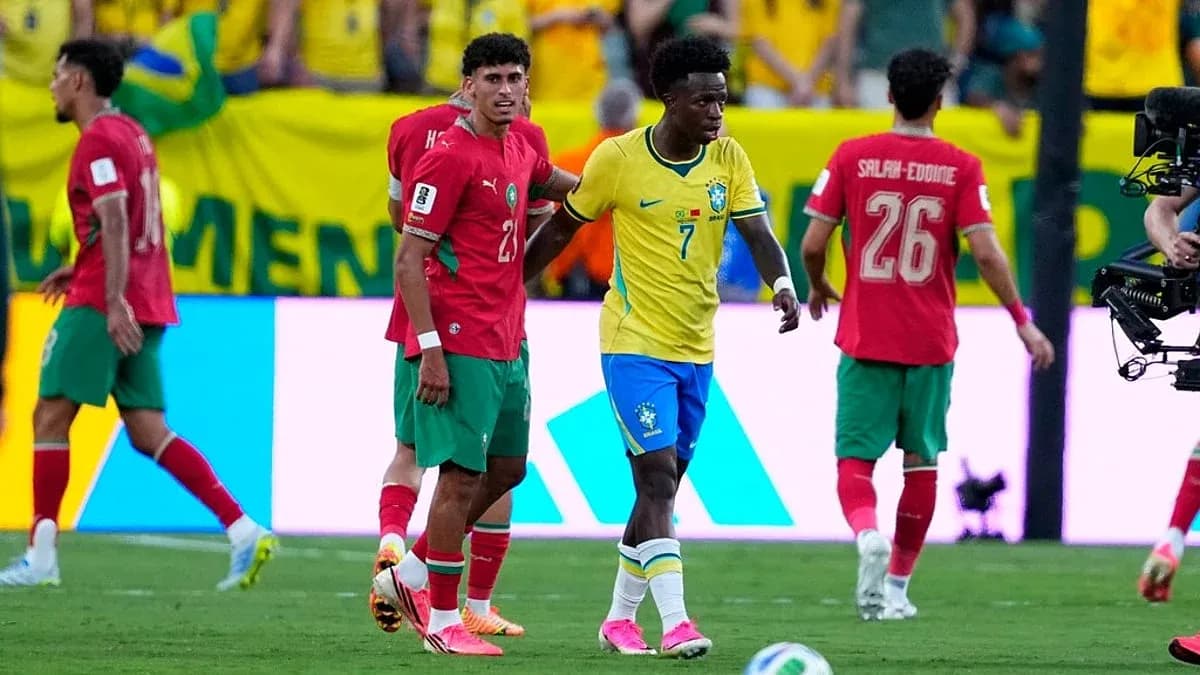
Brazil 1-1 Morocco at MetLife Stadium opens Group C with both sides moving to 2 points from two games and remaining in the qualifying places, but without taking full control of the group. Brazil stay on 2 points with 2 goals for and 2 against (goal difference 0), while Morocco also sit on 2 points with an identical 2-2 record and goal difference 0, underlining how finely balanced this section remains after another draw.
Match Report
The game’s first major incident arrived on 21', when Morocco struck the opener. 21' Morocco goal — Ismael Saibari (assisted by Brahim Díaz). Díaz drifted between the lines and slid a precise pass into Saibari, who timed his run into the right channel and finished low across Alisson to make it 0-1.
Brazil responded with more aggression in possession and were rewarded on 32'. 32' Brazil goal — Vinicius Junior (assisted by Bruno Guimaraes). Bruno Guimaraes broke the Moroccan midfield line with a vertical pass into Vinicius Junior on the left edge of the box; the winger drove inside and curled a composed finish beyond Bono to level at 1-1.
The Brazilian midfield then began to leave more space in transition, and their attempts to disrupt Moroccan counters brought disciplinary trouble. 37' Casemiro (Brazil) — yellow card (Tripping) after halting a break in the centre circle. Six minutes later, another defender went into the book: 43' Ibanez (Brazil) — yellow card (Tripping) for a late challenge stepping into midfield.
At half-time Carlo Ancelotti reacted decisively to those bookings and some defensive discomfort. On 46', Danilo replaced Ibanez (Brazil), a like-for-like change at right-back to remove a carded defender. Simultaneously, 46' Fabinho replaced Casemiro (Brazil), refreshing the holding role and adding slightly more mobility against Morocco’s fluid attacking midfielders.
Brazil continued to push after the interval, but their attacking structure was tweaked just after the hour. 61' M. Cunha replaced Lucas Paqueta (Brazil), with Cunha offering more direct running from central areas. A minute later, 62' Luiz Henrique replaced I. Thiago (Brazil), introducing a different profile in the front line to attack Morocco’s full-backs with more width and 1v1 threat.
Morocco answered with their own double change on 65' to restore energy and protect the draw. 65' C. Talbi replaced B. Diaz (Morocco), removing the chief creator but adding fresh legs in the front line for pressing. In midfield, 65' S. El Mourabet replaced A. Ounahi (Morocco), adding defensive discipline in front of the back four.
As Brazil increased their territorial pressure, Morocco’s full-backs began to tire, prompting further adjustments on 80'. 80' A. Salah-Eddine replaced N. Mazraoui (Morocco), a straight swap at left-back to cope with Brazilian attacks down that side. At the same time, 80' A. Amaimouni replaced B. El Khannouss (Morocco), bringing on another forward option to stretch Brazil on the counter.
Ancelotti made his final midfield change also on 80', looking for more vertical passing from deep. 80' Danilo Santos replaced Bruno Guimaraes (Brazil), with Danilo Santos tasked with moving the ball forward quickly against a now deeper Moroccan block.
In the closing stages, Morocco made one last attacking substitution to chase transitions and relieve pressure. 89' S. Rahimi replaced I. Saibari (Morocco), taking off the goalscorer but adding fresh pace to threaten behind Brazil’s advanced defensive line. Despite late Brazilian pressure and some half-chances, neither side could find a decisive second goal, and the contest closed at 1-1.
Fixture Statistics & Tactical Audit
- xG: Brazil 1.24 vs 1.28 Morocco
- Possession: Brazil 54% vs 46% Morocco
- Shots on Target: Brazil 4 vs 2 Morocco
- Goalkeeper Saves: Brazil 1 vs 3 Morocco
- Blocked Shots: Brazil 4 vs 6 Morocco
The statistical profile points to a broadly balanced contest, with Morocco very marginally ahead on xG (1.28 to 1.24) despite having less of the ball. Brazil’s greater possession (54%) and higher volume of shots on target (4 vs 2) reflected their territorial dominance in phases, but Morocco’s compact block forced many Brazilian efforts into crowded central zones, as shown by Morocco’s 6 blocked shots. Conversely, Morocco generated similar total shots and slightly higher xG from fewer on-target attempts, indicating that their best chances were of higher quality when they did break through. Bono’s 3 saves versus Alisson’s 1 underline that Brazil applied more sustained pressure, but the underlying chance quality supports the fairness of a draw.
Standings Update & Seasonal Impact
For Brazil, this second 1-1 draw moves them from 1 to 2 points, with their goals for rising from 1 to 2 and goals against from 1 to 2, leaving their goal difference unchanged at 0. They remain in the advancing zone in Group C but have not yet converted possession control into a win, keeping qualification open and increasing the importance of their final group match.
Morocco also progress from 1 to 2 points, with goals for moving from 1 to 2 and goals against from 1 to 2, maintaining a goal difference of 0. Already in an advancing position in Group C, they consolidate that status but, like Brazil, miss the opportunity to establish a clear gap at the top of the group, setting up a tight finish in the race for seeding and group supremacy.
Lineups & Personnel
Brazil Starting XI
- GK: Alisson
- DF: Douglas Santos, Gabriel Magalhães, Marquinhos, Roger Ibañez
- MF: Bruno Guimarães, Casemiro, Vinícius Júnior, Raphinha, Lucas Paquetá
- FW: Igor Thiago
Morocco Starting XI
- GK: Bono
- DF: Noussair Mazraoui, Chadi Riad, Issa Diop, Achraf Hakimi
- MF: Ayyoub Bouaddi, Neil El Aynaoui, Bilal El Khannouss, Azzedine Ounahi, Brahim Díaz
- FW: Ismael Saibari
Post-Match Verdict
This was a controlled yet not fully ruthless Brazilian performance, with their territorial edge and higher shots on target (4 vs 2) not translating into a volume of clear chances commensurate with their possession (54%). Morocco executed a disciplined mid-block, evidenced by their 6 blocked shots and near-parity in xG (1.28 vs Brazil’s 1.24), suggesting their defensive structure effectively forced Brazil into lower-quality shooting zones. Offensively, Morocco were selective but incisive, creating slightly better-quality chances from fewer on-target efforts, while Brazil’s repeated reshaping of the midfield could not consistently unpick Morocco’s compact lines. In the end, both teams showed enough organisation and resilience to justify a point, but neither found the tactical sharpness in the final third required to turn a finely balanced statistical picture into a decisive victory.