Tuchel's Left-Side Woes: England's Tactical Challenges
Thomas Tuchel did not bother with diplomacy. England’s head coach took aim at his entire left flank – Anthony Gordon, Marcus Rashford and the rotating cast of full-backs – and made it brutally clear that one side of his team is dragging the rest down.
Tuchel’s left-side problem
Tuchel thought he had cracked it. Gordon dazzled in the final warm-up against Costa Rica, the combinations on that side of the pitch snapping into place, the movement sharp, the passing intuitive.
“I saw the game against Costa Rica and thought: ‘OK, left side is solved, this unit, they find their link,’” he said.
That feeling has vanished.
Across England’s first two Group games, Tuchel has watched the same flank turn from solution to headache. The manager was asked about Rashford’s chances of starting against Panama; he answered with a sweeping critique of the entire left side.
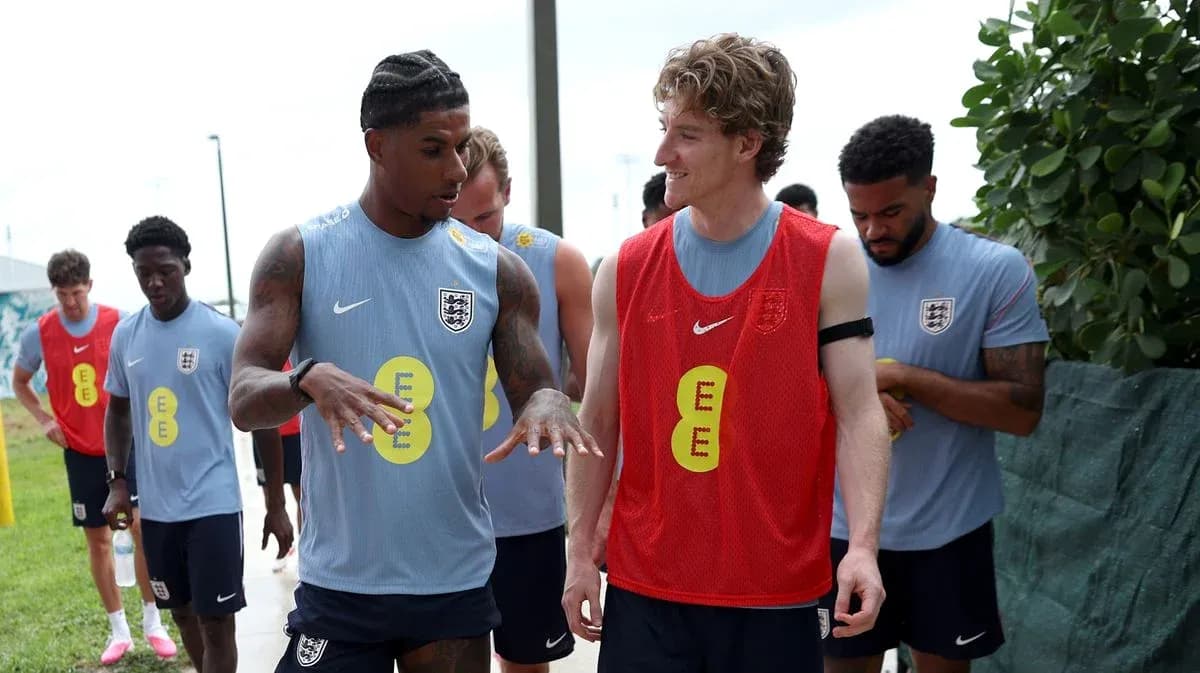
“Marcus is in a good place, but when he started he was not as decisive as Anthony, that's just it,” Tuchel admitted.
It was not just about the winger, though. He went straight to the wider issue: “The unit on the left side hasn't provided the same quality as they did against Costa Rica.”
The word “unit” is doing a lot of work there. Tuchel is not only talking about Gordon or Rashford. He is pointing at the full-backs as well – Nico O’Reilly and Djed Spence – and the way the pieces fit, or rather fail to fit, together.
The fallout has already started. O’Reilly lost his place to Spence for the goalless draw with Ghana, a change that did not fix the problem. Tuchel bemoaned the lack of “connection and penetration” down that side, the absence of “verticality” that once looked so natural in the Costa Rica friendly.
Rashford: weapon from the bench, question mark from the start
Rashford finds himself in a curious position. Trusted, praised, yet still under the microscope.
“He struggled to have the same influence for us from the start, and yet from the bench he was always pushing,” Tuchel said.
The numbers and end product have not matched the faith, a point the manager did not dodge: “Many times we spoke about him and you said, ‘You trust him so much, but what is the output?’ True, but he tries and he's there.”
Tuchel clearly values Rashford’s impact as a substitute. He even hinted that keeping him in reserve can be a deliberate ploy. “Marcus is just also very good from the bench, and it's sometimes nice to hold someone back,” he said.
Still, the door to the XI is not closed. Rashford remains “a candidate to start,” but the coach’s demand is non-negotiable: whoever plays, that left side “needs to click a bit more and provide a bit more threat.”
At the moment, it doesn’t. And Tuchel is not hiding from that.
No “perfect recipe” for low blocks
If the left flank is one problem, breaking down deep defences is another. Ghana exposed both.
England’s 0-0 draw has left Group top spot in the balance and raised familiar questions about creativity against a low block. Tuchel, though, sounded less alarmed than irritated by the narrative.
“It is difficult to accelerate the match against these low blocks,” he said. “You see this in the Champions League as well, you see it in the Premier League. I saw many matches that looked like this.”
The pattern is familiar: domination of territory and possession, half-chances from crosses, the nagging feeling that one clean action would be enough. “It needs this one moment of quality and a bit more precision with the crossing,” Tuchel argued. Better timing, better awareness, more aggressive runs into the box, more shots from distance to force deflections. Small margins, but decisive ones.
And there is no magic plan. “I haven’t found the recipe where ‘they do this, then we do this – and then we are fine,’” he admitted. That line told its own story. This is not a tactical cheat code problem; it is a game-state grind that even elite sides have to suffer.
Ghana certainly enjoyed it. “Once Ghana came over the halfway line they celebrated like it was a goal,” Tuchel said. At full-time, they treated the 0-0 like a win. England trudged off frustrated. “We were kind of disappointed and that shows it is just what it is.”
Tuchel refused to label it a failure. “I don’t think it was a low,” he insisted. He has seen this before, in Champions League group stages away to well-drilled sides in Copenhagen or Leipzig. You do enough to win, you control the counter-attacks – Ghana threatened twice – and you still walk away with a draw.
Panama next: another wall to break down
There is no time to dwell. Panama await at the MetLife Stadium, ranked 42nd in the world, 23 places above Ghana. On paper, that should sharpen the sense of danger, not ease it.
Tuchel expects another long, awkward evening. “We will face another deep block in another kind of formation,” he said. “We now see a back five. For many moments in the match we see a back six, we see a back seven.”
That is the reality: waves of red shirts behind the ball, waiting for England to lose patience or shape. Tuchel wants the opposite – an “active and aggressive approach” without being “stupid and naive.” More urgency, but not chaos.
He also knows the noise will grow if England stumble again. The reaction to the Ghana draw has already triggered the familiar hindsight chorus: why no Cole Palmer? Why no Trent Alexander-Arnold? Why not a Phil Foden-type schemer to unlock the door?
Tuchel is unmoved.
“I cannot engage this after a draw,” he said, pointing out that Spain, Brazil and Portugal have all dropped points.
Then he revealed the message that shaped his view of the Ghana game: a text from a “very famous” and “very well respected” coaching colleague, sent after Carlos Queiroz took over as Ghana boss.
“He texted us: ‘Your most difficult game is now the second game, I tell you that.’”
Tuchel took that seriously. He stressed respect for the opponent and for the players he did select. “It helps no-one if we question things now,” he said. The temptation to anoint the unused or the absent as saviours is, in his words, “a reflex”: “The guys on the bench are suddenly the winners or the guys at home are the winners. That’s not it.”
His stance is clear. The squad was chosen on evidence, not fantasy. “It cannot be that you’re not selected as a player and suddenly you will be. This is not how it works.”
So the challenge is internal. The left side must rediscover its rhythm. The attack must find that “one moment of quality” against another packed defence. And England, still aiming to top the group, must show they can turn frustration into control when the next wall goes up in New Jersey.