Sweden's Journey Back to the World Cup: From Chaos to Hope
Sweden were dead. Or as close to it as a football nation of their pedigree can be.
One point from the first four World Cup qualifiers under Jon Dahl Tomasson, a 1-0 defeat away to Kosovo in October 2025, and a campaign that looked beyond saving. The Dane was sacked. The mood was flat. The World Cup felt a long way away.
Then Graham Potter walked back into Swedish football like a familiar character returning in the final act.
Potter returns to his spiritual home
For Swedish fans, Potter is not “the Chelsea guy who struggled” or “the West Ham experiment that never quite clicked”. He is the coach who took Östersund from the Swedish fourth tier to the Allsvenskan, won the cup, and turned a provincial club into a Europa League story that reached all the way to Arsenal.
So when he spoke to Fotbollskanalen in October 2025, it sounded less like a polite answer and more like a public invitation. “I have feelings for Sweden. I love the country and I love Swedish football. Coaching the national team would be an incredible opportunity for me, absolutely.” Days later, the Swedish FA called his bluff and handed him the job.
He did not start with fireworks. No win in his first two matches. Yet the federation had seen enough. In March, they pushed a contract extension across the table that runs to 2030. That is how quickly he convinced them this team had a future again.
Potter arrived promising a back four but quickly reverted to something more Swedish in tone than in formation: defensive stubbornness, collective discipline, and ruthless counterattacks. In the playoffs he lined up in a 5-3-2, the message clear – keep it tight, trust the break, live off moments.
The moments came.
Nations League lifeline, Gyökeres seizes it
The Nations League threw Sweden a rope back into the World Cup qualifying picture. They grabbed it with both hands in Spain, where Ukraine were swept aside 3-1 in the semi-final. Viktor Gyökeres scored all three.
It was the kind of centre-forward performance that rewrites a player’s status in a country. Hat-trick on neutral soil, in a game that matters, for a team that had forgotten how to win. Suddenly Sweden were 90 minutes from a World Cup that had looked like a fantasy.
The final against Poland was something else entirely. Nervy, disjointed, and for long stretches tilted towards the visitors. Robert Lewandowski prowled. Sweden bent. They did not break.
At 2-2, with the clock draining away, the game screamed for a hero. Gyökeres answered again, smashing in an 88th-minute winner in a 3-2 thriller that felt like a collective exhale for an entire football nation.
On the touchline, Potter lost himself in the chaos. “It’s hard to explain, hard to describe,” he said afterwards, voice still riding the adrenaline. “Just an incredible evening, just so proud to be part of that and obviously proud to experience it. It was just the best night I’ve had in football. Incredible, like I was having some sort of out-of-body experience. I’m looking at the goal and suddenly all our bench is running and you’re thinking: ‘Am I here?’ I’m just grateful to be part of that.”
From two points in six group games to a World Cup ticket via a Nations League back door. Ugly at times, dramatic at others. Very Swedish in its resilience. Very Potter in its detail.
Now they land in North America with Tunisia, Netherlands and Japan in their path – and, crucially, with hope.
Life without Kulusevski, doubts over Isak
The hope is not blind. It is tempered by reality, and reality has hit hard.
Dejan Kulusevski, captain and emotional reference point, will not make it. His absence is more than a missing name on a teamsheet. He knits attacks, sets the tone in pressing, and carries a swagger this squad otherwise lacks. Sweden will feel that loss in every third-man run that does not come, every break that dies one pass too early.
Alexander Isak, once the golden boy and now the most expensive transfer in Premier League history after his £125m move from Newcastle to Liverpool, arrives in a cloud of questions. Form? Unclear. Fitness? The same. He did score as a substitute in a worrying 3-1 defeat to Norway on 1 June, but the match itself raised more alarms than it calmed.
Isak remains a potentially devastating weapon. Right now, though, he is not the man this team or this tournament revolves around.
The new talisman: Viktor Gyökeres
That role belongs to Gyökeres. Officially an Arsenal forward, unofficially the country’s new football cult figure.
His start in north London was bumpy, the goals slow to arrive, the adaptation harsh. Then something clicked. The same relentlessness that shredded Ukraine and punished Poland began to appear in club colours as well. Four of Sweden’s six goals in the two playoff ties came from him.
The nation has fallen for him in a way that goes beyond statistics. His goal celebration – borrowed from Bane, Tom Hardy’s masked villain in The Dark Knight Rises – has spawned a wave of imitations across Sweden. Social media is full of fans recreating it, kids in local parks copying the pose. It is playful, but it also underlines a truth: in this team, Gyökeres is the face, the reference point, the man expected to turn tight group games into victories.
A baron at the back and a midfield general
Potter’s Sweden are not built only on stars. They are built on characters.
Take Gustaf Lagerbielke. On paper, he is a Braga defender and former Celtic centre-back. In practice, he was monumental in the playoff final against Poland, rising to crash home a thunderous header and then spending the rest of the night making Lewandowski look mortal.
Then there is the detail that makes him irresistible to storytellers: he is a baron and 254th in line to the Swedish throne. A nobleman anchoring the back line, throwing himself into duels while carrying a title that sounds like it belongs in a period drama. There is serious interest in him from bigger leagues. A strong World Cup, and that move feels inevitable.
In midfield, Jesper Karlström will do the work most people notice only when it is missing. Captain of Udinese, a late bloomer who had to grind his way through Djurgården and a spell at Lech Poznan, he brings a calm authority.
His story is not clean. He has spoken openly about his struggles with gambling addiction at Djurgården, and how the club and his family pulled him back from the edge. That experience shows now in his presence: a deep-lying midfielder who tackles hard, reads the game well, and keeps the ball moving when others tense up.
With youngsters like Yasin Ayari and Lucas Bergvall around him, Karlström becomes even more important. He is the metronome and the shield, the one who stops games against the technical Dutch and the relentless Japanese from turning into chaos.
The travelling Swedes and an old Trump line
Sweden will not be alone in North America. They rarely are.
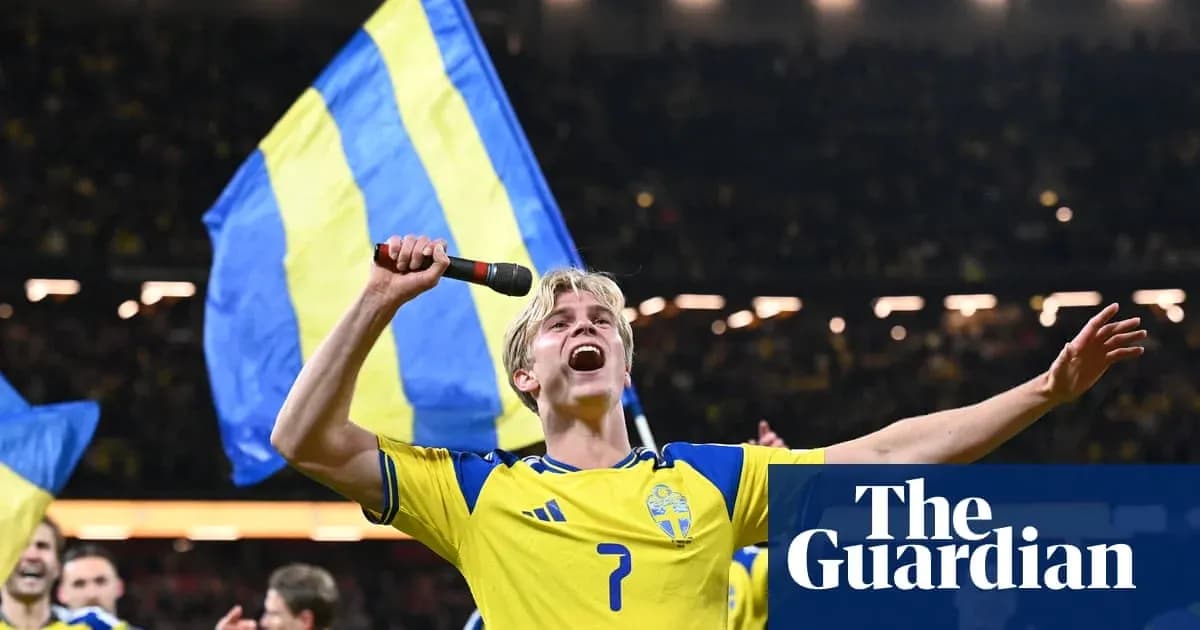
Blågult fans travel in numbers and in colour. The yellow shirts, the blue flags, the booming choruses – they turn neutral cities into temporary outposts. Their reputation is for noise without menace, heavy on banter and light on trouble.
Their soundtrack? “Kanna på”, a song about beer pitchers that never stop arriving and a promise: “We are coming with 100,000 men.” The Viking imagery is tongue-in-cheek, the drinking not always so. Expect a sea of yellow, a lot of singing, and more than a few empty kegs.
As Sweden arrive in the United States, an old line from 2017 hangs in the background like an odd footnote. “Look what happened in Sweden last night,” said Donald Trump, invoking supposed chaos linked to immigration and terrorism. Nothing major had actually happened. He later claimed he was referring to a Fox News report, which did little to clarify the confusion.
Swedish paper Aftonbladet responded by listing what had really gone on that day: singer Owe Thörnqvist suffering technical problems in rehearsals, a man setting himself on fire in central Stockholm, and road closures in the north due to harsh weather. Hardly the collapse of a nation.
Now the relationship returns to a more familiar script: Swedes landing in America not as a political talking point, but as a football story.
A team that stumbled, changed coach, clung to a Nations League lifeline and rode the goals of a Bane-celebrating striker back to the World Cup.
They arrive bruised, missing their captain, still unsure about their £125m forward – but with Potter on the touchline, Gyökeres up front, and a fanbase ready to paint North America yellow.
After everything that has happened, would you dare write them off again?