
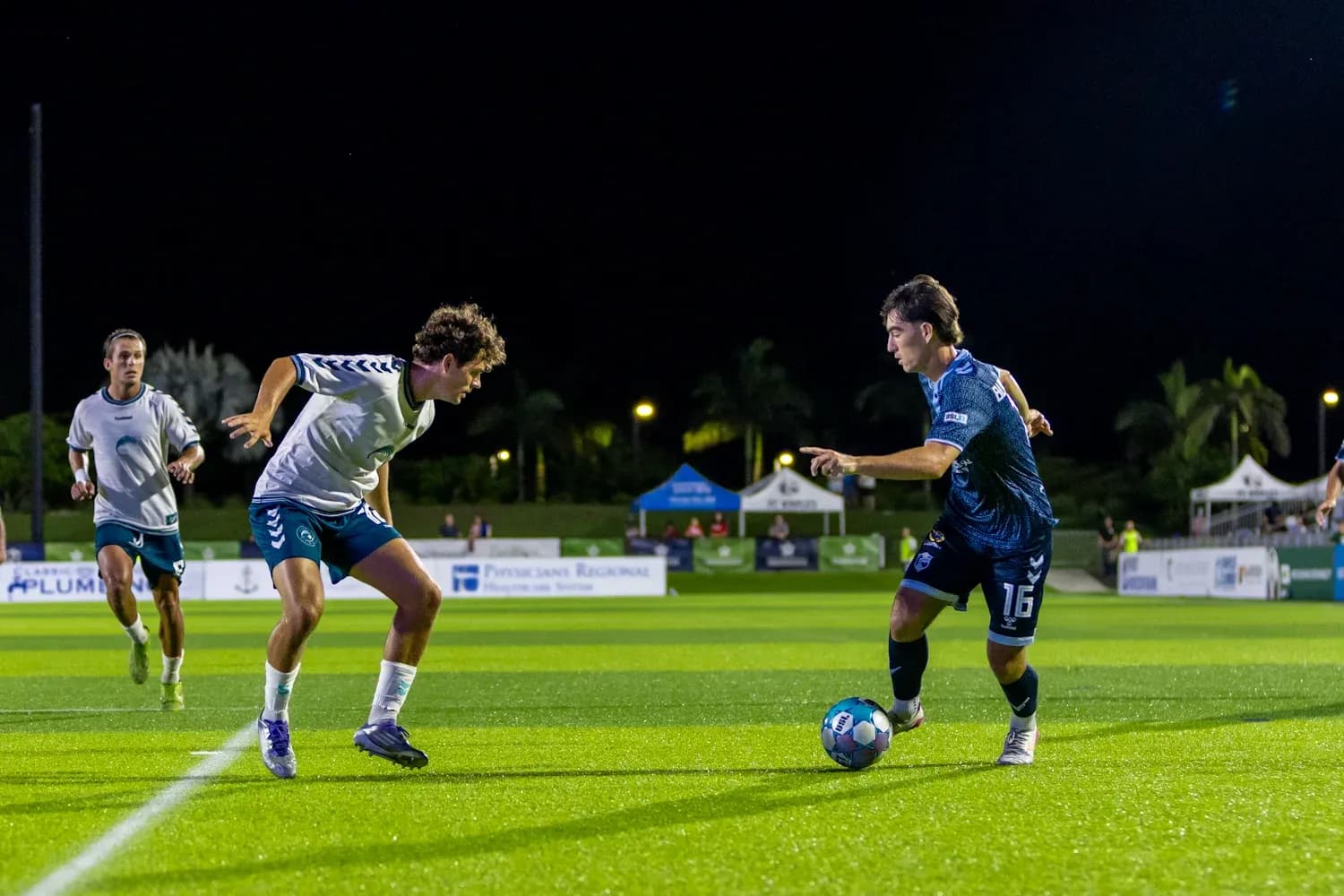
Sarasota's Tactical Victory Over Naples in USL League One Cup
Under the lights at Paradise Coast Sports Complex, Sarasota Paradise’s 2–0 win over Naples felt less like a routine group-stage result and more like a quiet reshaping of Group 7’s hierarchy in the USL League One Cup. The scoreline matched the broader seasonal patterns: Naples’ fragility without the ball, Sarasota’s compact, low-scoring pragmatism, and a table that now shows the hosts stuck on 2 points with a goal difference of -3, while Sarasota climb to 3 points with a goal difference of -2.
I. The Big Picture – contrasting identities, same pressure
Heading into this game, both sides arrived with three matches on the board in the competition. Overall, Naples had played 3 fixtures, winning 1 and losing 2, with 3 goals scored and 7 conceded. That 2.3 goalsAgainst average in total told the story of a side that can be opened up, especially on their travels, where they had allowed 4.0 goalsAgainst on average. At home, Naples were marginally more controlled, conceding 1.5 on average and scoring 1.0, but they had yet to record a single clean sheet in total and had already failed to score once at home.
Sarasota Paradise were hardly an attacking juggernaut heading in. Across 3 matches in total, they had scored just 2 goals, averaging 0.7 goalsFor, but they kept games tight, conceding 4 in total at 1.3 goalsAgainst on average. On their travels, they were more balanced: 2 goals scored and 2 conceded, an away goalsAgainst average of 1.0 and away goalsFor average of 1.0. Their only clean sheet in total had come away from home, reinforcing the idea of a team more comfortable absorbing pressure and countering on the road.
The full-time 0–2 in Naples’ own backyard underlined those trends. Sarasota delivered another away performance built on structure and timing, while Naples’ attacking promise once again crashed against their own defensive instability.
II. Tactical Voids – discipline and invisible pressure
Officially, there were no pre-announced absences or injury lists, so both coaches, Matthew Poland for Naples and Mika Elovaara for Sarasota, had their full squads available. The voids, then, were less about who was missing and more about how existing weaknesses were exposed.
Naples’ season-long disciplinary pattern hinted at a side that loses control as the game wears on. Their yellow-card distribution showed a clear spike between 46–60 minutes, where 40.00% of their total cautions arrived, with further pockets at 31–45 (20.00%) and 76–90 (20.00%), plus a late 91–105 segment also at 20.00%. Even more telling, their only red card in total this campaign came between 46–60 minutes. That window, right after half-time, is where their emotional temperature tends to boil.
Sarasota, by contrast, spread their disciplinary load more broadly but with a noticeable late surge. Their yellow cards peaked at 76–90 minutes, accounting for 37.50% of their total, with secondary waves at 46–60 (25.00%) and smaller contributions at 16–30, 31–45, and 91–105 (each 12.50%). They have not seen a red card in any time range. This is a side that grows more combative late on, but rarely tips into outright self-destruction.
In a match that finished 0–2, those profiles suggest a familiar script: Naples chasing, stretching, and risking disciplinary trouble in the middle phase; Sarasota staying compact, accepting bookings late as the cost of protecting a lead.
III. Key Matchups – Hunter vs Shield, Engine Room battles
Naples’ front line, led by the likes of J. Grant and G. Miglietti, was tasked with cracking a Sarasota defence that had conceded only 2 goals in 2 away games heading into the night. On their travels, Sarasota’s 1.0 goalsAgainst average stood in stark contrast to Naples’ total attacking output of just 1.0 goalsFor on average. The “Hunter vs Shield” duel was always going to hinge on whether Naples could generate high-quality chances against a side comfortable in a low block.
Grant, wearing 99, offered a physical reference point up front, with C. Garcia and D. Bachstein providing the wide running and secondary pressure. Yet the structural support behind them was thin. Naples’ midfield trio of J. Osorio, H. Gay, and I. Cerro had to both build play and screen transitions. With no clean sheet in total this season, Naples’ shape has repeatedly been dragged out of position when those midfielders are forced to defend large spaces.
On the other side, Sarasota’s attacking trident of J. Bender, S. Karani, and E. Bryant carried the burden of turning a low-scoring side into a clinical one. Bender, wearing 9, floated between the lines, while Karani’s direct running and Bryant’s work rate helped pin back Naples’ full-backs J. Cisneros and M. Torrellas. Behind them, the defensive line anchored by D. Watters and R. Valentine had a clear brief: keep Grant away from central zones and force Naples into hopeful crosses.
In the engine room, A. Rodriguez and M. Tainio formed Sarasota’s stabilising axis. Their job was to disrupt Osorio’s passing rhythms and deny Miglietti the quick, vertical service he thrives on. That duel in midfield went Sarasota’s way; Naples’ build-up became predictable, and their forwards were often isolated with their backs to goal.
IV. Statistical Prognosis – what this result really says
Following this result, the underlying numbers remain brutally consistent with the scoreline. Naples, with 3 goals scored and 7 conceded in total, continue to sit on a total goalsFor average of 1.0 and a total goalsAgainst average of 2.3. They have yet to keep a clean sheet and have already failed to score once at home, a tally now reinforced by this 0–2 defeat.
Sarasota, meanwhile, stay within their narrow margins. Across 3 matches in total, they have 2 goals scored and 4 conceded, with total averages of 0.7 goalsFor and 1.3 goalsAgainst. On their travels, they remain balanced at 1.0 goalsFor and 1.0 goalsAgainst on average, and their only clean sheet in total is still an away performance.
Without explicit xG data, the best proxy is pattern and probability. Naples concede too many chances relative to what they create, especially once they are forced to chase the game. Sarasota, though modest in attack, reliably keep matches in the 0–2 goal band either way, and their discipline profile suggests they can absorb late pressure without imploding.
In narrative terms, this was a match where Sarasota’s defensive solidity and timing overcame Naples’ need for a statement home performance. Unless Naples can tighten their mid-game discipline and reduce that 2.3 total goalsAgainst average, their attacking talents will keep running into the same hard ceiling that 90 minutes at Paradise Coast just made painfully clear.